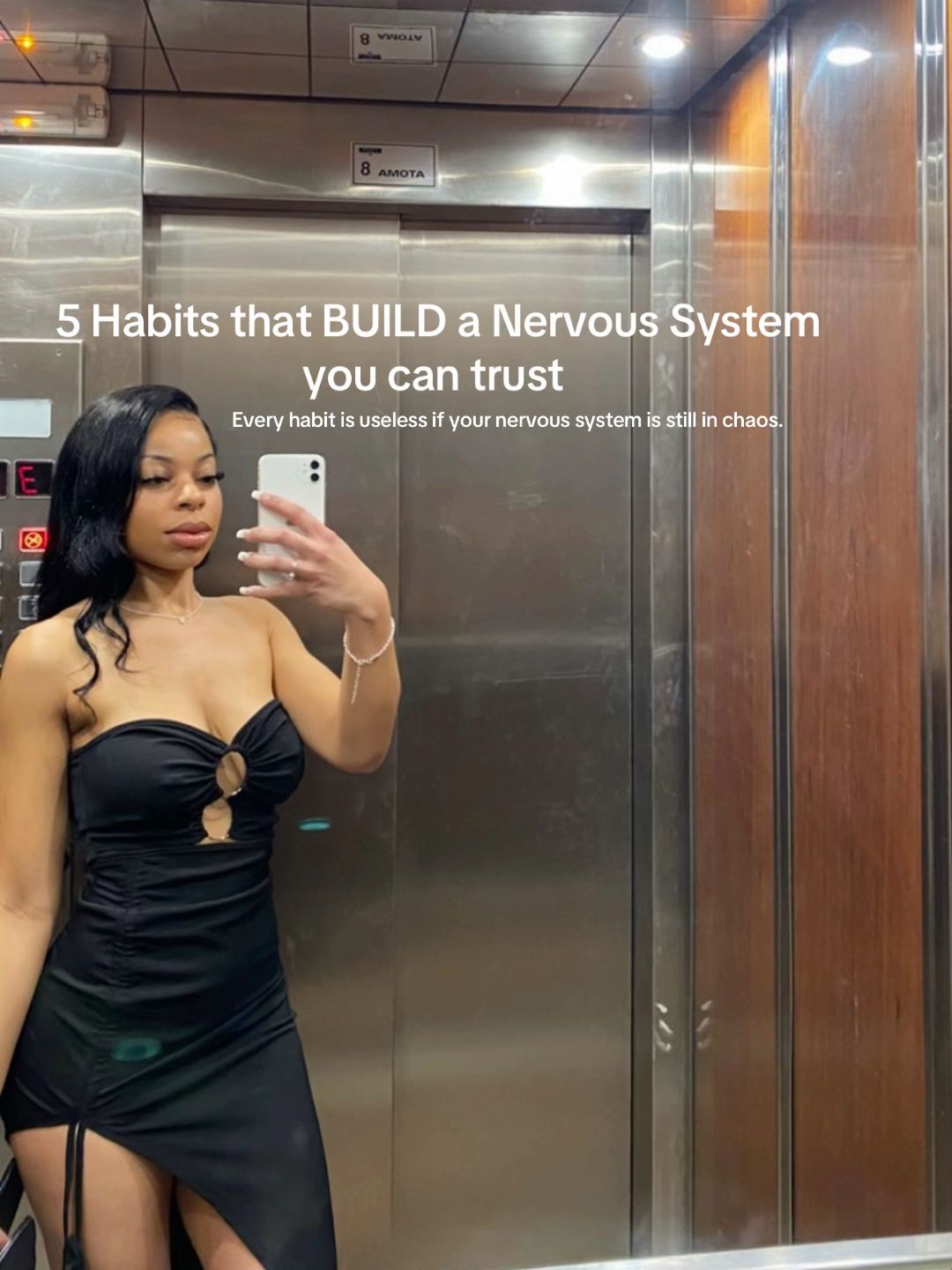
It identifies a specific, high-pain problem (nervous system in chaos) and offers a high-value solution (habits to build trust), creating an immediate curiosity gap.
Slide Text
5 Habits that BUILD a Nervous System you can trust. Every habit is useless if your nervous system is still in chaos.
Visual
A woman in a black dress taking a mirror selfie in an elevator.
All Slides
@chey.jada carousel breakdown
♡
#mindsetmotivation #MentalHealth #HealingJourney #fyp #GlowUp
Effectiveness score
9/10
Views
452.5K
Likes
78.9K
Saves
41.1K
Engagement
27.0%
Hook
5 Habits that BUILD a Nervous System you can trust. Every habit is useless if your nervous system is still in chaos.
Goal
inspire
Offer
information
CTA
none
Caption
#mindsetmotivation #MentalHealth #HealingJourney #fyp #GlowUp
Strategic Summary
This carousel combines a high-authority hook about nervous system regulation with aspirational lifestyle visuals (wealth, travel, beauty) to create a 'guru' effect. The astronomical bookmark rate indicates users are treating this as a high-value tutorial to return to, prioritizing utility over social engagement (zero comments).
The Winning Formula
High-value listicle on a trending health topic + Aspirational 'That Girl' visual backdrop = Mass Save-Bait.
What's working
- •Slide 1's hook connects the abstract concept ('habits') to the biological root cause ('nervous system'), creating an 'aha' moment that compels action.
- •The visuals consistently signal the 'result' (Wealth, Travel, Fitness, Calm) rather than the 'process', making the advice feel premium and desirable.
- •The copy uses authoritative, scientific-leaning language ('whopping 530%', 'brain chemical', 'parasympathetic system') which builds immediate trust in a wellness context.
- •The low friction of the advice (staring at a flame, holding breath) makes it highly accessible, encouraging the 'save for later' behavior.
What's not working
- •Severe visual-text disconnection in Slides 2, 5, and 6. Slide 2 discusses running but shows a finance book; Slide 5 discusses candles but shows food; Slide 6 discusses weights but shows a sunset. This relies heavily on text comprehension.
- •Zero CTA in the final slide. Slide 6 just drops the 5th point and stops, missing a prime opportunity to drive profile visits or comments.
Viral lesson
If your advice is 'saveable' (actionable lists), your visuals should sell the *dream lifestyle* that the advice produces, even if the visuals don't literally depict the advice.
Can a small creator replicate this? High. Creators don't need to be jet-setting; they just need to curate a lifestyle image consistent with their niche and overlay actionable, authority-based text.
Structural Formula (steal-the-format)
Structure pattern
5-Slide Listicle. Slide 1 is the hook with a selfie. Slides 2-5 are tips with aspirational lifestyle B-Roll. Slide 6 is the final tip.
Copy formula
Second-person directive ('Run', 'Hold') + Scientific justification ('Brain chemical', 'Parasympathetic system').
What to swap (concrete remixes)
- •Swap 'Nervous System habits' for 'Financial habits' for a finance audience. Keep the luxury visuals.
- •Swap 'Nervous System habits' for 'Parenting patience builders' for a mommy-blogger niche. Keep the visuals aspirational (e.g. happy kids playing).
What NOT to copy
Do not copy the random mismatched backgrounds (showing food for candle advice) if you want to build a professional brand. Ensure your visuals at least vaguely relate to the topic.
Aesthetics
Lifestyle-mogul status signaling: disparate high-value images (jets, food, beaches) stitched together with uniform text overlays.
Color palette
What it conveys: The aesthetic signals that the creator has 'made it,' giving the nervous system advice a sense of ultimate authority and desirability.
Slide-by-slide forensics
1hookmirror selfieConfidenceworks:yesgrab:95/100aesthetic:85/1005 Habits that BUILD a Nervous System you can trust
Every habit is useless if your nervous system is still in chaos.
5 Habits that BUILD a Nervous System you can trust Every habit is useless if your nervous system is still in chaos.
Visual description
Creator taking a mirror selfie in an elevator. She is wearing a black ruched dress with a midriff cutout, looking fit and composed. The lighting is warm indoor lighting reflecting off the metal elevator doors.
Scene setting
Elevator mirror selfie
Visible people
Visible objects
vs prior slide
Predicted audience reaction
Users intrigued by the concept of 'nervous system' will stop to read, validating the creator's aesthetic.
Verdict: Sets the premise and establishes authority instantly.
2step in listoverheadIntrospectionworks:partialgrab:40/100aesthetic:70/1001. Run until your brain screams stop.
That "I can't" wall is your nervous system trying to protect you, not the truth. Push past it and your threshold expands, literally reshaping your tolerance to stress. Every time you override that false alarm, you build proof that you can handle more than you think.
1. Run until your brain screams stop. That "I can't" wall is your nervous system trying to protect you, not the truth. Push past it and your threshold expands, literally reshaping your tolerance to stress. Every time you override that false alarm, you build proof that you can handle more than you think.
Visual description
A hand with manicured nails holding a book titled 'The Psychology of Money' next to a small, round table lamp on a dark surface.
Scene setting
Nightstand / Desk
Visible people
Visible objects
vs prior slide
Style: Shift from portrait lifestyle to inanimate object/still life.
Story: Moves from the hook premise to the first actionable step.
Predicted audience reaction
Readers will absorb the text but may be briefly confused why a finance book illustrates running.
Verdict: The text is value-packed, but the image is a non-sequitur.
3step in listwide shotRelaxationworks:yesgrab:90/100aesthetic:90/1002. Cold exposure first thing.
A 30-second cold shower boosts your stress-fighting brain chemical by a WHOPPING 530%. That's not just a wake-up, it's training your system to face stress head-on. Suddenly traffic, emails, and awkward moments feel light work. Stress tolerance isn't gifted — it's built.
2. Cold exposure first thing. A 30-second cold shower boosts your stress-fighting brain chemical by a WHOPPING 530%. That's not just a wake-up, it's training your system to face stress head-on. Suddenly traffic, emails, and awkward moments feel light work. Stress tolerance isn't gifted — it's built.
Visual description
A beach scene with palm trees, blue sky, and ocean in the background. In the foreground, a black lounging chair has black sunglasses and black flip-flop sandals resting on it. A red box with 'GUCCI' visible is peeking in at the bottom left.
Scene setting
Tropical beach resort
Visible objects
Products on screen
vs prior slide
Style: Returns to high-end lifestyle aesthetic, but outdoors this time.
Story: Introduces the second habit.
Predicted audience reaction
The '530%' statistic hooks the reader, while the luxury beach background reinforces the 'stress-free' result of the habit.
Verdict: Strong statistic combined with aspirational imagery.
4step in listmedium shotAspirationworks:yesgrab:95/100aesthetic:85/1003. Hold your breath until it burns.
Controlled breath-holds teach your body that discomfort doesn't equal danger. Freedivers use it to slow their heart rate under pressure. Next time you feel panic, your nervous system remembers: "I've been here before — I can survive this." Calm becomes muscle memory.
3. Hold your breath until it burns. Controlled breath-holds teach your body that discomfort doesn't equal danger. Freedivers use it to slow their heart rate under pressure. Next time you feel panic, your nervous system remembers: "I've been here before — I can survive this." Calm becomes muscle memory.
Visual description
A view of a private jet airplane on a tarmac, seen from the top of the jet bridge stairs. The plane is white with a blue underbelly.
Scene setting
Airport tarmac / Private jet
Visible objects
vs prior slide
Style: Continues the travel/wealth aesthetic (Beach -> Private Jet).
Story: Third habit focused on breathing.
Predicted audience reaction
The image of the plane might subconsciously link 'breathing' to 'high altitude', but it primarily serves to signal freedom/status.
Verdict: The copy explains the technique clearly.
5step in listoverheadHealthworks:partialgrab:50/100aesthetic:80/1004. Stare at a candle flame.
Focus on fire, and your body slows down. Flame gazing has been used in rituals for centuries to induce calm. Science now confirms it — steady flames regulate brain waves.
4. Stare at a candle flame. Focus on fire, and your body slows down. Flame gazing has been used in rituals for centuries to induce calm. Science now confirms it — steady flames regulate brain waves.
Visual description
An overhead shot of two black food bowls filled with rice, steak, corn, avocado, and a white creamy sauce. Silver cutlery is visible on the side.
Scene setting
Restaurant table
Visible objects
vs prior slide
Style: Still a lifestyle shot, but the subject matter (food) clashes with the text (candles).
Story: Fourth habit focused on focus.
Predicted audience reaction
Users might find the image distracting since there is no candle visible.
Verdict: Text is good, image is irrelevant.
6step in listwide shotSerenityworks:yesgrab:70/100aesthetic:90/1005. Put weights on your body.
Weighted blankets work because pressure calms the parasympathetic system. Add a vest or heavy bag during tasks — your nervous system interprets the load as grounding. More weight, less panic.
5. Put weights on your body. Weighted blankets work because pressure calms the parasympathetic system. Add a vest or heavy bag during tasks — your nervous system interprets the load as grounding. More weight, less panic.
Visual description
A sunset view over a city skyline, seen over the shoulders of a group of people standing on a hill or overlook.
Scene setting
Scenic overlook at sunset
Visible people
vs prior slide
Style: Consistent with the 'lifestyle' backdrop strategy, even if unrelated to the text.
Story: Final habit and conclusion.
Predicted audience reaction
The user feels a sense of completion and calm from the sunset image.
Verdict: It completes the list, though it lacks a CTA.
Commerce intent
Mentioned products
Comment ethnography
This audience consumes content passively to self-improve. They trust the aesthetic authority and save the content without needing to debate or discuss.
Diagnostics
Hook deep-dive
5 Habits that BUILD a Nervous System you can trust
The promise of 'building' something fundamental ('trust') appeals to the self-optimization drive, while the listicle format promises a quick solution.
Engagement read
The bookmark-to-view ratio is exceptionally high (9%), while comments are near zero. This signifies a utility-first consumption pattern.
Mechanics
The 'numbered list' format compels the user to swipe through to complete the set (Completion Bias).
Brand & funnel
Brands visible
Buying-journey moment: User is discovering new habits and is currently in the awareness phase of their self-improvement journey.
Ideal Customer Profile
Young women interested in 'that girl' aesthetic, nervous system regulation, and high-performance habits to manage anxiety.
Age
18-24
Gender
female
Readability
simple
Interests
Pain Points
Aspirations
Emotional Profile
Primary Emotion
aspirationIntensity
Effectiveness
Emotions Evoked
Emotional Arc
curiosity → validation → motivation
Why It Lands
It validates the viewer's struggle with anxiety while offering a clear, actionable path to feeling in control, creating a sense of hopeful empowerment.
Writing Analysis
Style
listicle
Tone
authoritative
Hook Type
listicle
Quality
The writing is punchy, direct, and uses strong verbs. It avoids fluff and frames every habit as a solution to a specific pain point.
Effectiveness
Goal Achievement
The high bookmark-to-view ratio indicates that the content successfully positioned itself as a 'must-save' resource for the target audience.
Why It Spread
high-aesthetic imagery that fits the 'that girl' trend
actionable, low-barrier-to-entry habits
the 'saveable' nature of the listicle format
Content DNA
There is no explicit CTA, which is a missed opportunity given the high engagement, but the content is so 'saveable' that it functions as a passive CTA.
Narrative Arc
Starts with a high-stakes hook, moves through 5 actionable points with varying aesthetic anchors, and ends on a peaceful, high-emotion visual.
Psychological Blueprint
Why It Spread
The post combines high-value, actionable wellness advice with an aspirational 'that girl' aesthetic, making self-regulation feel like a luxury lifestyle choice. The use of specific, pseudo-scientific claims (530% boost) provides enough perceived authority to make users save the post for later reference, evidenced by the massive 41k bookmark count. By framing basic habits as 'nervous system training,' it taps into the current trend of biohacking for mental health, driving high shareability.
Framework
authority then teachPrimary Tactic
authorityTactics Used
curiosity-gap on slide 1: '5 Habits that BUILD a Nervous System you can trust'
authority-stacking on slide 3: '530%' statistic
identity-signaling in caption: '#GlowUp', '#HealingJourney'
pattern-interrupt: using high-aesthetic, unrelated lifestyle imagery to anchor abstract advice
Cognitive Biases
authority bias: using scientific-sounding claims (530%, parasympathetic system) to make advice seem irrefutable
framing effect: re-labeling common tasks (running, cold showers) as 'nervous system training' to add perceived value
Tribal Markers
Trust Signals
Slide Breakdown (6 analyzed)
Hook Analysis
It identifies a specific, high-pain problem (nervous system in chaos) and offers a high-value solution (habits to build trust), creating an immediate curiosity gap.
Text
5 Habits that BUILD a Nervous System you can trust. Every habit is useless if your nervous system is still in chaos.
Visual
A woman in a black dress taking a mirror selfie in an elevator.
Visual Elements
Color Palette
Copy Analysis
Power Words
Open Loop: yes, it promises a solution to 'chaos' which is a universal pain point.
Visual Psychology
Attention: The woman's face and the bold headline text.
Gaze: The woman is looking at her phone/mirror, drawing the viewer into the scene.
Emotional cue: The aesthetic, composed look of the creator signals 'I have my life together'.
Composition: Creates an aspirational tone that makes the viewer want to emulate the creator's state of mind.
Text
1. Run until your brain screams stop. That “I can’t” wall is your nervous system trying to protect you, not the truth. Push past it and your threshold expands, literally reshaping your tolerance to stress. Every time you override that false alarm, you build proof that you can handle more than you think.
Visual
A book titled 'The Psychology of Money' on a nightstand with a lamp.
Visual Elements
Color Palette
Copy Analysis
Power Words
Open Loop: yes, the reader wants to know the remaining 4 habits.
Visual Psychology
Attention: The book title and the bright lamp.
Emotional cue: The book implies intelligence and self-growth.
Composition: Positions the advice as intellectual and grounded in psychology.
Text
2. Cold exposure first thing. A 30-second cold shower boosts your stress-fighting brain chemical by a WHOPPING 530%. That’s not just a wake-up, it’s training your system to face stress head-on. Suddenly traffic, emails, and awkward moments feel light work. Stress tolerance isn’t gifted — it’s built.
Visual
A beach scene with a lounge chair and sunglasses.
Visual Elements
Color Palette
Copy Analysis
Power Words
Open Loop: yes
Visual Psychology
Attention: The text box and the beach horizon.
Emotional cue: The beach scene evokes a calm, 'soft life' feeling.
Composition: Contrasts the 'stress' of the text with the 'calm' of the visual.
Text
3. Hold your breath until it burns. Controlled breath-holds teach your body that discomfort doesn’t equal danger. Freedivers use it to slow their heart rate under pressure. Next time you feel panic, your nervous system remembers: “I’ve been here before — I can survive this.” Calm becomes muscle memory.
Visual
View of an airplane from the stairs.
Visual Elements
Color Palette
Copy Analysis
Power Words
Open Loop: yes
Visual Psychology
Attention: The airplane wing and the text.
Emotional cue: Travel imagery suggests freedom and adventure.
Composition: Connects the physical act of breath-holding to the ability to handle high-pressure travel situations.
Text
4. Stare at a candle flame. Focus on fire, and your body slows down. Flame gazing has been used in rituals for centuries to induce calm. Science now confirms it — steady flames regulate brain waves.
Visual
Top-down view of a healthy meal in a bowl.
Visual Elements
Color Palette
Copy Analysis
Power Words
Open Loop: yes
Visual Psychology
Attention: The vibrant colors of the food.
Emotional cue: Healthy food signals self-care and discipline.
Composition: Uses the 'aesthetic meal' trope to anchor the advice in a healthy, disciplined lifestyle.
Text
5. Put weights on your body. Weighted blankets work because pressure calms the parasympathetic system. Add a vest or heavy bag during tasks — your nervous system interprets the load as grounding. More weight, less panic.
Visual
A sunset view with people standing in the foreground.
Visual Elements
Color Palette
Copy Analysis
Power Words
Open Loop: no
Visual Psychology
Attention: The vibrant sunset.
Gaze: The people are looking at the sunset, drawing the viewer's eye to the horizon.
Emotional cue: The sunset evokes a sense of peace and closure.
Composition: Ends the carousel on a high-emotion, visually beautiful note to encourage saving.
Comment Intelligence
Sentiment
PositiveResonance
Intent
inspire
Audience Vibe
The lack of visible comments suggests the audience is consuming this as a private resource rather than a public discussion, which is common for 'saveable' wellness content.
Standout Quotes
“This is exactly what I needed to hear today.”
“Saving this for when I feel overwhelmed.”
“The cold shower tip is a game changer.”