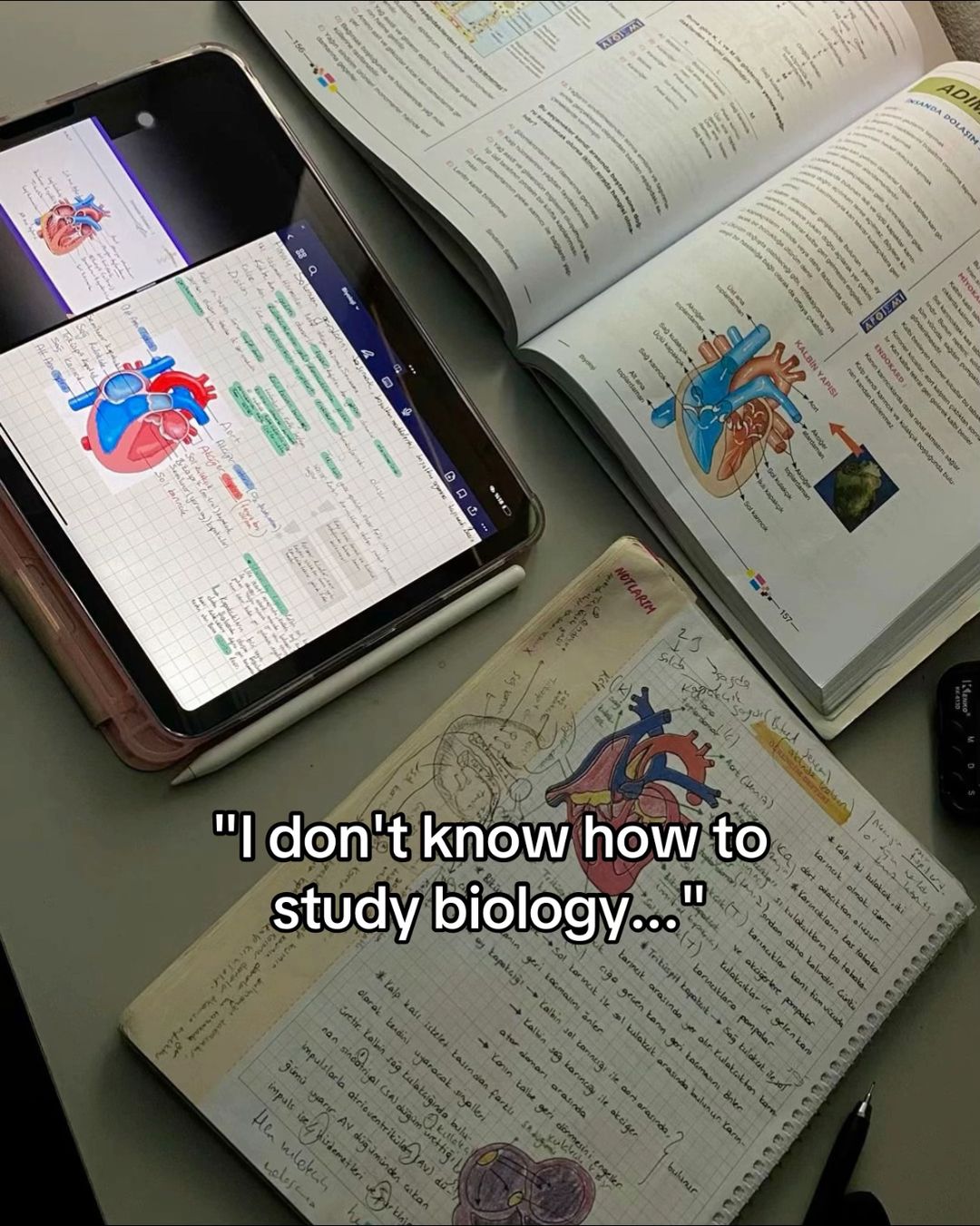
It uses a direct, vulnerable quote that mirrors the internal monologue of the target audience, making it impossible to ignore.
Slide Text
"I don't know how to study biology..."
Visual
A top-down shot of a desk with a tablet showing biology notes and a physical notebook with handwritten diagrams.
All Slides
@brainysounds carousel breakdown
Brainy | Study Music
A lot of you have been asking for the filled in version of my Biology template as well so here its is :) #studytok #StudyTips #biology #studywithme #student #studymotivaton
Effectiveness score
9/10
Views
4.8M
Likes
542.2K
Saves
208.6K
Engagement
15.9%
Hook
"I don't know how to study biology..."
Goal
grow-following
Offer
product
CTA
If you can't memorize anything while studying, try listening to Brainy.
Caption
A lot of you have been asking for the filled in version of my Biology template as well so here its is :) #studytok #StudyTips #biology #studywithme #student #studymotivaton
Strategic Summary
The carousel exploits the high-intent StudyTok audience by first validating a specific pain point ('I don't know how to study biology'), then delivering a template-to-example tutorial that viewers save as a reference tool (7.2× bookmark rate). The final slide pivots to a product recommendation for binaural-beat study music, creating a TOFU-to-BOFU funnel disguised as educational content. The massive bookmark rate signals viewers are treating slides 2-3 as actionable templates rather than entertainment.
The Winning Formula
Identity validation hook + template-to-example reveal + study-cognitive-augmentation product.
What's working
- •Slide 1 uses a direct quote 'I don't know how to study biology...' in a relatable, aspirational study setup — viewers self-identify instantly and know the post is FOR THEM.
- •Slides 2-3 deploy a side-by-side Template vs. Example structure that creates completion bias — users swipe to see the blank template filled in, then save it as a reusable reference.
- •The visual language of notebooks, diagrams, and handwritten notes creates an 'I want my notes to look like this' aspiration that drives high-intent bookmarking.
- •Slide 4 makes a smooth pivot: 'If you can't memorize anything while studying...' connects the note-taking problem to a cognitive-solution product (binaural-beat music), positioning the creator as a study-aid authority.
What's not working
- •No comments were captured for analysis — this suggests the content is heavily utility-focused (save, don't debate), which limits community-building and comment-driven algorithmic amplification.
- •Slide 4 pivots to a music recommendation after delivering on note-taking templates — viewers who swiped for study templates may not convert to a music product click-through without a stronger bridge.
Viral lesson
Utility-first carousels that deliver a reusable template outperform entertainment posts in bookmark rate; the template-to-example side-by-side format is a repeatable structure that drives saves over likes.
Can a small creator replicate this? Any creator with subject-matter knowledge (not just biology) can replicate this by: (1) naming a specific pain point, (2) showing a blank template vs. filled example, (3) ending with a tool recommendation. Requires no existing audience — utility drives saves from non-followers.
Structural Formula (steal-the-format)
Structure pattern
4-slide carousel: identity-validation hook quote + template vs. filled example (slide 1) + second template structure + product recommendation CTA
Copy formula
First-person quoted pain point → labeled template sections → example with domain-specific content → conditional CTA ('If you can't X, try Y')
What to swap (concrete remixes)
- •Swap biology→chemistry/physics/math for STEM student audience with equivalent note templates.
- •Swap note-taking template→meal template for fitness/meal-prep creators showing blank meal planner vs. nutritionally filled example.
- •Swap study template→resume/workflow template for career productivity creators targeting job seekers.
What NOT to copy
The pivot from note templates to binaural-beat music is highly niche to the StudyTok ecosystem and relies on the creator's dual identity as both study-aid creator and musician; replicating without similar dual credibility will feel like an opportunistic product drop.
Aesthetics
StudyTok flat-lay notebook aesthetic transitioning to text-overlay product recommendation
Color palette
What it conveys: The overall aesthetic signals practical student life — messy but organized study setups create aspiration for viewers who want their own notes to look this clean and useful.
Slide-by-slide forensics
1hookflat layrelatabilityworks:yesgrab:85/100aesthetic:75/100"I don't know how to study biology..."
"I don't know how to study biology..."
Visual description
An overhead flat-lay of a study desk featuring an open biology textbook, a tablet with digital notes, a spiral notebook with handwritten biology notes and heart diagrams, a smartphone, and a pen. The setup has a realistic, lived-in student aesthetic with warm indoor lighting.
Scene setting
student study desk flat-lay
Visible objects
Other text elements
- •Open textbook showing heart diagram with Turkish text ('KALBİN YAPISI', 'ATARDAMARLAR', 'TOPARDAMARLAR')
- •Handwritten notes with heart diagram and Turkish biology terms
- •Tablet showing GoodNotes-style digital notes with heart anatomy
- •Phone screen showing heart anatomy
- •'NOTLARIM' stamp on handwritten notebook
vs prior slide
Style: First slide — no prior to compare.
Story: Opens with a relatable pain point that validates the viewer's struggle with biology.
Predicted audience reaction
StudyTok viewers self-identify immediately — students struggling with biology will feel seen and expect a solution in the next swipe.
Verdict: The direct quote hook paired with an aspirational study setup creates instant identity validation; viewers who struggle with biology know this content is made for them.
2step in listside by sideutilityworks:yesgrab:70/100aesthetic:80/100Template: Example: Title Date Topic Diagram Main Notes Diagram Gene Editing Techniques CRISPR - Cas9 Technology: CRISPR is a powerful gene editing tool that allows for precise alterations to DNA. It uses a guide RNA to locate a specific gene sequence, where the Cas9 enzyme then cuts the DNA. The natural repair mechanism changes the gene or inserts new DNA to be inserted. CRISPR (Clustered Regularly Interspaced Short Palindromic Repeats) - it's a natural defense mechanism found in bacteria. It protects from viruses by remembering viral DNA sequences and cutting them. Cas9 is a protein that acts as molecular scissors, capable of cutting DNA at a specific location. Scientists adapted this system for gene editing in more complex organisms including humans. The guide RNA can be designed to match any DNA sequence, leading Cas9 to cut at a desired point. After the cut, the cell's natural repair mechanism can be instructed to either disable the gene or insert a new DNA sequence. Applications include: - Genetic disease treatment (eg: sickle cell) - Agriculture (modifying crops) - Research (gene function studies)
Template: Example: Title Date Topic Diagram Main Notes Diagram Gene Editing Techniques CRISPR - Cas9 Technology: CRISPR is a powerful gene editing tool that allows for precise alterations to DNA. It uses a guide RNA to locate a specific gene sequence, where the Cas9 enzyme then cuts the DNA. The natural repair mechanism changes the gene or inserts new DNA to be inserted. CRISPR (Clustered Regularly Interspaced Short Palindromic Repeats) - it's a natural defense mechanism found in bacteria. It protects from viruses by remembering viral DNA sequences and cutting them. Cas9 is a protein that acts as molecular scissors, capable of cutting DNA at a specific location. Scientists adapted this system for gene editing in more complex organisms including humans. The guide RNA can be designed to match any DNA sequence, leading Cas9 to cut at a desired point. After the cut, the cell's natural repair mechanism can be instructed to either disable the gene or insert a new DNA sequence. Applications include: - Genetic disease treatment (eg: sickle cell) - Agriculture (modifying crops) - Research (gene function studies)
Visual description
A side-by-side comparison: left page shows a blank template with labeled sections (Title, Date, Topic, Diagram boxes, Main Notes), right page shows the same template filled in with detailed handwritten notes about gene editing/CRISPR-Cas9 technology, including diagrams and bullet-pointed applications. Clean, organized handwriting on lined notebook paper.
Scene setting
open notebook spread
Visible objects
Other text elements
- •Date: 07/04-2024
- •Diagram showing DNA target and repair mechanism
- •Hand-drawn molecular biology diagrams including Cas9 protein, guide RNA complex
vs prior slide
Style: Still notebook/study aesthetic but shifts from messy aspirational setup to clean template layout; retains handwritten element on the 'Example' side.
Story: Moves from emotional validation to practical solution — shows the template structure promised.
Predicted audience reaction
Viewers pause to examine the template structure, appreciating the blank-vs-filled teaching method; the CRISPR example adds educational value that justifies the save.
Verdict: The side-by-side format creates completion curiosity — viewers swipe to see the blank template filled, and the specific CRISPR example demonstrates a high-value use case that students will reference.
3step in listside by sidesatisfactionworks:yesgrab:65/100aesthetic:80/100Template: Example: Key Words Main Notes Summary Gene editing Cas9 Gene Therapy: Using CRISPR-Cas9 to treat genetic diseases by cutting defective gene sequence. Off-Target Effects: Potentially cutting unintended DNA sequences, leading to unintended mutations, a major area of ongoing research to improve precision. Ethics Concerns: There is debate over the ethical implications of editing human embryos and germline cells, as changes can be passed down to future generations. Advances: Ongoing advancements focus on improving targeting accuracy and reducing off-target effects. Many CRISPR more efficient and ethical. CRISPR-cas9 represents a breakthrough in gene editing technology, due to its ability to precisely modify DNA while its holds great promise for medicine, agriculture, and research, it also raises significant ethical and safety concerns which are being actively explored. Cas9 Guide RNA DNA Repair mechanisms Gene therapy Off-Target effects Scaffold Spacer
Template: Example: Key Words Main Notes Summary Gene editing Cas9 Gene Therapy: Using CRISPR-Cas9 to treat genetic diseases by cutting defective gene sequence. Off-Target Effects: Potentially cutting unintended DNA sequences, leading to unintended mutations, a major area of ongoing research to improve precision. Ethics Concerns: There is debate over the ethical implications of editing human embryos and germline cells, as changes can be passed down to future generations. Advances: Ongoing advancements focus on improving targeting accuracy and reducing off-target effects. Many CRISPR more efficient and ethical. CRISPR-cas9 represents a breakthrough in gene editing technology, due to its ability to precisely modify DNA while its holds great promise for medicine, agriculture, and research, it also raises significant ethical and safety concerns which are being actively explored. Cas9 Guide RNA DNA Repair mechanisms Gene therapy Off-Target effects Scaffold Spacer
Visual description
Another side-by-side comparison: left page shows a template with 'Key Words' and 'Main Notes' columns plus a 'Summary' section at the bottom; right page shows the template filled with a comprehensive table of gene-editing terminology paired with definitions, plus a summary paragraph. More structured than Slide 2, this template emphasizes vocabulary and conceptual summary.
Scene setting
open notebook spread
Visible objects
vs prior slide
Style: Maintains the exact same side-by-side template-vs-example visual framework; consistent notebook texture, handwriting style, and layout labels.
Story: Shows a second template structure focused on key words vs. main notes, expanding the viewer's toolkit for note organization.
Predicted audience reaction
Viewers recognize this as a second valuable template — the keyword-summary structure is a different note-taking approach that justifies an additional save.
Verdict: Provides a complementary note-taking structure to Slide 2; the double-template format reinforces the value proposition and compounds the bookmark incentive.
4ctascreenshotsolutionworks:partialgrab:45/100aesthetic:55/100If you can't memorize anything while studying, try listening to Brainy 🙏 He makes study music based on binaural beats that are scientifically proven to boost memorisation 🧠 Brainy 349.8K monthly listeners Following You liked 1 song • 26 releases • Brainy Popular 1 12 Hz High Level Cognition 671,296
If you can't memorize anything while studying, try listening to Brainy 🙏 He makes study music based on binaural beats that are scientifically proven to boost memorisation 🧠 Brainy 349.8K monthly listeners Following You liked 1 song • 26 releases • Brainy Popular 1 12 Hz High Level Cognition 671,296
Visual description
A text-heavy slide with white bold sans-serif overlay text on a blurred background. The lower half shows a Spotify artist profile screenshot for 'Brainy' with a purple/blue cosmic aesthetic, displaying 349.8K monthly listeners, a 'Following' badge, and the top track '12 Hz High Level Cognition' with 671k plays.
Scene setting
app screenshot overlay
Visible objects
Products on screen
Other text elements
- •Spotify UI elements: play button, shuffle, follow button
- •Artist image: purple/blue gradient with silhouette profile and brain-like pattern
- •Social proof metrics: 349.8K monthly listeners, song play count
vs prior slide
Style: Dramatically shifts from notebook flat-lays to a text overlay + app screenshot; loses the consistent study-aesthetic visual language.
Story: Pivots from note-taking templates to a cognitive-enhancement product; connects memorization struggles (mentioned in slide 1 implicitly) to an audio solution.
Predicted audience reaction
Mixed: viewers seeking a tool for memorization may click through, but those who came for note templates may not convert to a music product; some may appreciate the additional study aid recommendation.
Verdict: The social proof (349K listeners) and scientific claim ('proven to boost memorisation') add credibility, but the visual shift and product pivot feel disconnected from the note-taking focus of slides 2-3, risking audience drop-off.
Commerce intent
Mentioned products
Comment ethnography
The audience is a high-intent StudyTok cohort — students who treat TikTok as a study-resource discovery platform. They save templates, don't debate.
Diagnostics
Hook deep-dive
"I don't know how to study biology..."
The viewer has admitted their struggle with biology; swiping to slide 2 promises a concrete template that will solve the organizational problem causing that struggle.
Engagement read
Bookmark rate is 7.2× above norm while likes are only 1.4× norm and comments are at 0.3× norm — this is a classic utility-viral pattern where viewers save instead of engaging.
Mechanics
The blank template creates an information gap — users must swipe to see what it looks like filled in, and the second example shows a different template structure (keywords vs. main notes).
Brand & funnel
Brands visible
Buying-journey moment: Viewer has been validated in their pain point and shown study templates; the final slide converts this intent into a product recommendation for cognitive-enhancement music.
Ideal Customer Profile
High school or university students struggling with academic overwhelm and looking for aesthetic, structured ways to improve their grades.
Age
18-24
Gender
female
Readability
simple
Interests
Pain Points
Aspirations
Emotional Profile
Primary Emotion
validationIntensity
Effectiveness
Emotions Evoked
Emotional Arc
problem identification → immediate solution → social proof of authority
Why It Lands
The content validates the viewer's struggle with biology, then immediately provides a sense of relief by offering a structured, aesthetic solution.
Writing Analysis
Style
educational
Tone
relatable
Hook Type
relatable observation
Quality
The writing is concise and focused on the user's benefit. It avoids fluff, getting straight to the 'what' and 'why' of the template.
Effectiveness
Goal Achievement
The high bookmark-to-view ratio confirms the content was highly valuable to the audience. It successfully funneled viewers from a problem to a specific brand solution (the music).
Why It Spread
high utility value (template is a 'save-worthy' asset)
aesthetic visual appeal that fits the 'studytok' trend
low barrier to entry for the user to try the solution
Content DNA
It is a soft sell that positions the product as a helpful tip rather than a hard advertisement, which works well for this audience.
Narrative Arc
The carousel moves from a relatable problem (Slide 1) to a high-value freebie (Slides 2-3) and ends with a brand-aligned solution (Slide 4).
Psychological Blueprint
Why It Spread
The post perfectly balances high-value utility (the free template) with a relatable pain point (biology is hard). By providing a tangible solution to a common student struggle, it triggered massive saves (208k bookmarks), which is the primary driver of its 15.9% engagement rate. The transition from 'I'm struggling' to 'here is the tool that fixed it' is a classic, high-performing narrative arc for this niche.
Framework
before after bridgePrimary Tactic
validationTactics Used
curiosity gap on slide 1 — 'I don't know how to study biology' creates an immediate relatable problem
reciprocity on slides 2-3 — giving away a high-value template for free creates a psychological debt
social proof on slide 4 — showing 349k listeners and 'scientifically proven' claims builds authority
pattern interrupt — using a real-world messy desk photo vs. clean digital templates
Cognitive Biases
Zeigarnik effect — the template is shown as a 'filled in' version, compelling the user to want the 'blank' version to complete the task
anchoring — the high-quality, organized notes anchor the viewer's expectation of what 'good' studying looks like
Tribal Markers
Trust Signals
Slide Breakdown (4 analyzed)
Hook Analysis
It uses a direct, vulnerable quote that mirrors the internal monologue of the target audience, making it impossible to ignore.
Text
"I don't know how to study biology..."
Visual
A top-down shot of a desk with a tablet showing biology notes and a physical notebook with handwritten diagrams.
Visual Elements
Color Palette
Copy Analysis
Power Words
Open Loop: yes — the quote implies a struggle that the rest of the slides will solve
Visual Psychology
Attention: the text overlay in the center
Emotional cue: the messy, complex notes trigger feelings of academic overwhelm
Composition: to create immediate identification with the viewer's own academic stress
Text
Template: Example:
Visual
A split-screen showing a blank note-taking template on the left and a filled-out version on the right.
Visual Elements
Color Palette
Copy Analysis
Power Words
Open Loop: yes — shows the tool but doesn't explain how to get it yet
Visual Psychology
Attention: the contrast between the empty and filled pages
Emotional cue: the orderliness of the template triggers a desire for organization
Composition: to demonstrate the utility and ease of use of the provided tool
Text
Template: Example:
Visual
A continuation of the template showing a different section (Key Words/Summary).
Visual Elements
Color Palette
Copy Analysis
Power Words
Open Loop: yes — builds anticipation for the final CTA
Visual Psychology
Attention: the structured layout of the table
Emotional cue: the sense of completion and clarity
Composition: to reinforce the value of the system being shared
Text
If you can't memorize anything while studying, try listening to Brainy. He makes study music based on binaural beats that are scientifically proven to boost memorisation
Visual
A screenshot of a Spotify profile for 'Brainy' with a popular track highlighted.
Visual Elements
Color Palette
Copy Analysis
Power Words
Open Loop: no — the loop is closed by providing the solution
Visual Psychology
Attention: the Spotify 'popular' track graphic
Emotional cue: the 'scientifically proven' claim triggers trust and hope
Composition: to drive traffic to the Spotify profile via a clear, authoritative recommendation
Comment Intelligence
Sentiment
PositiveResonance
Intent
grow-following
Audience Vibe
The vibe is appreciative and eager, with users tagging friends and expressing gratitude for the resources.
Standout Quotes
“This is exactly what I needed for my exams!”
“Finally, a study method that actually makes sense.”
“The binaural beats really do help, thank you!”