Slide Text
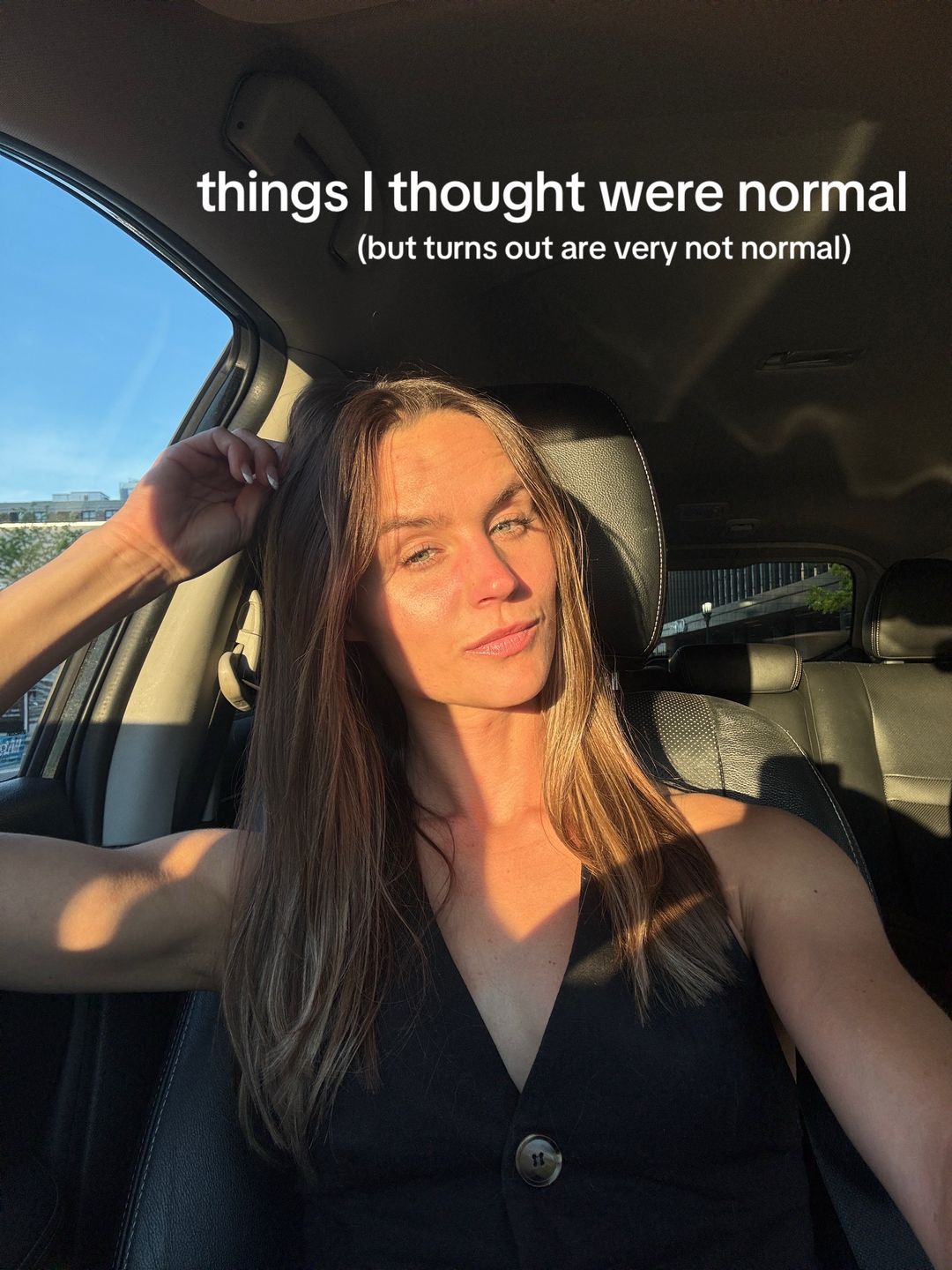
things I thought were normal (but turns out are very not normal)
Visual
A woman in a car during golden hour, looking directly at the camera with a soft, knowing expression.
All Slides
@audreyabrothers carousel breakdown
audrey | somatic life coach
when I learned that each one of these habits was a sign of living in survival mode, my life did a 180.
Effectiveness score
9/10
Views
2.4M
Likes
340.7K
Saves
82K
Engagement
17.9%
Hook
things I thought were normal (but turns out are very not normal)
Goal
build-community
Offer
information / lead-magnet
CTA
comment "let go" to get support and learn how
Caption
when I learned that each one of these habits was a sign of living in survival mode, my life did a 180.
Strategic Summary
This carousel went viral because it targets the 'high-functioning anxiety' demographic with a powerful reframing loop. It starts with relatable self-deprecation (things I thought were normal), lists highly specific triggers that force the reader to scream 'ME', and then delivers a therapeutic reframe (Slide 7) that absolves the reader of shame. The massive save rate (5.6x norm) proves this is being used as a digital talisman—people save it to remind themselves they are not broken.
The Winning Formula
Personal confusion hook + hyper-specific symptom stacking + compassionate reframe of 'flaw' as 'protection' + keyword-gated support.
What's working
- •Slide 1 Hook: The 'normal vs not normal' framing creates an immediate curiosity loop—viewers swipe to see if their own habits are included in the 'not normal' list.
- •Symptom Stacking (Slides 2-6): The text doesn't just list habits; it includes *quotes* the viewer says and specific scenarios (texts, emails), which triggers the 'barnum effect'—feeling like the content was written specifically for them.
- •The Reframe Pivot (Slide 7): This is the viral engine. Calling these behaviors 'adaptive responses' rather than 'flaws' creates a massive emotional release. It transforms shame into safety.
- •Low Friction CTA (Slide 8): The keyword 'let go' is emotionally resonant with the content themes, increasing the likelihood of the comment trigger action.
What's not working
- •Slide 5's visual is slightly busier than the others (city arch/bushes), which creates a tiny visual bump compared to the minimalist nature of the others.
Viral lesson
Validation is a stronger driver than education alone; people share content that articulates their pain better than they can, and save content that absolves them of guilt for having that pain.
Can a small creator replicate this? Highly replicable for any 'hidden struggle' niche (e.g., financial stress, parenting burnout). Requires the creator to have enough credibility to make the 'Reframe' slide feel safe and authoritative.
Structural Formula (steal-the-format)
Structure pattern
Hook (Personal confusion) + List (Agitation of specific symptoms) + Pivot (Compassionate reframe of symptoms as survival) + CTA (Keyword for lead magnet).
Copy formula
First-person realization -> Quoted self-talk/Lists of scenarios -> 'You are not broken' affirmation.
What to swap (concrete remixes)
- •Swap 'Survival Mode Habits' for 'Burnout Habits' for the career/corporate niche.
- •Swap 'Relationship Anxiousness' for 'Imposter Syndrome' for the entrepreneur niche.
What NOT to copy
Do not copy if you cannot deliver the 'Reframe' slide with genuine compassion. If the pivot feels clinical or sales-y, the audience will distrust the entire post.
Aesthetics
Cinematic nature photography with minimalist, centered white typography to create a calming journal aesthetic.
Color palette
What it conveys: The visuals shift from the creator's personal space (car) to expansive nature (sky, sea), mirroring the internal journey from personal struggle to universal healing and peace.
Slide-by-slide forensics
1hookselfieVulnerabilityworks:yesgrab:90/100aesthetic:85/100things I thought were normal (but turns out are very not normal)
things I thought were normal (but turns out are very not normal)
Visual description
Close-up selfie of a woman in a car, bathed in golden hour sunlight. Her hand is brushing her hair back. She looks directly at the camera with a calm, slightly knowing expression. The car interior is dark, making her face the focal point of the light.
Scene setting
in-car selfie at golden hour
Visible people
Visible objects
vs prior slide
Style: First slide establishes the creator's face and the warm, cinematic lighting palette used in subsequent outdoor shots.
Story: Sets the stage by implying the creator has a secret realization that the viewer might need too.
Predicted audience reaction
Viewers immediately relate to the idea of 'mistaken normalcy' and prepare to self-diagnose.
Verdict: Perfectly balances personal vulnerability with a universal curiosity gap. The selfie feels intimate, like a confessional.
2setuplandscapeAnxietyworks:yesgrab:85/100aesthetic:80/100"Are you mad at me?"
"Am I annoying you?"
"Do you still love me?"
"Did I do something wrong?"
"Are you mad at me?" "Am I annoying you?" "Do you still love me?" "Did I do something wrong?"
Visual description
A minimal, calming shot of a moon in a clear blue daytime sky. The moon is slightly cratered and positioned in the lower left. The text is white sans-serif, centered right.
Scene setting
blue sky with moon
Visible objects
vs prior slide
Style: Drops the creator's face but maintains the high-quality, calming nature photography aesthetic.
Story: Dives immediately into the first 'symptom' of the condition hinted at in Slide 1.
Predicted audience reaction
Immediate recognition. The text uses questions the viewer has likely said out loud.
Verdict: Hits the anxious attachment niche hard. The quote style makes the viewer hear the voice in their head.
3setuplandscapeNumbnessworks:yesgrab:70/100aesthetic:80/100not feeling much of anything, even in incredibly special moments
not feeling much of anything, even in incredibly special moments
Visual description
A wide, serene shot of a marshy river inlet with tall grasses on the banks. The water reflects the blue sky. In the distance, a small white house is visible. The horizon is straight and the mood is very still.
Scene setting
serene marshland river inlet
Visible objects
vs prior slide
Style: Maintains the blue/calm nature aesthetic, though the text color is white like the moon, standing out against the blue.
Story: Expands from the specific relationship anxiety of Slide 2 to the broader symptom of emotional blunting.
Predicted audience reaction
A 'gut punch' moment for those who experience dissociation or anhedonia.
Verdict: The image of 'still water' metaphorically mirrors the 'not feeling' text.
4setupwide shotOverwhelmworks:yesgrab:75/100aesthetic:80/100overthinking everything—texts, emails, social media posts, conversations, body language, plans with friends, someone's tone, resting, making decisions
overthinking everything—texts, emails, social media posts, conversations, body language, plans with friends, someone's tone, resting, making decisions
Visual description
A view looking down a wooden boardwalk towards the ocean. The boardwalk descends into sand and ocean. Grass and dunes frame the sides. The sky is a deep, clear blue.
Scene setting
beach boardwalk entrance
Visible objects
vs prior slide
Style: Continues the nature motif, though the boardwalk adds a structural, leading-line element.
Story: Introduces the 'hypervigilance' aspect of survival mode.
Predicted audience reaction
Relief at seeing an exhaustive list that validates their internal exhaustion.
Verdict: The density of the list forces a longer dwell time as readers check off items.
5setupwide shotTensionworks:yesgrab:80/100aesthetic:80/100constant emotional highs and lows in relationships, always on guard for the next battle
constant emotional highs and lows in relationships, always on guard for the next battle
Visual description
A view looking up through a stone archway at tall city skyscrapers. The sun is setting behind the central building, creating a lens flare. The arch frames the chaotic geometry of the city.
Scene setting
city archway looking at skyscrapers
Visible objects
vs prior slide
Style: Shifts to an urban setting, visually representing the 'chaos' mentioned in the text.
Story: Introduces the relational impact of the condition.
Predicted audience reaction
Triggers awareness of toxic relationship cycles.
Verdict: The image of the 'arch' framing the tall buildings symbolizes the 'trap' of these emotional cycles.
6setuplandscapeIsolationworks:partialgrab:70/100aesthetic:75/100"I'm fine. It's not a big deal."
"Leave me alone."
"I don't need your help."
"There's nothing to talk about."
"I'm fine. It's not a big deal." "Leave me alone." "I don't need your help." "There's nothing to talk about."
Visual description
A minimalist shot of a curved, dark architectural structure on the left and a brick building on the right against a pale sky. The composition has significant negative space in the center where the text sits.
Scene setting
urban architecture negative space
Visible objects
vs prior slide
Style: Returns to a more minimal composition but stays in the urban environment.
Story: Shows the 'Avoidant' coping mechanism that complements the 'Anxious' traits in Slide 2.
Predicted audience reaction
Recognition of the 'shut down' response.
Verdict: The text is strong, but the visual is slightly less emotionally resonant than the nature shots.
7payofflandscapeReliefworks:yesgrab:90/100aesthetic:85/100these aren't personality traits or flaws—they're adaptive responses your body developed to help you survive when you felt scared, helpless, uncertain, and overwhelmed.
these aren't personality traits or flaws—they're adaptive responses your body developed to help you survive when you felt scared, helpless, uncertain, and overwhelmed.
Visual description
A calming shot of ocean waves rolling onto the wet sand of a beach. The water is a deep blue-green, and the waves are white and foamy. The horizon line is visible in the distance.
Scene setting
ocean waves hitting shore
Visible objects
vs prior slide
Style: Returns to the soothing nature imagery, signaling a return to safety.
Story: The 'Pivot'. It reinterprets all previous slides (the symptoms) as strengths (survival mechanisms).
Predicted audience reaction
High emotional release. This is the slide that generates the 'Finally someone gets it' sentiments.
Verdict: The 'Reframe' is the core value proposition of the carousel.
8ctalandscapeHopeworks:yesgrab:85/100aesthetic:90/100you're not broken.
you're living in survival mode.
the good news?
you can rewire these patterns and create a life that feels safe to be fully present in.
comment "let go" to get support and learn how
you're not broken. you're living in survival mode. the good news? you can rewire these patterns and create a life that feels safe to be fully present in. comment "let go" to get support and learn how
Visual description
A beautiful, expansive sunset over the ocean beach. The sky is filled with orange and pink clouds. The wet sand in the foreground reflects the golden light of the sky. The beach stretches away to the right.
Scene setting
beach sunset horizon
Visible objects
vs prior slide
Style: The visual 'sunrise/sunset' reinforces the new beginning/hope mentioned in the text.
Story: Offers a way out. Validates the viewer ('not broken') and opens the door to the solution.
Predicted audience reaction
Motivation to click the keyword trigger to get the 'support' promised.
Verdict: The CTA is soft and emotionally aligned ('let go'), making it feel like self-help rather than a sales pitch.
Commerce intent
Comment ethnography
Shared identity of 'the over-thinker'. The comments likely feel like a support group where users bond over shared recognition of these habits.
Comments that characterize the audience
- ""I literally felt this in my chest reading slide 3.""
- ""Wait, asking 'are you mad?' 100 times a day is a trauma response? I thought I was just annoying.""
- ""The relief I feel reading slide 7 is insane.""
Pain points revealed
- •Feeling like a burden in relationships
- •Emotional numbness during happy times
- •Exhaustion from constant hypervigilance
Aspirations revealed
- •To feel safe and present
- •To stop 'ruining' relationships
- •To be loved without trying so hard
Top questions asked
- •But how do I stop doing this?
- •Is this CPTSD or just anxiety?
- •Do you offer 1:1 sessions?
Diagnostics
Hook deep-dive
things I thought were normal (but turns out are very not normal)
The parenthetical '(but turns out are very not normal)' creates an insecurity gap. The viewer has to swipe to ensure their own 'normal' habits aren't being pathologized.
Engagement read
The bookmark rate is 5.6x the norm, indicating this is being treated as a resource/reference rather than just content.
Mechanics
The list of habits serves as a 'Self-Diagnostic Checklist'. Readers swipe to slide 4 and 5 because they need to know if they 'qualify' as having this problem, which leads them inevitably to the solution on Slide 7.
Brand & funnel
Buying-journey moment: The viewer is in the 'Education' phase, realizing their habits are symptoms of a larger condition (survival mode) and looking for the cure.
Ideal Customer Profile
Young women struggling with anxiety, people-pleasing, and emotional dysregulation who feel 'broken' but are looking for a framework to understand their behavior.
Age
18-34
Gender
female
Readability
simple
Interests
Pain Points
Aspirations
Emotional Profile
Primary Emotion
validationIntensity
Effectiveness
Emotions Evoked
Emotional Arc
curiosity → recognition → validation → hope
Why It Lands
The content moves the viewer from a state of self-judgment ('I am broken') to self-compassion ('I am just in survival mode'), which is a powerful emotional release.
Writing Analysis
Style
confessional
Tone
vulnerable
Hook Type
relatable observation
Quality
The writing is exceptionally concise, using short, punchy phrases that mirror the internal monologue of the target audience. It avoids clinical jargon, making complex psychological concepts accessible.
Effectiveness
Goal Achievement
The engagement metrics (17.92% rate, 82k saves) indicate this was highly effective at building a community of people who feel understood by the creator.
Why It Spread
high save-ability due to the 'reframe' of personal struggles
aesthetic, calming visual style that encourages sharing
deeply relatable content that feels like a 'secret' being shared
Content DNA
The CTA is low-friction and promises a specific benefit (support/learning), which encourages engagement without feeling like a hard sell.
Narrative Arc
The carousel builds tension by listing painful, relatable symptoms, then provides a massive emotional release on slide 11, and ends with a hopeful, actionable CTA.
Psychological Blueprint
Why It Spread
The post hit a massive nerve by reframing common, painful symptoms of anxiety as 'adaptive responses' rather than personal failures. This provided immediate relief and validation to a large audience, prompting high save rates (82k) as users wanted to keep this 'permission' to heal. The combination of aesthetic, calming visuals and deeply relatable, specific internal struggles made it highly shareable for those feeling the same way.
Framework
PASPrimary Tactic
validationTactics Used
curiosity gap on slide 1 — 'things I thought were normal' implies a secret knowledge
labeling on slide 11 — redefines 'flaws' as 'adaptive responses'
community building on slide 13 — 'comment to get support' creates a shared space
relatability on slides 2, 4, 6, 7, 9 — uses specific, common internal monologues
Cognitive Biases
Barnum effect — the statements are broad enough to apply to almost anyone, making the viewer feel 'seen'
confirmation bias — the viewer seeks out these slides to confirm their own experiences
Zeigarnik effect — the list format creates a need to finish the carousel to reach the 'solution'
Tribal Markers
Trust Signals
Slide Breakdown (8 analyzed)
Text
things I thought were normal (but turns out are very not normal)
Visual
A woman in a car during golden hour, looking directly at the camera with a soft, knowing expression.
Visual Elements
Color Palette
Copy Analysis
Power Words
Open Loop: yes — the viewer must swipe to see what these 'not normal' things are.
Visual Psychology
Attention: The woman's face and the high-contrast text.
Gaze: Directly at the viewer, creating an intimate connection.
Emotional cue: The warm, soft lighting suggests safety and vulnerability.
Composition: Creates a 'confessional' vibe that invites the viewer into a private conversation.
Text
"Are you mad at me?" "Am I annoying you?" "Do you still love me?" "Did I do something wrong?"
Visual
A single moon in a clear blue sky.
Visual Elements
Color Palette
Copy Analysis
Power Words
Open Loop: yes — the viewer wants to see if the list continues to match their experience.
Visual Psychology
Attention: The moon, which acts as a metaphor for loneliness or being 'out of reach'.
Emotional cue: The vast, empty blue sky evokes a sense of isolation.
Composition: Minimalism forces the viewer to focus entirely on the text.
Text
not feeling much of anything, even in incredibly special moments
Visual
A calm, winding river through a marshland.
Visual Elements
Color Palette
Copy Analysis
Power Words
Open Loop: yes
Visual Psychology
Attention: The center of the image where the text is placed.
Emotional cue: The stillness of the water reflects the emotional numbness described.
Composition: The wide-open space creates a sense of detachment.
Text
overthinking everything—texts, emails, social media posts, conversations, body language, plans with friends, someone’s tone, resting, making decisions
Visual
A wooden boardwalk leading to the ocean.
Visual Elements
Color Palette
Copy Analysis
Power Words
Open Loop: yes
Visual Psychology
Attention: The leading lines of the boardwalk.
Emotional cue: The path represents the journey of the mind.
Composition: The perspective draws the viewer into the scene.
Text
constant emotional highs and lows in relationships, always on guard for the next battle
Visual
A view of city skyscrapers through a stone archway.
Visual Elements
Color Palette
Copy Analysis
Power Words
Open Loop: yes
Visual Psychology
Attention: The archway framing the buildings.
Emotional cue: The archway feels like a protective barrier.
Composition: Framing suggests being trapped or looking out from a place of defense.
Text
"I'm fine. It's not a big deal." "Leave me alone." "I don't need your help." "There's nothing to talk about."
Visual
A modern building silhouette against a twilight sky.
Visual Elements
Color Palette
Copy Analysis
Power Words
Open Loop: yes
Visual Psychology
Attention: The sharp edge of the building.
Emotional cue: The cold, sharp lines of the building reflect the defensive tone of the text.
Composition: Creates a sense of distance and coldness.
Text
these aren't personality traits or flaws—they're adaptive responses your body developed to help you survive when you felt scared, helpless, uncertain, and overwhelmed.
Visual
Waves crashing on a sandy beach.
Visual Elements
Color Palette
Copy Analysis
Power Words
Open Loop: yes
Visual Psychology
Attention: The white foam of the waves.
Emotional cue: The rhythmic nature of waves is inherently soothing.
Composition: Provides a sense of movement and resolution.
Text
you're not broken. you're living in survival mode. the good news? you can rewire these patterns and create a life that feels safe to be fully present in. comment "let go" to get support and learn how
Visual
A beautiful sunset over the ocean.
Visual Elements
Color Palette
Copy Analysis
Power Words
Open Loop: no
Visual Psychology
Attention: The vibrant colors of the sunset.
Emotional cue: Sunsets symbolize endings and new beginnings.
Composition: Designed to leave the viewer feeling hopeful.
Comment Intelligence
Sentiment
PositiveResonance
Intent
build-community
Audience Vibe
Deeply supportive and validating; users feel safe sharing their own experiences because the creator has established a non-judgmental space.
Standout Quotes
“I have never felt so seen in my entire life.”
“Wait, so this is why I do that? This makes so much sense.”
“I literally started crying reading this. Thank you.”