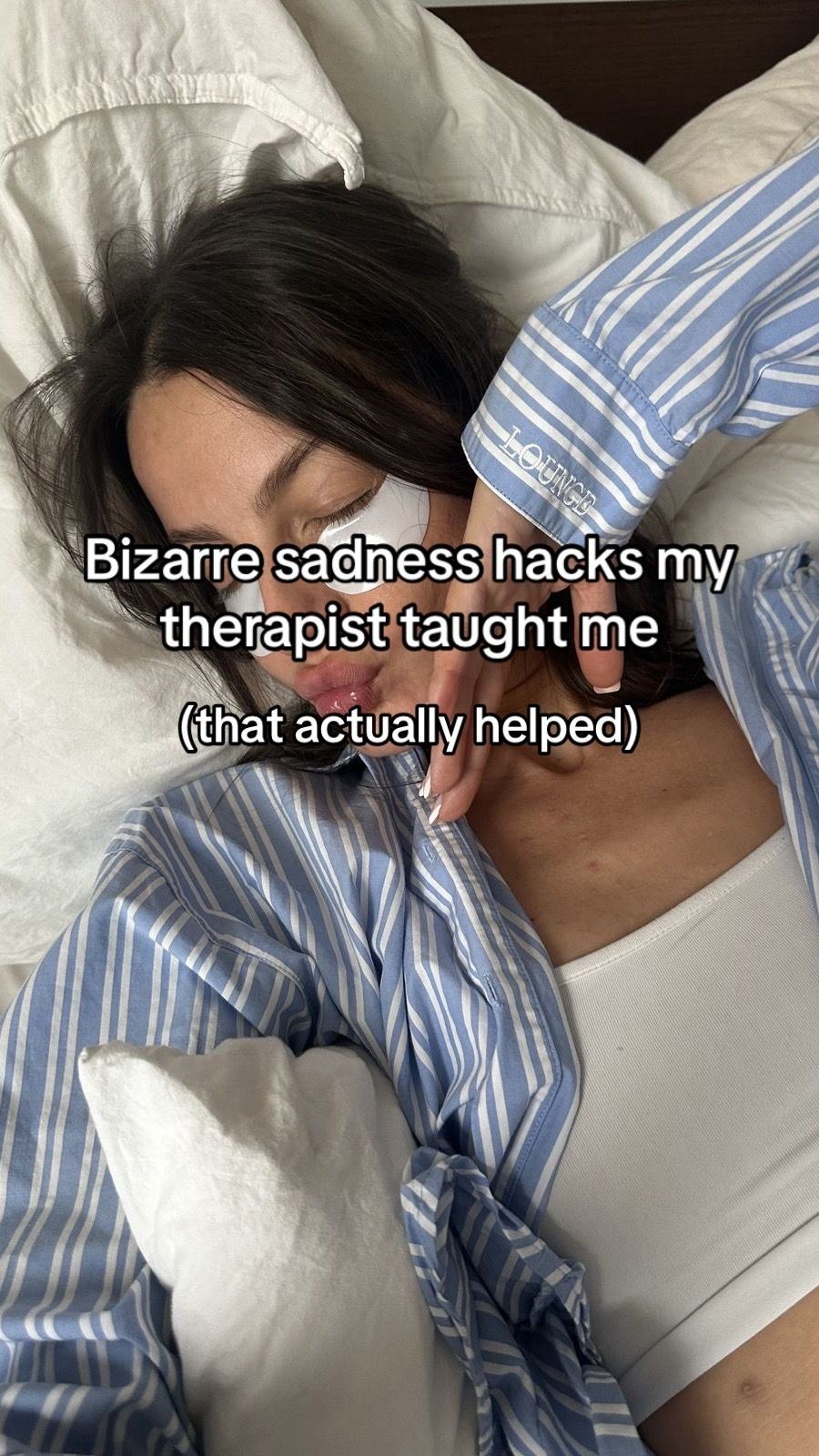
Slide Text
Bizarre sadness hacks my therapist taught me (that actually helped)
Visual
Woman lying in bed with eye patches, wearing a striped lounge shirt, soft lighting.
All Slides
@daily.mental.tips carousel breakdown
Mental Health Tips
My tips to help with sadness #SelfCare #selfdevelopment #sad
Effectiveness score
9/10
Views
866K
Likes
83.2K
Saves
53.2K
Engagement
16.7%
Hook
Bizarre sadness hacks my therapist taught me (that actually helped)
Goal
build-community
Offer
information
CTA
none
Caption
My tips to help with sadness #SelfCare #selfdevelopment #sad
Strategic Summary
This carousel went viral primarily due to an extreme 'Save' rate (10x norm) driven by the 'Save for Later' utility of the content. It positions itself as a personal mental-health toolkit. The hook combines 'Authority' (Therapist) with 'Curiosity' (Bizarre) to stop the scroll. The tips focus on somatic (body-based) interventions which feel actionable when cognitive reframing is too hard for a sad person. The aesthetic builds trust through intimacy.
The Winning Formula
Authority-backed emotional validation + somatic body-hacks list + soft affiliate plug on slide 6.
What's working
- •Slide 1 Hook uses 'Bizarre' + 'Therapist' to create an irresistible curiosity gap about forbidden/secret knowledge.
- •Focus on Somatic/Physical actions (Salt water, Cold shower, Legs up wall) makes 'mental health' feel immediately doable, driving massive saves.
- •Aesthetic consistency: The 'cozy/soft' visuals reduce the threat response, making a sad viewer feel safe enough to read.
- •Placement of monetization: The 'useventy.com' drop on Slide 6 is late enough to build trust, but early enough to catch serious users before they drop off.
What's not working
- •Slide 6 (Tip 5) is too abstract ('Process your emotions') compared to the rest of the concrete steps; it momentarily breaks the 'hack' pattern.
- •The URL in Slide 6 is visually jarring against the otherwise 'vibe' based aesthetic; however, this likely filters for high-intent clicks anyway.
Viral lesson
To drive saves, your content must act as a Tool, not just Information. When you give people a list of physical actions to solve an emotional problem, they save it so they can use it when the emotion returns.
Can a small creator replicate this? Any wellness or self-help creator can replicate this by finding 5 physical 'hacks' for an emotional problem and framing them through the lens of 'Expert' or 'Experience' authority.
Structural Formula (steal-the-format)
Structure pattern
7-slide list, aesthetic POV photography, numbered overlay text, soft affiliate plug on slide 6.
Copy formula
Imperative command + Numbered constraint + Physiological justification ('It helps your nervous system').
What to swap (concrete remixes)
- •Swap Sadness->Anxiety for 'Bizarre anxiety hacks my therapist taught me' targeting corporate burnout audience.
- •Swap Therapist->Stylist for 'Bizarre styling hacks my stylist taught me' targeting fashion audience.
What NOT to copy
Do not copy the 'useventy.com' drop if you do not have the authority established in slides 1-5; it will feel spammy without the prior value delivery.
Aesthetics
"Cozy-Girl" authenticity: Soft lighting, muted neutrals, and intimate POV shots that feel like FaceTime from a best friend who is doing better than you.
Color palette
What it conveys: The overall aesthetic conveys "Safety" and "Recovery". It signals to the viewer that if they watch this, they too can be calm and cozy.
Slide-by-slide forensics
1hookclose upcomfortworks:yesgrab:90/100aesthetic:85/100Bizarre sadness hacks my therapist taught me (that actually helped)
Bizarre sadness hacks my therapist taught me (that actually helped)
Visual description
Close-up POV of a woman lying in bed, wearing blue and white striped pajamas and eye patches. The lighting is soft and natural, suggesting morning or a nap. The framing creates intimacy and vulnerability.
Scene setting
bedroom in bed
Visible people
Visible objects
vs prior slide
Style: The raw, aesthetic photography combined with white sans-serif text overlay creates a consistent 'storytime' vibe.
Story: Sets the context: Sadness management via therapist advice.
Predicted audience reaction
Users feeling sad or anxious will immediately feel seen by the 'in bed' imagery and swiped to see what the 'bizarre' hacks are.
Verdict: The 'Therapist' keyword adds authority to the 'Bizarre' claim, making the viewer assume the tips are safe but effective.
2step in listmedium shotcalmworks:yesgrab:70/100aesthetic:80/1001. Drink a glass of salt water first thing in the morning
Not the big ugly saltwater chug - just warm water with a pinch of sea salt. It helps your nervous system reset and somehow makes the sadness feel less heavy in your body.
1. Drink a glass of salt water first thing in the morning Not the big ugly saltwater chug - just warm water with a pinch of sea salt. It helps your nervous system reset and somehow makes the sadness feel less heavy in your body.
Visual description
A clear glass of water sitting on a white countertop. The background is a blurred interior (kitchen/living area) with neutral tones. The focus is entirely on the water.
Scene setting
kitchen counter
Visible objects
vs prior slide
Style: Continued use of white overlaid text on a photo background; the photo quality remains high and aesthetic.
Story: Introduces the first actionable hack.
Predicted audience reaction
This is an easy win. The advice is low effort (drinking water), validating the user immediately.
Verdict: Low barrier to entry tip that makes the user feel they can actually do this.
3step in listlifestyle shotgroundingworks:yesgrab:80/100aesthetic:85/1002.Set a timer and cry for exactly 7 minutes
This one sounds wild but crying with intention actually helps clear your mind and reduce stress.
When the timer goes off, you stop. It's like giving your sadness a container instead of letting it flood everything.
2.Set a timer and cry for exactly 7 minutes This one sounds wild but crying with intention actually helps clear your mind and reduce stress. When the timer goes off, you stop. It's like giving your sadness a container instead of letting it flood everything.
Visual description
Three small potted succulent plants sitting on a wooden table. In the background, there's a blurred living room setting with a sofa and window.
Scene setting
living room table
Visible objects
vs prior slide
Style: Maintains the aesthetic of calm domestic objects (plants) to contrast with the 'wild' nature of the tip.
Story: Introduces a more psychological/somatic intervention.
Predicted audience reaction
The '7 minutes' specificity makes this feel like a legitimate protocol rather than just 'cry if you need to'.
Verdict: The 'Container' metaphor resonates deeply with therapy patients.
4step in listlifestyle shotcozyworks:yesgrab:85/100aesthetic:90/1003.Listen to the happiest song you know on repeat
Throw on that song that always makes you smile and loop it. The repetition helps shift your mood, and before long you'll catch yourself singing along instead of sinking deeper.
3.Listen to the happiest song you know on repeat Throw on that song that always makes you smile and loop it. The repetition helps shift your mood, and before long you'll catch yourself singing along instead of sinking deeper.
Visual description
A cozy evening scene. A cat sits on a desk looking out a window at a snowy landscape. There are lit candles (orange jars) and a laptop screen visible on the right. A desk lamp is on.
Scene setting
cozy desk at night
Visible objects
vs prior slide
Style: The lighting gets warmer (candles/lamp) matching the 'happiest song' theme.
Story: Sensory intervention (auditory).
Predicted audience reaction
Users are likely nodding along, recalling their own 'happy songs'.
Verdict: Visuals match the advice perfectly.
5step in listmirror selfievulnerableworks:yesgrab:85/100aesthetic:80/1004.Say your feelings out loud to your reflection
Like actually look yourself in the eyes and say "I feel sad about..." or "I'm disappointed because..."
Your brain processes emotions differently when you speak them instead of just thinking them.
4.Say your feelings out loud to your reflection Like actually look yourself in the eyes and say "I feel sad about..." or "I'm disappointed because..." Your brain processes emotions differently when you speak them instead of just thinking them.
Visual description
A bathroom mirror with heavy steam condensation, obscuring the reflection. You can see the blurry outline of a person and maybe a shower head or faucet at the bottom.
Scene setting
steamy bathroom mirror
Visible people
Visible objects
vs prior slide
Style: The steam obscures the face, which aligns with privacy and the difficulty of looking at oneself when sad.
Story: Introduces 'Mirror Work' psychological concept.
Predicted audience reaction
The steam mirror makes the viewer feel safe (no judgment from a clear face) but intrigued.
Verdict: The visual metaphor of the cleared/steamy mirror works well here.
6step in listlifestyle shothealingworks:yesgrab:75/100aesthetic:80/1005.Process your emotions
Don't try to solve it or make it make sense. Just get it all out of your head. When emotions sit in your brain, they multiply and get twisted.
I use "useventy.com" for this
5.Process your emotions Don't try to solve it or make it make sense. Just get it all out of your head. When emotions sit in your brain, they multiply and get twisted. I use "useventy.com" for this
Visual description
A dim lit shelf or bedside table. There are stacks of books, a small plant, crystals/stones, and a Himalayan salt lamp glowing warm orange. A framed picture hangs on the wall above.
Scene setting
nightstand shelf
Visible objects
vs prior slide
Style: The 'book stack' visual implies reading/journaling, which supports the 'Process your emotions' copy.
Story: The slide introduces the specific product pitch.
Predicted audience reaction
Users looking for a deeper solution than the physical hacks will click this link.
Verdict: This is the monetization moment. It's placed late enough to have established value first.
7step in listlifestyle shotshockworks:yesgrab:80/100aesthetic:80/1006.Take a freezing cold shower for 30 seconds
It shocks your nervous system in the best way and forces your body to focus on something other than the sadness. Plus you feel weirdly accomplished after.
6.Take a freezing cold shower for 30 seconds It shocks your nervous system in the best way and forces your body to focus on something other than the sadness. Plus you feel weirdly accomplished after.
Visual description
A bathroom shower scene. A modern chrome shower head is spraying water. White tiles and a window with daylight are visible in the background. Shampoo bottles are in a caddy.
Scene setting
bathroom shower
Visible objects
vs prior slide
Style: Return to a practical, physical setting matching the physical action described.
Story: Moves back to a 'harder' physical intervention (cold shower) to close the loop on somatic tips.
Predicted audience reaction
Many users will have heard of cold showers, but the '30 seconds' makes it sound manageable. High save driver.
Verdict: Cold therapy is a proven high-engagement topic in wellness.
8step in listPOVreliefworks:yesgrab:90/100aesthetic:85/1007.Lie on the floor with your legs up the wall
This weird position actually helps activate your parasympathetic nervous system like a reset button for overwhelming feelings. Do it for 5 minutes and your body literally can't hold onto the stress the same way.
7.Lie on the floor with your legs up the wall This weird position actually helps activate your parasympathetic nervous system like a reset button for overwhelming feelings. Do it for 5 minutes and your body literally can't hold onto the stress the same way.
Visual description
POV shot of legs resting up against a white door or wall. The person is wearing grey sweatpants and white sneakers. A plant is visible in the background.
Scene setting
floor against wall
Visible people
Visible objects
vs prior slide
Style: The POV shot invites the viewer to imagine doing the pose themselves.
Story: Final tip: The 'Viparita Karani' yoga pose. Acts as the ultimate 'reset'.
Predicted audience reaction
The visual demonstration makes this immediately actionable. Users will physically try this while looking at the screen.
Verdict: This is the 'Save' closer. It's the easiest tip with the biggest physiological claim.
Commerce intent
Mentioned products
Comment ethnography
The audience is seeking relief and practical tools, viewing the creator as a safe guide rather than a controversial figure.
Pain points revealed
- •Sadness
- •Overwhelming emotions
- •Need for nervous system regulation
Aspirations revealed
- •Emotional regulation
- •Relief from sadness
- •Self-care routines
Diagnostics
Hook deep-dive
Bizarre sadness hacks my therapist taught me (that actually helped)
The viewer swipes because they trust the therapist's authority but are curious about why the hacks are labeled 'Bizarre'.
Engagement read
The bookmark-to-like ratio is inverted compared to typical viral content; users are saving this at a much higher rate than they are liking it, treating it as a tool.
Mechanics
The promise of 'Hacks' that are 'Bizarre' keeps users swiping to see if the next tip is the one they've never heard of.
Brand & funnel
Buying-journey moment: The viewer is in the 'Research' phase of solving their sadness.
Ideal Customer Profile
Young adults, primarily women, struggling with emotional regulation, anxiety, or low-level depression who are looking for accessible, 'low-friction' ways to feel better.
Age
18-24
Gender
female
Readability
simple
Interests
Pain Points
Aspirations
Emotional Profile
Primary Emotion
validationIntensity
Effectiveness
Emotions Evoked
Emotional Arc
curiosity → recognition → validation → empowerment
Why It Lands
The content validates the user's pain by acknowledging that sadness is 'heavy' and 'bizarre,' then provides immediate relief through actionable, non-judgmental steps.
Writing Analysis
Style
listicle
Tone
relatable
Hook Type
bold claim
Quality
The writing is concise, empathetic, and avoids clinical jargon, making complex nervous system concepts feel accessible and non-intimidating.
Effectiveness
Goal Achievement
The massive bookmark-to-view ratio indicates that the content is highly valued as a resource, successfully positioning the creator as a helpful, relatable authority.
Why It Spread
high utility/saveability (the tips are actionable)
aesthetic visual style that fits the 'wellness' algorithm
counter-intuitive advice (e.g., 'cry for 7 minutes') that encourages comments and discussion
Content DNA
There is no explicit CTA, which is a missed opportunity for growth, though it keeps the content feeling purely helpful rather than promotional.
Narrative Arc
The flow is consistent, with each slide offering a new, bite-sized tip that keeps the user swiping to the end.
Psychological Blueprint
Why It Spread
The carousel succeeded by combining high-aesthetic 'that girl' imagery with low-barrier, actionable mental health advice. By framing the tips as 'bizarre' and 'therapist-approved,' it created a curiosity gap that drove high bookmark rates (53k+), as users saved the content to reference later when feeling sad. The 16.69% engagement rate is driven by the high utility of the tips, which feel like 'secrets' to emotional regulation.
Framework
authority then teachPrimary Tactic
authorityTactics Used
curiosity-gap on slide 1: 'bizarre' and 'actually helped' implies a secret knowledge
authority-borrowing on slide 1: 'my therapist taught me' adds instant credibility
pattern-interrupt: using unconventional, 'bizarre' tips (salt water, 7-minute timer) to break the user's scroll
tribal-signaling: 'that girl' aesthetic and 'lounge' branding signals to a specific wellness-focused subculture
Cognitive Biases
authority bias: attributing tips to a therapist makes the advice feel safer and more effective
framing effect: presenting sadness as something that can be 'hacked' or 'contained' makes it feel manageable rather than overwhelming
mere exposure: the repetition of the 'nervous system' concept reinforces the educational value
Tribal Markers
Trust Signals
Slide Breakdown (2 analyzed)
Text
Bizarre sadness hacks my therapist taught me (that actually helped)
Visual
Woman lying in bed with eye patches, wearing a striped lounge shirt, soft lighting.
Visual Elements
Color Palette
Copy Analysis
Power Words
Open Loop: yes, the reader needs to know what these 'bizarre' hacks are.
Visual Psychology
Attention: the text overlay and the woman's face
Gaze: woman's eyes are closed, directing focus to the text
Emotional cue: the 'sad but aesthetic' vibe
Composition: to create an immediate sense of relatability and intimacy
Text
1. Drink a glass of salt water first thing in the morning. Not the big ugly saltwater chug - just warm water with a pinch of sea salt. It helps your nervous system reset and somehow makes the sadness feel less heavy in your body.
Visual
A glass of water on a white table.
Visual Elements
Color Palette
Copy Analysis
Power Words
Open Loop: yes, the reader wants to see the next tip.
Visual Psychology
Attention: the glass of water
Emotional cue: clean, simple imagery
Composition: to provide a clear, simple instruction
Comment Intelligence
Sentiment
PositiveResonance
Intent
build-community
Audience Vibe
The comments are sparse but reflect a community of people sharing their own experiences and validating the tips.
Standout Quotes
“I actually tried the 7 minute timer and it really works.”
“The salt water trick is a game changer for my anxiety.”
“Thank you for sharing this, I really needed it today.”