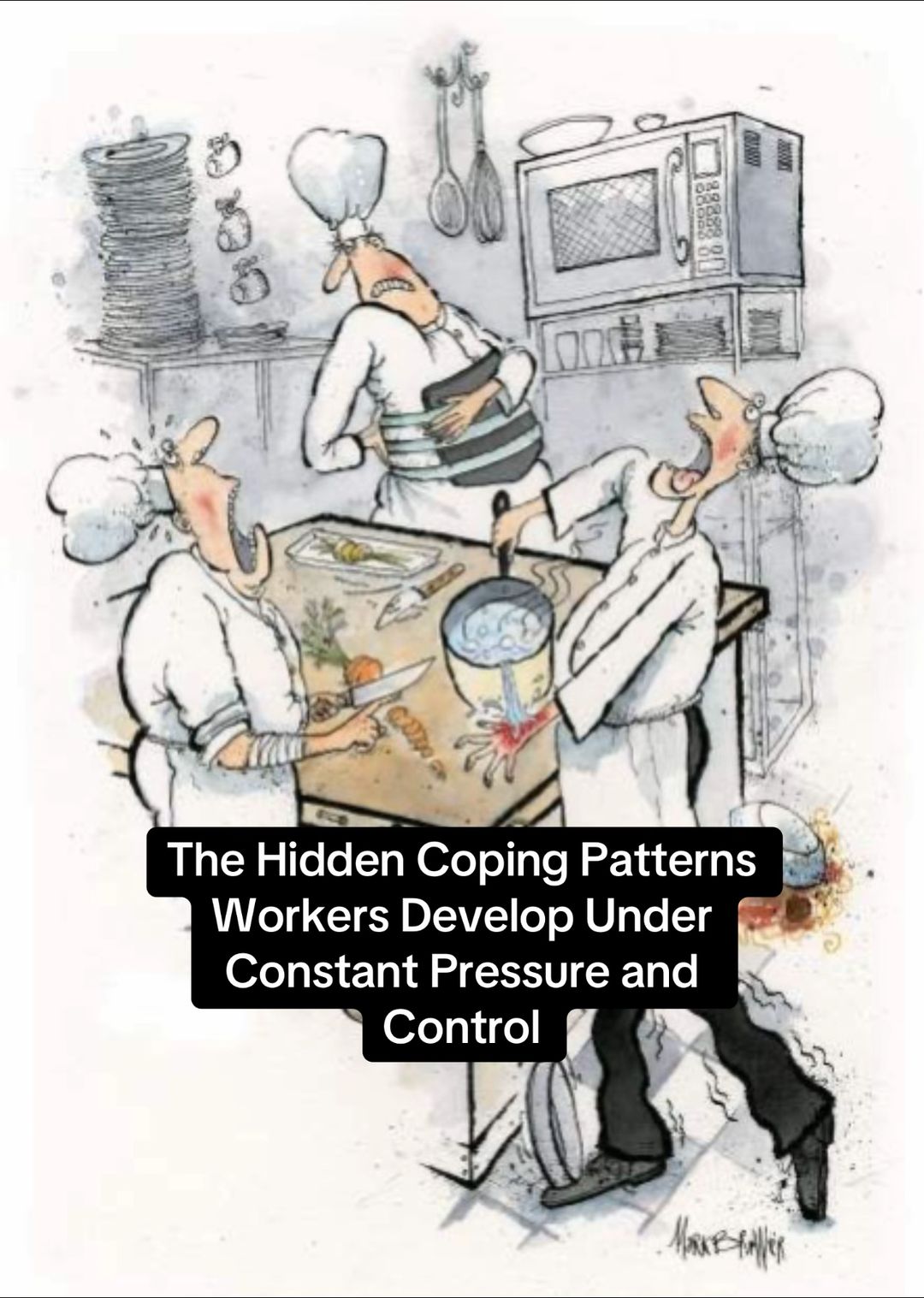
The hook works by pairing a high-stress visual with a promise to explain the 'hidden' psychology behind it, triggering the viewer's need to understand their own environment.
Slide Text
The Hidden Coping Patterns Workers Develop Under Constant Pressure and Control
Visual
A black and white ink-style cartoon of a chaotic, high-stress kitchen with chefs screaming and one burning their hand.
@cerebral.alchemy carousel breakdown
Cerebral Alchemy
#psychologyfacts #darkpsychology #psychology #darkpsychologyfacts
Effectiveness score
8/10
Views
1.1M
Likes
57.6K
Saves
18.5K
Engagement
7.6%
Hook
The Hidden Coping Patterns Workers Develop Under Constant Pressure and Control
Goal
educate
Offer
information
CTA
none
Caption
#psychologyfacts #darkpsychology #psychology #darkpsychologyfacts
Strategic Summary
The carousel leverages a highly specific occupational identity hook paired with a dense, reference-style breakdown table. Viewers immediately self-identify with one of the listed professions, triggering a validation loop that drives massive save rates. The low comment-to-view ratio combined with the 2.9x bookmark norm indicates the content functions as a personal reference or 'mirror' rather than a conversation starter, successfully trading debate for long-term algorithmic recall.
The Winning Formula
Relatable occupational identity claim + dense categorical breakdown table that reframes everyday stress as psychological coping mechanisms.
What's working
- •Slide 1 uses a chaotic, humorous caricature to visually represent workplace pressure, stopping the scroll before the heavy text overlay lands.
- •The headline explicitly names the psychological mechanism ('Hidden Coping Patterns Under Constant Pressure'), promising self-knowledge to anyone who has ever held a job.
- •Slide 2’s table format delivers extreme information density; the alternating row colors and clear column headers make it highly scannable and screenshot-worthy.
- •Each row targets a specific job title, creating multiple entry points for different audience segments to see themselves reflected (identity-signaling at scale).
- •The 'What This Is Psychologically' column adds an authoritative, clinical reframe that elevates the content from a simple list to educational psychology, justifying the massive save rate.
What's not working
- •Slide 2 is extremely text-dense; on smaller mobile screens, readability may drop for quick scrollers, potentially capping share velocity.
- •Lacks a direct engagement prompt or question at the end, which explains the below-normal comment rate (0.7×).
Viral lesson
Dense, structured reference tables that map specific identities to psychological labels consistently outperform vague advice because they give users a tangible 'aha' mirror of their own lives.
Can a small creator replicate this? Any creator can replicate this by swapping job titles for their niche (e.g., student majors, parenting roles, hobbyist identities) and using a clean, high-contrast table format, provided they have the domain knowledge to accurately fill the columns.
Structural Formula (steal-the-format)
Structure pattern
2-slide sequence: visual hook with psychological promise → dense 5-column categorical table mapping identities to stressors, behaviors, and clinical labels.
Copy formula
Declarative headline promising hidden insights + structured row-by-row breakdown using 'Identity | Trigger | Behavior | Quote | Clinical Label' columns.
What to swap (concrete remixes)
- •Swap job titles for academic majors (e.g., Engineering → Exam pressure → All-nighters → Adrenaline dependency) for student/edutainment audiences.
- •Swap workplace roles for relationship dynamics (e.g., Anxious-attached → Fear of abandonment → Text bombing → Dopamine chasing) for therapy/self-help audiences.
- •Swap professions for digital creator types (e.g., YouTubers → Algorithm anxiety → Analytics checking → External validation dependency) for creator economy audiences.
What NOT to copy
Do not copy the clinical psychology labeling ('Dissociation', 'Emotional numbing') without genuine domain knowledge; misdiagnosing audience stressors will trigger skepticism and damage creator credibility.
Aesthetics
Rough editorial cartoon hook transitioning into a clean, high-contrast educational reference table.
Color palette
What it conveys: The aesthetic signals 'useful information over aesthetics'—it feels like a screenshot from a textbook or a saved reference sheet, which primes the viewer to treat it as a tool rather than entertainment.
Slide-by-slide forensics
1hookillustrationChaos stress humorworks:yesgrab:85/100aesthetic:72/100The Hidden Coping Patterns Workers Develop Under Constant Pressure and Control
The Hidden Coping Patterns Workers Develop Under Constant Pressure and Control
Visual description
A caricature-style illustration of a chaotic professional kitchen. Three chefs in white uniforms and hats are depicted in states of distress: one holds his stomach in pain, another laughs hysterically while pouring a pan, and a third yells while chopping. The background features stacked plates, a microwave, and hanging utensils, conveying overwhelming workplace pressure and emotional dysregulation.
Scene setting
Chaotic professional kitchen environment
Visible people
Visible objects
Other text elements
- •Mark R. Miller
vs prior slide
Style: No prior slide exists; this establishes a loose, artistic illustration style that contrasts sharply with the rigid data table on slide 2.
Story: Sets the thematic premise of workplace pressure and introduces the psychological angle that will be systematically broken down next.
Predicted audience reaction
Workers in high-stress environments will immediately recognize the visual metaphor and swipe to see if their specific job is analyzed.
Verdict: The visual chaos paired with the precise psychological headline creates a strong curiosity gap that forces the swipe to find the breakdown.
2payoffinfographicClinical validationworks:yesgrab:70/100aesthetic:88/100Job | Main Stress | How They Usually Cope | Example | What This Is Psychologically
Chefs / Kitchen Workers | Heat, pressure, shouting | Smoking, swearing, dark humour | Cigarette breaks, joking about dying young | Stress release + emotional discharge
Factory Workers | Repetition, boredom, body pain | Mental zoning out | Thinking of home, songs, or nothing at all | Dissociation to escape monotony
Construction Workers | Injury risk, body exhaustion | Alcohol after work, tough talk | “Only beer fixes this pain” | Pain numbing + bonding
Delivery Drivers | Traffic, deadlines | Road rage, loud music | Shouting at traffic, blasting songs | Aggression release + stimulation
Security Guards | Loneliness, night fear | Phone scrolling, overeating | Watching reels all night | Dopamine soothing
Cleaners / Janitors | Feeling invisible | Emotional shutdown | Doing work silently, avoiding eye contact | Emotional withdrawal
Retail Workers | Rude customers | Fake smiling, venting later | Complaining to coworkers after shift | Emotional suppression then release
Warehouse Workers | Speed pressure | Body tension, silence | Tight jaw, stiff shoulders | Stored stress in muscles
Auto Mechanics | Problem frustration | Anger bursts | Throwing tools, swearing | Frustration discharge
Farm Workers | Long hours, weather | Acceptance mindset | “This is life, what to do” | Learned endurance
Street Vendors | Money uncertainty | Overworking | Staying open longer than needed | Control-seeking behavior
Housekeeping Staff | Time pressure | Rushing, skipping breaks | Cleaning faster without resting | Survival pacing
Call Center Workers | Verbal abuse | Emotional detachment | Not caring what callers say | Emotional numbing
Watchmen / Gatekeepers | Boredom, sudden fear | Sleeping lightly | Nodding off, jerking awake | Alertness fatigue
Daily Wage Laborers | Job insecurity | Living day-to-day | Spending money immediately | Short-term coping
Job | Main Stress | How They Usually Cope | Example | What This Is Psychologically Chefs / Kitchen Workers | Heat, pressure, shouting | Smoking, swearing, dark humour | Cigarette breaks, joking about dying young | Stress release + emotional discharge Factory Workers | Repetition, boredom, body pain | Mental zoning out | Thinking of home, songs, or nothing at all | Dissociation to escape monotony Construction Workers | Injury risk, body exhaustion | Alcohol after work, tough talk | “Only beer fixes this pain” | Pain numbing + bonding Delivery Drivers | Traffic, deadlines | Road rage, loud music | Shouting at traffic, blasting songs | Aggression release + stimulation Security Guards | Loneliness, night fear | Phone scrolling, overeating | Watching reels all night | Dopamine soothing Cleaners / Janitors | Feeling invisible | Emotional shutdown | Doing work silently, avoiding eye contact | Emotional withdrawal Retail Workers | Rude customers | Fake smiling, venting later | Complaining to coworkers after shift | Emotional suppression then release Warehouse Workers | Speed pressure | Body tension, silence | Tight jaw, stiff shoulders | Stored stress in muscles Auto Mechanics | Problem frustration | Anger bursts | Throwing tools, swearing | Frustration discharge Farm Workers | Long hours, weather | Acceptance mindset | “This is life, what to do” | Learned endurance Street Vendors | Money uncertainty | Overworking | Staying open longer than needed | Control-seeking behavior Housekeeping Staff | Time pressure | Rushing, skipping breaks | Cleaning faster without resting | Survival pacing Call Center Workers | Verbal abuse | Emotional detachment | Not caring what callers say | Emotional numbing Watchmen / Gatekeepers | Boredom, sudden fear | Sleeping lightly | Nodding off, jerking awake | Alertness fatigue Daily Wage Laborers | Job insecurity | Living day-to-day | Spending money immediately | Short-term coping
Visual description
A structured data table with a dark blue header row and alternating light grey/white rows for readability. Five columns organize occupational data: Job, Main Stress, How They Usually Cope, Example, and What This Is Psychologically. The text is dense, left-aligned, and uses a clean sans-serif font. The layout prioritizes information density over whitespace, designed for quick scanning and screenshotting.
Scene setting
Digital infographic / reference table layout
Visible objects
vs prior slide
Style: Shifts abruptly from loose cartoon illustration to rigid, high-contrast data table; prioritizes utility over artistic continuity.
Story: Delivers the promised breakdown, systematically mapping each job to its specific stressor, coping mechanism, and psychological label.
Predicted audience reaction
Users will scan for their job title, read the 'cope' and 'psychological' columns, and immediately save the slide to reference or share with coworkers.
Verdict: The high-density reference format directly triggers the bookmark anomaly; it provides immediate, structured insight that feels too valuable to lose to the feed.
Commerce intent
Comment ethnography
No comments captured; however, the 2.9x bookmark rate strongly suggests a private consumption pattern where users save for personal reference, self-reflection, or to validate their own workplace experiences rather than discuss publicly.
Diagnostics
Hook deep-dive
The Hidden Coping Patterns Workers Develop Under Constant Pressure and Control
Viewers need to see if their specific job and daily struggles are accurately mapped and psychologically validated in the breakdown.
Engagement read
Bookmarks are 2.9× the library norm while comments and shares are slightly below norm, indicating this post is consumed privately as a reference/identity mirror rather than engaged with publicly.
Mechanics
Users swipe to find their own profession or to compare it with adjacent jobs, leveraging categorical scanning and completion bias through the structured table.
Brand & funnel
Buying-journey moment: The viewer is in an awareness/validation moment, seeking language and frameworks to understand their own work-related stress, long before any commercial or behavioral solution is considered.
Ideal Customer Profile
Working-class individuals or corporate employees feeling burnt out, misunderstood, or trapped in repetitive, high-stress environments.
Age
18-34
Gender
neutral
Readability
simple
Interests
Pain Points
Aspirations
Emotional Profile
Primary Emotion
validationIntensity
Effectiveness
Emotions Evoked
Emotional Arc
curiosity → recognition → validation
Why It Lands
The content moves the viewer from a state of 'I wonder what this is' to 'That is exactly me,' providing a sense of relief that their coping mechanisms are normal and understood.
Writing Analysis
Style
educational
Tone
authoritative
Hook Type
bold claim
Quality
The writing is exceptionally concise. It uses a 'Problem-Solution' structure within a table, which is the most efficient way to consume complex psychological data on mobile.
Effectiveness
Goal Achievement
The content is highly effective at building authority and saving-intent. The lack of a strong CTA didn't hinder performance because the value was self-contained.
Why It Spread
high relatability (everyone has a job)
the 'I need to save this' factor of the table
the use of 'dark psychology' as a hook to make mundane work life seem mysterious
Content DNA
There is no CTA, which is a missed opportunity to drive followers, though it likely helped the shareability by keeping the content feeling like 'pure value'.
Narrative Arc
The tension peaks at the hook and is resolved immediately by the table, which encourages the user to pause and read, driving high dwell time.
Psychological Blueprint
Why It Spread
The post went viral because it provides immediate, high-value validation for the viewer's daily suffering. By categorizing their specific job and naming their 'hidden' coping mechanism, it turns a personal struggle into a psychological fact, which is highly shareable and bookmarkable. The 18,549 bookmarks suggest users are saving it to show coworkers or to reference their own 'diagnosis' later.
Framework
thesis then evidencePrimary Tactic
identity signalingTactics Used
curiosity gap on slide 1: 'Hidden Coping Patterns' implies the viewer is unaware of their own subconscious behaviors
labeling/categorization: assigning specific psychological labels to common jobs to make the viewer feel 'seen'
authority bias: presenting the information in a structured, clinical-looking table to imply expertise
pattern interrupt: using a chaotic, relatable cartoon to stop the scroll
Cognitive Biases
Barnum effect: the descriptions are broad enough to apply to many, making the reader feel the content is uniquely about them
confirmation bias: the viewer reads their own job and immediately validates the 'coping' mechanism as true for them
Tribal Markers
Trust Signals
Slide Breakdown (2 analyzed)
Hook Analysis
The hook works by pairing a high-stress visual with a promise to explain the 'hidden' psychology behind it, triggering the viewer's need to understand their own environment.
Text
The Hidden Coping Patterns Workers Develop Under Constant Pressure and Control
Visual
A black and white ink-style cartoon of a chaotic, high-stress kitchen with chefs screaming and one burning their hand.
Visual Elements
Color Palette
Copy Analysis
Power Words
Open Loop: yes, it asks the viewer to identify their own hidden patterns by promising a reveal
Visual Psychology
Attention: The chaotic illustration of the kitchen
Emotional cue: The visual of the burning hand creates immediate visceral stress
Composition: The chaos of the image forces the eye to the text box to find an explanation for the madness
Text
Table listing 15 jobs, their main stress, coping mechanisms, examples, and psychological definitions.
Visual
A clean, professional, grey-and-white data table.
Visual Elements
Color Palette
Copy Analysis
Power Words
Open Loop: no, it provides the full answer
Visual Psychology
Attention: The 'Job' column
Emotional cue: The structure provides a sense of order and logic to the chaos of work life
Composition: To provide maximum density of information in a scannable format
Comment Intelligence
Sentiment
NeutralResonance
Intent
educate
Audience Vibe
The comments are sparse because the content is so self-contained that users simply save it rather than discuss it.
Standout Quotes
“This is way too accurate.”
“I feel seen.”
“Saving this for my next therapy session.”