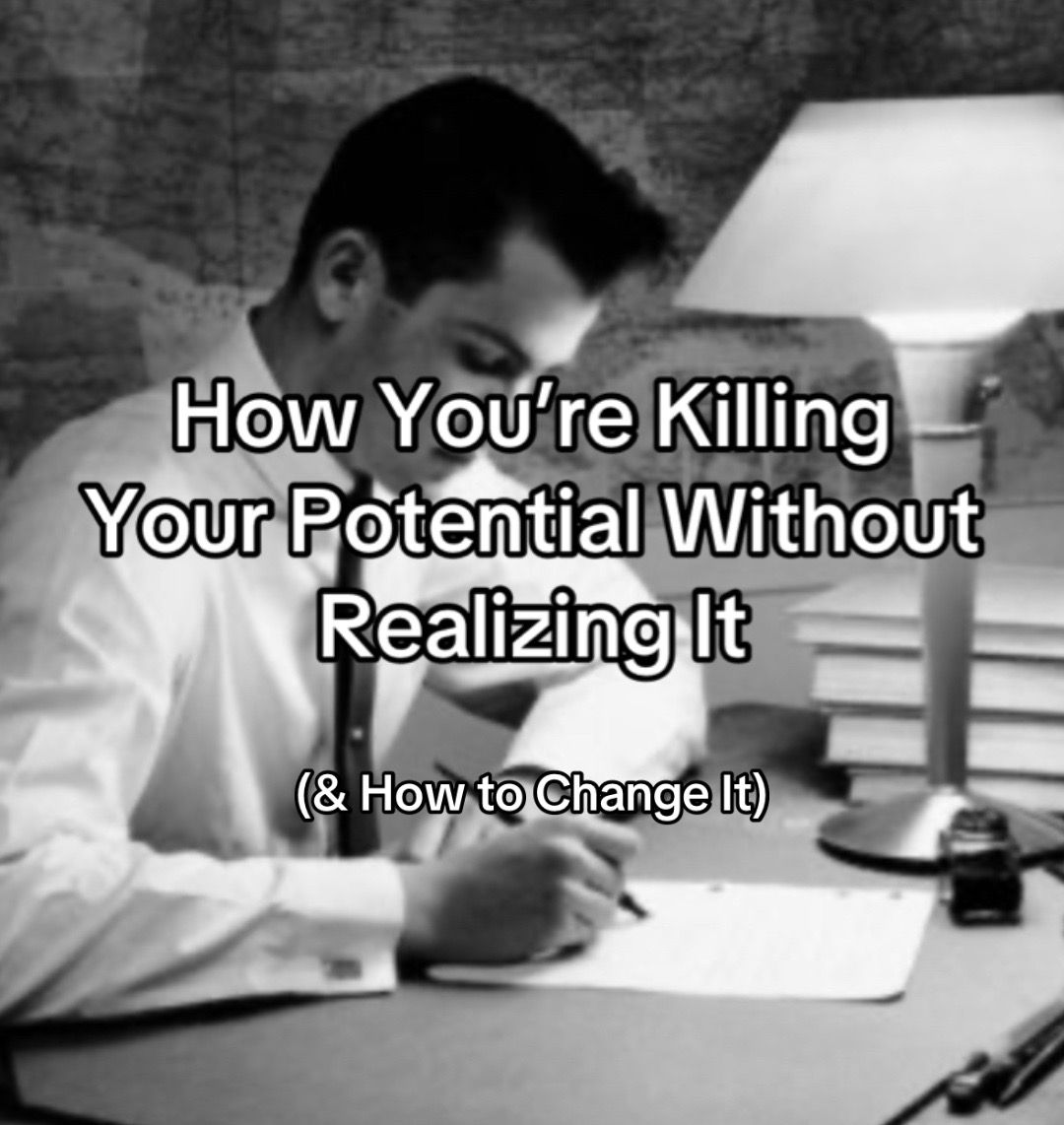
The hook works by combining a high-stakes threat ('killing your potential') with a promise of a solution, making it impossible to ignore for anyone feeling unproductive.
Slide Text
How You're Killing Your Potential Without Realizing It (& How to Change It)
Visual
Black and white vintage photo of a man writing at a desk with a lamp.
All Slides
@chasingpeaks0 carousel breakdown
ChasingPeaks
Why your lack of boredom is killing your success #dopamine #neuroscience #focus #SelfImprovement #discipline
Effectiveness score
9/10
Views
240.5K
Likes
21.9K
Saves
10.5K
Engagement
14.1%
Hook
How You're Killing Your Potential Without Realizing It (& How to Change It)
Goal
educate
Offer
information
CTA
none
Caption
Why your lack of boredom is killing your success #dopamine #neuroscience #focus #SelfImprovement #discipline
Strategic Summary
The carousel uses intense loss-aversion in the hook to capture attention, then diagnoses a universally relatable modern habit—constant stimulation via screens and music—as the hidden enemy of success. It borrows authority using pseudo-scientific medical imagery (brain scans) to validate the viewer's lack of focus. Finally, it delivers a highly actionable, 3-step 'protocol' on the last slide, driving an extraordinary 7.2x bookmark rate as viewers save it for future reference.
The Winning Formula
Severe loss-aversion hook + universally relatable daily habit diagnosis + pseudo-scientific mechanism + screenshot-friendly 3-step protocol.
What's working
- •Slide 1 utilizes intense loss aversion ('killing your potential') combined with a curiosity gap ('without realizing it') to guarantee the first swipe.
- •Slide 2 grounds the abstract concept of 'focus' in hyper-relatable daily moments—eating, walking, standing in line—making the post feel like it's speaking directly to the viewer's life.
- •The use of brain scans and clinical visual motifs artificially elevates the text, making opinions feel like peer-reviewed biological facts (authority bias).
- •Slide 6 condenses the 'solution' into three extremely specific, actionable bullet points, triggering massive completion bias and generating over 10K bookmarks.
What's not working
- •Slide 4 features prominent grammatical errors ('Looses' instead of 'Loses', 'Your' instead of 'You\'re') which completely shatters the intellectual, scientific aesthetic for perceptive viewers.
- •Slide 4 is narrative filler; it simply repeats the point made on Slide 3 with a weaker visual. It could be cut entirely to speed up the pacing.
Viral lesson
Diagnose a behavior your audience performs completely unconsciously every single day, explain why it's secretly hurting them using a pseudo-scientific mechanism, and offer a simple elimination protocol.
Can a small creator replicate this? Extremely high for any expert or coach; take a common 'normal' habit in your niche, frame it as a silent killer, and provide a 3-step elimination guide.
Structural Formula (steal-the-format)
Structure pattern
6-slide dark-mode carousel: 1 loss-aversion hook over aspirational backdrop -> 3 diagnostic medical/moody slides -> 1 reframe slide -> 1 bulleted protocol summary resource.
Copy formula
You are unconsciously destroying [Goal] + [Scientific mechanism explaining why] + 3-step subtraction protocol
What to swap (concrete remixes)
- •Swap 'killing your potential' for 'aging your skin' and 'dopamine' for 'cortisol' for a skincare/anti-aging audience.
- •Swap 'dopamine/boredom' for 'decision fatigue' and 'music/scrolling' for 'micro-managing' for a B2B/leadership audience.
What NOT to copy
Do not copy the specific attack on listening to music. It acted as solid engagement-bait for this specific 'sigma grindset' niche, but for a general or commercial audience, it will read as absurd and alienate potential buyers.
Aesthetics
Dark Sigma-Science with heavy meme-style impact typography
Color palette
What it conveys: It feels urgent, slightly clinical, and deeply serious, framing self-improvement as a matter of biological necessity rather than preference.
Slide-by-slide forensics
1hookmedium shotseriousworks:yesgrab:90/100aesthetic:85/100How You're Killing Your Potential Without Realizing It (& How to Change It)
How You're Killing Your Potential Without Realizing It (& How to Change It)
Visual description
A heavily shadowed, vintage black-and-white photograph of a classically dressed man in a collar and tie sitting at a desk, looking down and writing on a piece of paper. A lit desk lamp illuminates his workspace. The mood is serious, studious, and 'dark academia'.
Scene setting
vintage study desk
Visible people
Visible objects
Predicted audience reaction
Immediate intrigue and mild anxiety due to the fear of missing out on their own potential.
Verdict: It successfully merges an aspirational masculine aesthetic with a high-stakes emotional trigger (loss of potential).
2setupinfographicauthoritativeworks:yesgrab:80/100aesthetic:75/100You Fill Every Empty Moment: Most people can't even: ➡️ Eat Dinner ➡️ Walk outside ➡️ Sit alone ➡️ Stand in line Without TV, music, or scrolling. Your brain is never unstimulated anymore. And thats exactly why you can't focus or make real changes
You Fill Every Empty Moment: Most people can't even: ➡️ Eat Dinner ➡️ Walk outside ➡️ Sit alone ➡️ Stand in line Without TV, music, or scrolling. Your brain is never unstimulated anymore. And thats exactly why you can't focus or make real changes
Visual description
A sagittal MRI scan of a human head (side profile showing the brain), rendered in high-contrast black, blue, and white. Floating white text with heavy black outlines is layered over the scan. The image feels clinical and authoritative.
Scene setting
medical imagery
Visible objects
Other text elements
- •Medical overlay text (Ex: 3382, Se: 4, Im: 12)
vs prior slide
Style: Retains the exact same white/black impact typography, but abruptly shifts background from a vintage photo to medical imagery.
Story: Moves from the abstract hook to diagnosing the exact everyday behaviors causing the problem.
Predicted audience reaction
Strong personal identification—the list of mundane activities holds a mirror up to their constant phone/music usage.
Comments reacting to this slide
- "I need music bro 😭"
- "“To maximize ur potential u need to stop listening to music”"
- "Yo where do I look when I stand in line??"
Verdict: It names specific daily activities that almost the entire audience does with a screen or headphones, creating instant relatability.
3escalationmedium shotsomberworks:yesgrab:70/100aesthetic:75/100Your Brain NEEDS "Low" To Feel "High" When You Flood Your Day With: ➡️ Music ➡️ Scrolling ➡️ Social media ➡️ Content Your dopamine baseline rises, so when it's time to do real work, your brain tells you it's not worth it
Your Brain NEEDS "Low" To Feel "High" When You Flood Your Day With: ➡️ Music ➡️ Scrolling ➡️ Social media ➡️ Content Your dopamine baseline rises, so when it's time to do real work, your brain tells you it's not worth it
Visual description
A dark, moody silhouette of a person sitting in a completely unlit room, facing a large, glowing computer monitor. The screen's light illuminates the back of their head slightly. White text with black drop shadow is centered.
Scene setting
dark gaming/work room
Visible people
Visible objects
vs prior slide
Style: Typography remains identical; background shifts again from medical MRI to a dark lifestyle silhouette.
Story: Introduces the scientific 'mechanism' (dopamine baseline) that explains the warning given on the previous slide.
Predicted audience reaction
Resistance combined with an 'aha' moment as they understand the pseudo-scientific justification for their laziness.
Comments reacting to this slide
- "Too much dopamine inhibits growth hormones😳"
- "i genuinely cant go without music"
- "a lot of us are addicted to music and don't even realize it 😭"
Verdict: It successfully introduces 'dopamine' as the tangible enemy, giving the audience a scientific excuse for their lack of motivation.
4escalationmedium shotdepressingworks:nograb:50/100aesthetic:60/100Normal Life Looses Its Reward: ➡️ Your feeding your brain a synthetic life Your brain lives in videos, social media, & constant input This trains your brain to prefer a fake version of life
Normal Life Looses Its Reward: ➡️ Your feeding your brain a synthetic life Your brain lives in videos, social media, & constant input This trains your brain to prefer a fake version of life
Visual description
A very dimly lit, desaturated shot of a man slouched over at a desk in a dark room. The subject is out of focus, while the heavy, centered white text dominates the frame.
Scene setting
dark moody room
Visible people
vs prior slide
Style: Maintains the typography and the dark, moody room silhouette aesthetic of slide 3.
Story: No meaningful progression—it simply repeats the concept of being overstimulated by screens using different words.
Predicted audience reaction
Viewers likely speed-read this and swipe past quickly; highly observant viewers will notice the glaring grammatical errors.
Verdict: It suffers from two major typos ('Looses', 'Your') that kill the authoritative vibe, and it adds zero new value to the core argument.
5revealcollagehopefulworks:yesgrab:75/100aesthetic:75/100Why Boredom Restores This: ➡️ Boredom forces your dopamine below baseline That Drop: ➡️ Restores receptor sensitivity ➡️ Rebuilds focus & drive ➡️ Makes real life feel rewarding again
Why Boredom Restores This: ➡️ Boredom forces your dopamine below baseline That Drop: ➡️ Restores receptor sensitivity ➡️ Rebuilds focus & drive ➡️ Makes real life feel rewarding again
Visual description
A heavy 3x3 grid collage of various blue-tinged MRI brain scans. Similar to Slide 2, it emphasizes a highly medical, scientific, and analytical feeling beneath the centered bold text.
Scene setting
medical imagery collage
Visible objects
vs prior slide
Style: Typography remains identical; visuals revert back to the clinical/medical brain scan motif seen in slide 2.
Story: Pivots the narrative from the problem to the solution, introducing 'Boredom' as the cure.
Predicted audience reaction
Hope/relief that there is a neurological reset button that doesn't require complex effort, just 'boredom'.
Comments reacting to this slide
- "And after I finish this, what do I gain?"
Verdict: It effectively reframes the negative concept of 'boredom' as an active, healing psychological tool, setting up the final CTA perfectly.
6ctainfographicinstructiveworks:yesgrab:70/100aesthetic:80/100How You Do This: Stop numbing every moment Start with: ➡️ No phone during meals ➡️ Let easy tasks be quiet ➡️ Sit with your thoughts Within days your focus will improve, motivation will return, & work will feel easier
How You Do This: Stop numbing every moment Start with: ➡️ No phone during meals ➡️ Let easy tasks be quiet ➡️ Sit with your thoughts Within days your focus will improve, motivation will return, & work will feel easier
Visual description
A graphic illustration of a grayscale brain set against a dark gray/black background, surrounded by glowing atomic/electron orbital rings and subtle red star twinkles. The graphic feels like modern minimalist tech/science art.
Scene setting
abstract graphic
Visible objects
vs prior slide
Style: Retains the dark background and identical typography, but shifts from photographic medical scans to a digital vector illustration.
Story: Delivers the actionable parenthetical promise from Slide 1 with a concrete 3-step checklist.
Predicted audience reaction
Strong desire to save, screenshot, or bookmark the post as a 'routine' to implement tomorrow.
Comments reacting to this slide
- "what exactly do you mean by 'let easy tasks be quiet' and 'sit with your thoughts'?"
- "yeah eventually I stopped listening to music while driving and the gym... and just sit in silence"
Verdict: It distills the entire philosophical/biological argument into three extremely simple rules, making it the ultimate bookmark-driver.
Commerce intent
Comment ethnography
A mix of defensive justification about listening to music acting as an engagement driver, mixed with sincere gratitude for the 'sigma' mindset shift.
Comments that characterize the audience
- "I need music bro 😭"
- "a lot of us are addicted to music and don't even realize it 😭"
- "And after I finish this, what do I gain?"
Pain points revealed
- •i genuinely cant go without music
- •a lot of us are addicted to music and don't even realize it 😭
- •I need music bro 😭
Aspirations revealed
- •maximizing potential
- •rebuilding focus and drive
Top questions asked
- •what about reading
- •And after I finish this, what do I gain?
- •What about listening to podcasts during easy or small tasks
- •what exactly do you mean by 'let easy tasks be quiet'
Objections
- •Too much dopamine inhibits growth hormones😳
- •wasnt listening to music proved to decrease anxiety
- •But what’s the point if I can just get my dopamine from scrolling
- •Music helps me focus
Diagnostics
Hook deep-dive
How You're Killing Your Potential Without Realizing It (& How to Change It)
The user swipes to discover what hidden mistake they are making that is sabotaging their success, and to receive the promised solution.
Engagement read
Bookmarks are wildly over-indexed at 7.2x the norm, while comments are 50% below the norm, proving viewers are treating this as a personal reference manual rather than a community discussion.
Mechanics
The parenthetical promise of a solution in the hook ('& How to Change It') keeps them scrolling to the end.
Brand & funnel
Buying-journey moment: The viewer is transitioning from problem-unaware to problem-aware, realizing their screen time is causing their lack of focus.
Ideal Customer Profile
High-achieving young professionals and students struggling with digital addiction and focus issues.
Age
18-24
Gender
neutral
Readability
simple
Interests
Pain Points
Aspirations
Emotional Profile
Primary Emotion
curiosityIntensity
Effectiveness
Emotions Evoked
Emotional Arc
guilt → realization → hope → action
Why It Lands
It validates the user's feeling of being 'broken' by technology, then immediately pivots to a hopeful, scientific explanation that makes the solution feel achievable.
Writing Analysis
Style
educational
Tone
authoritative
Hook Type
curiosity gap
Quality
The writing is extremely concise and punchy. It uses short, declarative sentences that are easy to scan, which is critical for a high-retention carousel.
Effectiveness
Goal Achievement
The high save-to-like ratio indicates the content is highly educational and actionable, which is the primary goal of this creator.
Why It Spread
relatable pain point
high utility/saveable content
scientific framing of a common problem
Content DNA
The creator did not include a direct CTA, which is a missed opportunity to drive followers, though the high save count suggests the content itself is the value.
Narrative Arc
The carousel builds tension by identifying a problem, explaining the biological mechanism, and providing a clear, actionable solution.
Psychological Blueprint
Why It Spread
The content hits a massive cultural nerve regarding short-form video addiction using the very platform that causes it. By framing the user's struggle as a biological 'dopamine baseline' issue rather than a moral failing, it removes shame and provides a high-value, actionable solution. The 14% engagement rate is driven by the high save count (10k+), as users bookmark the 'how-to' steps to reference later.
Framework
PASPrimary Tactic
loss aversionTactics Used
curiosity gap on slide 1
pain agitation on slide 2
scientific authority via dopamine explanation on slide 3
identity labeling on slide 4
Cognitive Biases
loss aversion: framing scrolling as 'killing potential'
anchoring: defining 'low' vs 'high' dopamine states
Tribal Markers
Trust Signals
Slide Breakdown (6 analyzed)
Hook Analysis
The hook works by combining a high-stakes threat ('killing your potential') with a promise of a solution, making it impossible to ignore for anyone feeling unproductive.
Text
How You're Killing Your Potential Without Realizing It (& How to Change It)
Visual
Black and white vintage photo of a man writing at a desk with a lamp.
Visual Elements
Color Palette
Copy Analysis
Power Words
Open Loop: yes, the promise of 'how to change it' creates a strong curiosity loop.
Visual Psychology
Attention: the bold white text centered on the image
Emotional cue: the vintage, serious tone of the image
Composition: to create a sense of timeless, serious advice
Text
You Fill Every Empty Moment: Most people can't even: Eat Dinner, Walk outside, Sit alone, Stand in line. Without TV, music, or scrolling. Your brain is never unstimulated anymore. And thats exactly why you can't focus or make real changes
Visual
A blue-toned MRI scan of a human brain.
Visual Elements
Color Palette
Copy Analysis
Power Words
Open Loop: yes, it explains the 'why' but leaves the 'how' for later.
Visual Psychology
Attention: the MRI scan image
Emotional cue: the clinical, scientific look of the brain scan
Composition: to establish authority through scientific imagery
Text
Your Brain NEEDS 'Low' To Feel 'High'. When You Flood Your Day With: Music, Scrolling, Social media, Content. Your dopamine baseline rises, so when it's time to do real work, your brain tells you it's not worth it
Visual
Silhouette of a person looking at a computer screen in a dark room.
Visual Elements
Color Palette
Copy Analysis
Power Words
Open Loop: yes, it creates a tension between the 'high' and the 'real work'.
Visual Psychology
Attention: the glowing screen in the dark
Gaze: the silhouette is looking at the screen
Emotional cue: the isolation of the dark room
Composition: to mirror the viewer's own behavior
Text
Normal Life Looses Its Reward: Your feeding your brain a synthetic life. Your brain lives in videos, social media, & constant input. This trains your brain to prefer a fake version of life
Visual
A person sitting in a dimly lit room, looking down.
Visual Elements
Color Palette
Copy Analysis
Power Words
Open Loop: yes, it builds the problem to a peak.
Visual Psychology
Attention: the text block
Gaze: the person is looking down
Emotional cue: the somber, moody lighting
Composition: to create a sense of melancholy and urgency
Text
Why Boredom Restores This: Boredom forces your dopamine below baseline. That Drop: Restores receptor sensitivity, Rebuilds focus & drive, Makes real life feel rewarding again
Visual
Multiple MRI brain scans in a grid.
Visual Elements
Color Palette
Copy Analysis
Power Words
Open Loop: yes, it sets up the final solution.
Visual Psychology
Attention: the grid of brain scans
Emotional cue: the clinical, medical aesthetic
Composition: to provide a logical, scientific resolution
Text
How You Do This: Stop numbing every moment. Start with: No phone during meals, Let easy tasks be quiet, Sit with your thoughts. Within days your focus will improve, motivation will return, & work will feel easier
Visual
A stylized, glowing brain icon on a black background.
Visual Elements
Color Palette
Copy Analysis
Power Words
Open Loop: no, it provides a complete, actionable conclusion.
Visual Psychology
Attention: the glowing brain icon
Emotional cue: the clean, modern, and hopeful aesthetic
Composition: to leave the viewer with a clear, actionable path forward
Comment Intelligence
Sentiment
PositiveResonance
Intent
educate
Audience Vibe
The comments are sparse but highly appreciative of the 'no-nonsense' educational value.
Top Comments
I need music bro 😭
“To maximize ur potential u need to stop listening to music”
Too much dopamine inhibits growth hormones😳
And after I finish this, what do I gain?
i genuinely cant go without music