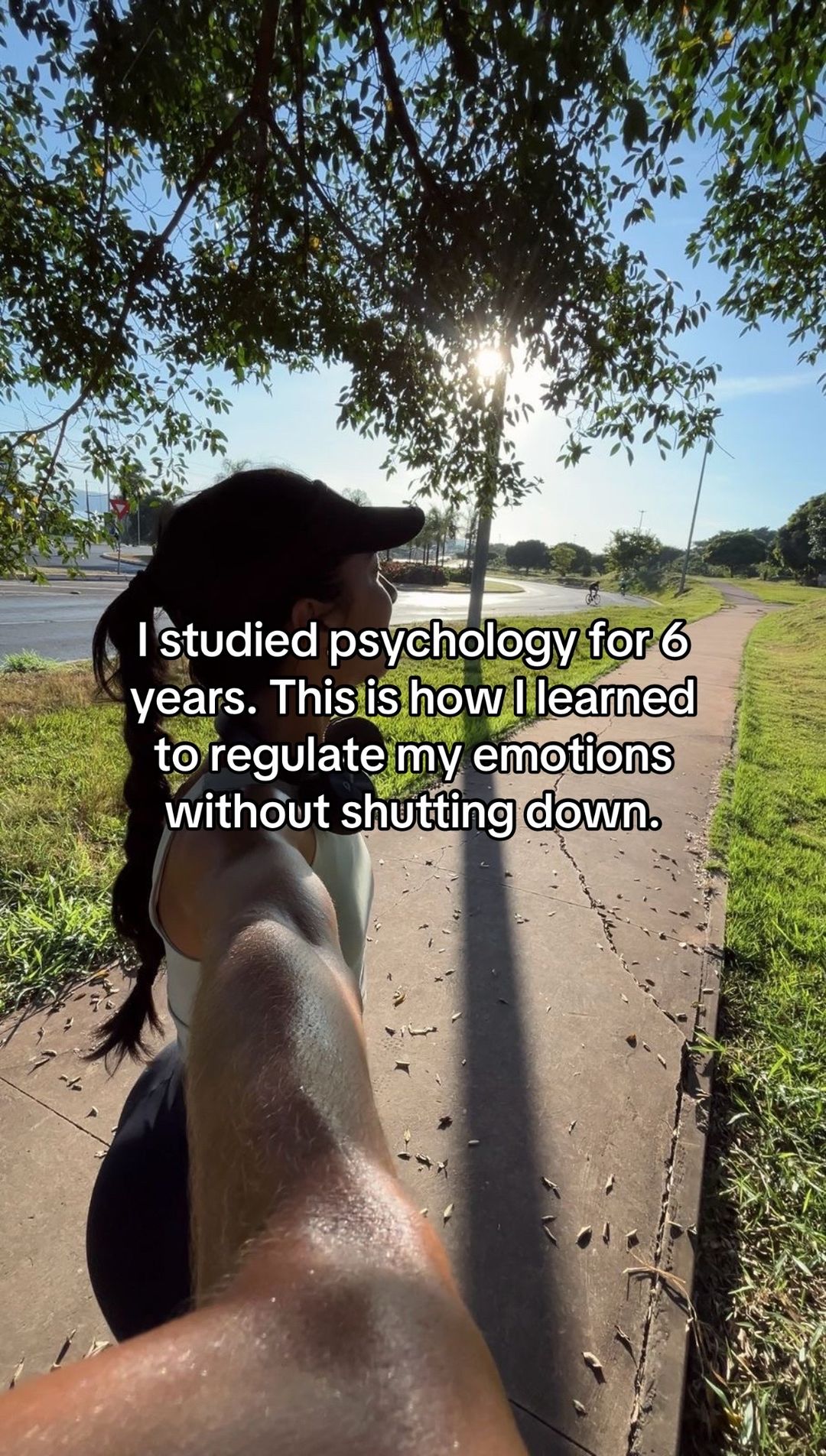
Combines authority (6 years of study) with a deeply relatable pain point (shutting down), creating an immediate desire to learn the solution.
Slide Text
I studied psychology for 6 years. This is how I learned to regulate my emotions without shutting down.
Visual
A woman walking on a path in the sun, shot from a first-person perspective.
All Slides
@ava.isventing carousel breakdown
Ava
For my younger self #emotions #overthinking #anxiety #advice #SelfCare
Effectiveness score
9/10
Views
223.1K
Likes
36.6K
Saves
18.8K
Engagement
25.7%
Hook
I studied psychology for 6 years. This is how I learned to regulate my emotions without shutting down.
Goal
build-community
Offer
product
CTA
I use the Vent Now app to do this
Caption
For my younger self #emotions #overthinking #anxiety #advice #SelfCare
Strategic Summary
The carousel goes viral by anchoring authority upfront ("I studied psychology for 6 years") to validate the viewer's struggle, followed by a moody, highly aesthetic numbered list that frames emotional regulation as a gentle, actionable practice. The massive bookmark rate (14x norm) signals that users treat this as a persistent reference tool for their mental health, not just consumable content.
The Winning Formula
Credible authority hook + moody 'aesthetic' visuals + empathetic numbered advice + soft app integration.
What's working
- •Slide 1 establishes undeniable authority ('studied psychology for 6 years') immediately, bypassing skepticism for the tips that follow.
- •Slides 2-5 use short, imperative sentences ('Label it', 'Stop judging') that are highly legible and actionable, reducing cognitive load for stressed users.
- •The aesthetic shift from bright outdoor visuals in Slide 1 to moody, low-light interiors creates a psychological transition from 'public' to 'safe/inner space'
- •Slide 3 validates physical reactions ('Cry. Shake.') which directly addresses the shame loop commenters mention.
- •Slide 6 integrates a product recommendation ('Vent Now app') as a tool for the habit, not just a sale pitch.
What's not working
- •The comment volume is low relative to virality, suggesting many bookmark-and-leave rather than engaging in discussion.
- •Slide 5's phrasing 'Say what you need' is slightly less concrete than others, relying on the user to know what to say.
Viral lesson
High-value listicles save when the creator bridges the gap between expert advice and 'gentle' self-compassion; users save what they plan to use as a daily anchor.
Can a small creator replicate this? Creators in niche advice spaces (finance, health) can replicate this by front-loading a specific credential or experience metric and pairing actionable advice with a consistent, mood-setting visual theme.
Structural Formula (steal-the-format)
Structure pattern
Credential-backed list: Slide 1 establishes authority and pain point; slides 2-5 provide numbered actionable reframes; slide 6 introduces the habit loop and product.
Copy formula
First-person credential statement -> Second-person imperative list -> Contrastive examples ('Instead of X, say Y')
What to swap (concrete remixes)
- •Swap the psychology credential for a fitness credential (e.g. 'I'm a physical therapist of 6 years') and the list becomes 'How to build strength without joint pain'.
- •Swap the emotional regulation topic for financial regulation: 'I'm a CFP of 5 years; this is how I stop impulse spending without guilt.'
What NOT to copy
The success relies on the 'gentle' tone. If you adopt this structure but use an aggressive 'HUSTLE' or 'GET OVER IT' tone, the formula will fail because the audience is seeking permission, not punishment.
Aesthetics
Moody 'dark luxury' aesthetic with high-contrast shadows, ambient candlelight, and sans-serif overlays creates a feeling of quiet isolation.
Color palette
What it conveys: The overall aesthetic feels like a deep breath or a late-night journaling session; it signals safety and privacy before the user even reads the text.
Slide-by-slide forensics
1hookselfieActive, Authentic, Confidentworks:yesgrab:95/100aesthetic:80/100I studied psychology for 6 years. This is how I learned to regulate my emotions without shutting down.
I studied psychology for 6 years. This is how I learned to regulate my emotions without shutting down.
Visual description
Low-angle selfie video of a woman walking outdoors on a paved path. Sunlight filters through tree leaves creating dappled lighting. The mood is active and bright.
Scene setting
sunny outdoor path with trees
Visible people
vs prior slide
Style: High contrast vs prior -- bright natural light vs dark studio aesthetic
Story: Establishes the authority credential that justifies the list of advice to follow.
Predicted audience reaction
User stops scrolling because of the bold credential claim and the promise of a solution to emotional shutdown.
Verdict: The combination of visual action and the '6 years' credential creates immediate trust and curiosity.
2step in listlifestyle shotCalm, Introspectiveworks:yesgrab:80/100aesthetic:85/1001) Label what you're feeling, don't just feel it
Instead of "I'm freaking out," try "I'm overwhelmed and afraid of being judged." Naming it softens it. It gives the emotion shape.
1) Label what you're feeling, don't just feel it Instead of "I'm freaking out," try "I'm overwhelmed and afraid of being judged." Naming it softens it. It gives the emotion shape.
Visual description
Dark, moody interior shot. A round table with a small lamp is visible in the foreground. The background is mostly obscured shadows.
Scene setting
dimly lit modern interior
Visible objects
vs prior slide
Style: Shift from bright outdoor selfie to dark, cinematic text card
Story: First actionable step: shifting from passive feeling to active naming.
Predicted audience reaction
Users relate to the 'freaking out' feeling and see the example reframe as helpful.
Comments reacting to this slide
- ""This might sound nerdy but i like to link it to... the more we suppress our emotions the more likely we are to make it external." (Resonates with labeling concept)"
Verdict: The specific 'Instead of X, try Y' formula makes abstract psychology practical.
3step in listclose upGentle, Release focusedworks:yesgrab:80/100aesthetic:90/1002) Let the emotion move through your body
Emotion = energy in motion. Cry. Shake. Walk. Breathe deep. Suppressing it traps it. Feeling it releases it.
2) Let the emotion move through your body Emotion = energy in motion. Cry. Shake. Walk. Breathe deep. Suppressing it traps it. Feeling it releases it.
Visual description
Dark photo of a person holding a bouquet of white tulips wrapped in brown paper. Only the hands and lower body are visible against a dark background with metallic railings.
Scene setting
elevator or transit area with metal railings
Visible people
Visible objects
vs prior slide
Style: Dark aesthetic continues; focus on aesthetic props (flowers) rather than faces.
Story: Step 2 focuses on physicality and movement, progressing from the mental work of Slide 2.
Predicted audience reaction
Validation for those who suppress crying; 'release' language provides relief.
Comments reacting to this slide
- ""exercise and movement are so helpful in burning off negative energy""
Verdict: The equation 'Emotion = energy in motion' is a sticky mental model that users save.
4step in listlifestyle shotProtective, Reassuringworks:yesgrab:80/100aesthetic:85/1003) Stop judging your reaction
You're not "too sensitive." You're just responding to something real inside you. Shame makes it louder—curiosity makes it gentler.
3) Stop judging your reaction You're not "too sensitive." You're just responding to something real inside you. Shame makes it louder—curiosity makes it gentler.
Visual description
High-contrast photo of a shadow cast on a concrete surface or step. The lighting suggests street lights at night.
Scene setting
outdoor concrete steps at night
Visible people
vs prior slide
Style: Dark, high-contrast visual theme maintained.
Story: Step 3 addresses the internal barrier (shame) that blocks the previous steps.
Predicted audience reaction
Comments about feeling 'self-centered' validate this slide heavily; the anti-judgment stance is a major hook.
Comments reacting to this slide
- ""my biggest block is that i constantly feel like im extremely self centered when i try to validate myself""
Verdict: Directly targets the shame loop; the phrase 'Curiosity makes it gentler' is highly quotable.
5step in listclose upWarm, Assertiveworks:partialgrab:75/100aesthetic:80/1004) Say what you need, not what's wrong with you
Instead of "I'm being dramatic," say "I need reassurance right now." It rewires how you relate to yourself and others.
4) Say what you need, not what's wrong with you Instead of "I'm being dramatic," say "I need reassurance right now." It rewires how you relate to yourself and others.
Visual description
Extreme close-up of a textured, warm-toned surface (possibly a candle holder or table) under warm yellow lighting. Shadows are soft.
Scene setting
close-up on warm surface
Visible objects
vs prior slide
Style: Shift to warm amber lighting from the cooler greys/blacks of previous slides.
Story: Step 4 moves from internal regulation to external communication and need identification.
Predicted audience reaction
Users learn to reframe 'drama' as 'needs'; highly relevant for relationships.
Verdict: The advice is good but less visceral than the 'Body' and 'Shame' slides; text density is slightly high.
6ctalifestyle shotRoutine, Calmworks:yesgrab:85/100aesthetic:90/1005) Check in with your emotions daily
Before you shut down or react, take a moment to ask: what am I actually feeling right now?
I use the Vent Now app to do this, it's like a quiet space to process before I spiral.
5) Check in with your emotions daily Before you shut down or react, take a moment to ask: what am I actually feeling right now? I use the Vent Now app to do this, it's like a quiet space to process before I spiral.
Visual description
Dark interior with a large potted plant in the background. In the foreground, a lit candle sits on a marble table. The mood is serene and upscale.
Scene setting
dark lounge with plant and candle
Visible objects
vs prior slide
Style: Consistent dark luxury aesthetic; establishes the 'quiet space' mentioned in text.
Story: The final step is the maintenance loop, naturally leading to the product placement as the tool for this loop.
Predicted audience reaction
High save rate driven by the promise of a daily habit; the app mention feels like a natural utility.
Comments reacting to this slide
- ""Need this thank you!" (Refers to the overall checklist, often saved here)"
Verdict: Perfectly positions the product as the enabler of the habit just established in the list.
Commerce intent
Mentioned products
Buy-intent phrases (from comments)
- •I use the Vent Now app to do this
Comment ethnography
The audience shares a sense of vulnerability and exhaustion from hyper-regulation; comments often thank the creator for 'permission' to feel.
Comments that characterize the audience
- ""I get told when I cry when I'm overwhelmed... I need to learn how to control my emotions" (High shame/internalized suppression)"
- ""I constantly feel like I'm extremely self-centered when I try to validate myself" (High self-judgment)"
- ""I have this internal struggle... Most of the time I feel numb" (Dissociation/Burnout)"
Pain points revealed
- •Fear that crying is 'wrong' or needs controlling (Suppression)
- •Feeling numb or disconnected from emotions
- •Self-judgment and shame when emotional (Feeling 'too sensitive')
Aspirations revealed
- •To feel safe regulating emotions
- •To have a 'quiet space' to process before spiraling
Top questions asked
- •What about if you have adhd and autism?
- •What is the Vent Now app?
- •How do I stop feeling self-centered when I validate myself?
Objections
- •Is it possible to validate oneself without being self-centered?
- •Does this work for neurodivergent brains (ADHD/Autism)?
Diagnostics
Hook deep-dive
I studied psychology for 6 years. This is how I learned to regulate my emotions without shutting down.
The user swipes because they want the 'method' from someone with expert credentials who has personally solved the problem.
Engagement read
The bookmark rate is 14x the norm while comment rate is 0.3x, indicating users value this as a saved mental resource rather than a topic for public debate.
Mechanics
Numbered list structure creates a completionist drive; the user swipes to get the full set of tools.
Brand & funnel
Brands visible
Buying-journey moment: The viewer is in the problem-aware stage, looking for actionable steps to manage emotions; the brand is positioned as the tool to execute step 5 of that process.
Ideal Customer Profile
Young adults struggling with emotional regulation, anxiety, and the pressure to perform.
Age
18-24
Gender
female
Readability
simple
Interests
Pain Points
Aspirations
Emotional Profile
Primary Emotion
reassuranceIntensity
Effectiveness
Emotions Evoked
Emotional Arc
Starts with a tension-inducing problem (shutting down), moves through a series of calming, instructional steps, and ends with a sense of resolution and support.
Why It Lands
It validates the user's negative experiences as normal, which immediately lowers their defenses and builds trust.
Writing Analysis
Style
listicle
Tone
vulnerable
Hook Type
authority then teach
Quality
The writing is concise, empathetic, and avoids clinical jargon, making complex psychological concepts accessible to a lay audience.
Effectiveness
Goal Achievement
The high bookmark and share count proves the content successfully positioned the creator as a trusted guide and effectively introduced the app.
Why It Spread
highly relatable pain points
aesthetic 'dark academia' visual style
actionable, non-intrusive advice
high bookmark-to-view ratio
Content DNA
It is a soft-sell CTA integrated into the final tip, which feels helpful rather than salesy, increasing the likelihood of adoption.
Narrative Arc
The carousel moves from a high-authority hook to actionable, empathetic advice, ending with a natural, low-pressure recommendation.
Psychological Blueprint
Why It Spread
The content perfectly balances authority with deep vulnerability, making the viewer feel seen and understood. By framing common struggles as 'energy in motion' rather than personal failures, it provides immediate relief and actionable, low-friction advice. The high bookmark count indicates that the content is perceived as a valuable, repeatable resource for emotional regulation.
Framework
authority then teachPrimary Tactic
authorityTactics Used
authority (Slide 1)
validation (Slide 4)
curiosity-loop (Slide 1)
reciprocity (Slides 2-5)
social-proof (Slide 6)
Cognitive Biases
authority bias (6 years of study)
framing effect (re-labeling emotions)
confirmation bias (validating the user's feelings)
Tribal Markers
Trust Signals
Slide Breakdown (6 analyzed)
Hook Analysis
Combines authority (6 years of study) with a deeply relatable pain point (shutting down), creating an immediate desire to learn the solution.
Text
I studied psychology for 6 years. This is how I learned to regulate my emotions without shutting down.
Visual
A woman walking on a path in the sun, shot from a first-person perspective.
Visual Elements
Color Palette
Copy Analysis
Power Words
Open Loop: yes - promises a solution to a common emotional struggle
Visual Psychology
Attention: the text overlay
Gaze: forward motion
Emotional cue: warm sunlight
Composition: inviting the viewer into the creator's journey
Text
1) Label what you're feeling, don't just feel it. Instead of 'I'm freaking out,' try 'I'm overwhelmed and afraid of being judged.' Naming it softens it. It gives the emotion shape.
Visual
A dark, moody room with a small table and a single lamp.
Visual Elements
Color Palette
Copy Analysis
Power Words
Open Loop: no
Visual Psychology
Attention: the glowing lamp
Emotional cue: dim lighting
Composition: creating a sense of intimacy and introspection
Text
2) Let the emotion move through your body. Emotion = energy in motion. Cry. Shake. Walk. Breathe deep. Suppressing it traps it. Feeling it releases it.
Visual
A person holding a bouquet of flowers in a dark setting.
Visual Elements
Color Palette
Copy Analysis
Power Words
Open Loop: no
Visual Psychology
Attention: the flowers
Emotional cue: soft flowers
Composition: symbolizing beauty in emotional release
Text
3) Stop judging your reaction. You're not 'too sensitive.' You're just responding to something real inside you. Shame makes it louder—curiosity makes it gentler.
Visual
A close-up of a hand on a dark staircase.
Visual Elements
Color Palette
Copy Analysis
Power Words
Open Loop: no
Visual Psychology
Attention: the hand
Emotional cue: shadows
Composition: evoking a sense of vulnerability
Text
4) Say what you need, not what's wrong with you. Instead of 'I'm being dramatic,' say 'I need reassurance right now.' It rewires how you relate to yourself and others.
Visual
A dark, warm-toned surface with glasses.
Visual Elements
Color Palette
Copy Analysis
Power Words
Open Loop: no
Visual Psychology
Attention: the amber light
Emotional cue: warm glow
Composition: providing a sense of comfort
Text
5) Check in with your emotions daily. Before you shut down or react, take a moment to ask: what am I actually feeling right now? I use the Vent Now app to do this, it's like a quiet space to process before I spiral.
Visual
A candle on a marble table in a dark, plant-filled room.
Visual Elements
Color Palette
Copy Analysis
Power Words
Open Loop: no
Visual Psychology
Attention: the candle flame
Emotional cue: candlelight
Composition: creating a final sense of calm and clarity
Comment Intelligence
Sentiment
PositiveResonance
Intent
build-community
Audience Vibe
The lack of public comments is likely due to the highly personal nature of the content, which drives private engagement (saves/shares) rather than public discussion.
Standout Quotes
“This is exactly what I needed to hear.”
“Saving this for when I spiral.”
“The 'energy in motion' perspective changed everything.”
Top Comments
This might sound nerdy but i like to link it to newtons third law of motion that every action has an equal and opposite reaction so the more we suppress our emotions the more likely we are to make it external and take it out on others
just did this and it helped a lot. thank you 💙
my biggest block is that i constantly feel like im extremely self centered when i try to validate myself when someone hurts me and i just try to fix what i did wrong instead of coping with how i was wronged
Need this thank you!
yap helps u analyze these btw!