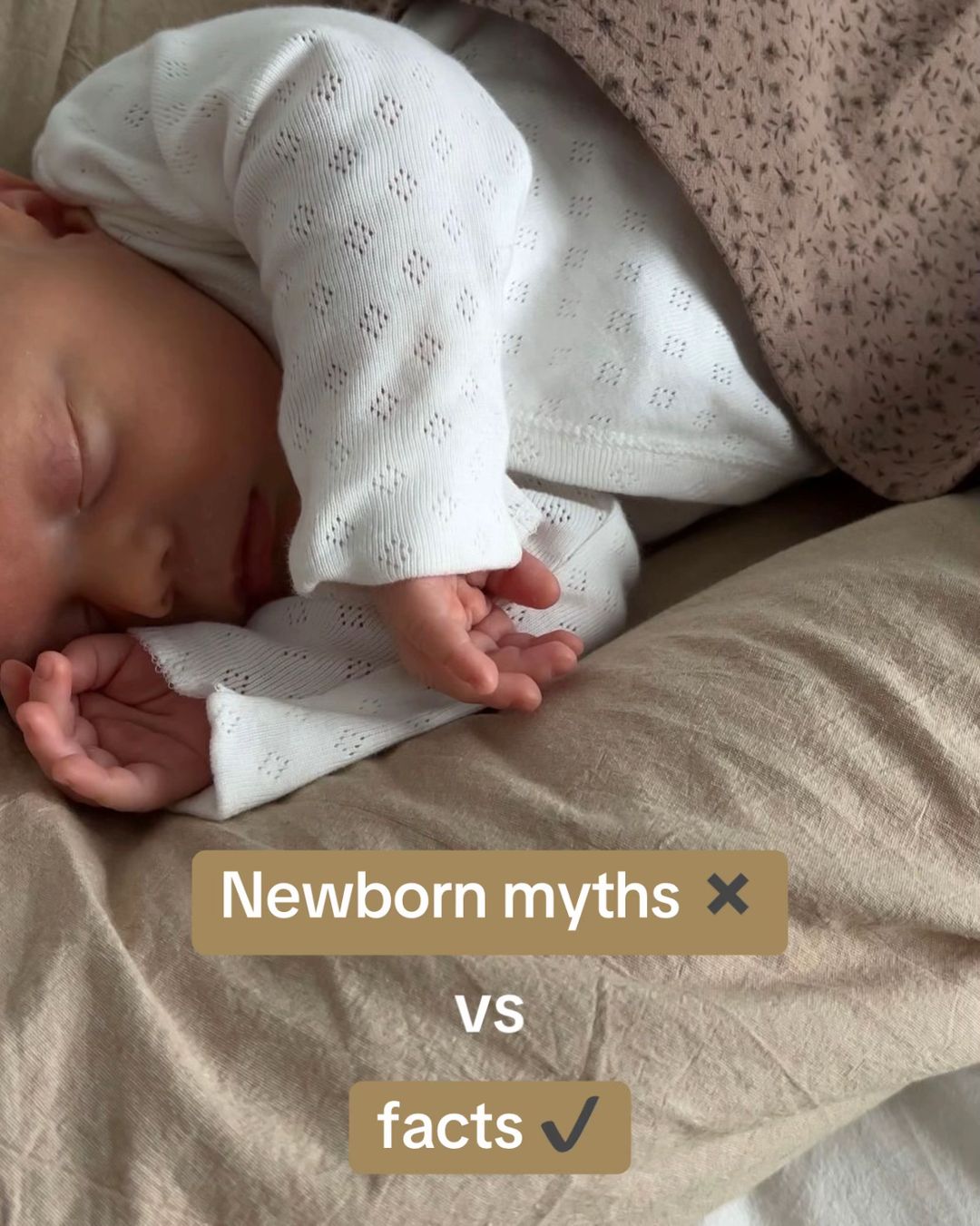
The contrast between 'Myth' and 'Fact' is a classic, high-performing hook because it challenges the reader's existing knowledge and promises an easy correction.
Slide Text
Newborn myths vs facts
Visual
Close-up of a sleeping newborn in white clothing under a soft brown blanket.
All Slides
@heymamatay carousel breakdown
Taylor
Myths about newborns and some actual facts #baby #newborn #MomsofTikTok #myth #mom
Effectiveness score
9/10
Views
1.6M
Likes
77.2K
Saves
31.2K
Engagement
8.0%
Hook
Newborn myths vs facts
Goal
build-community
Offer
information
CTA
Save for later
Caption
Myths about newborns and some actual facts #baby #newborn #MomsofTikTok #myth #mom
Strategic Summary
This carousel went viral because it addresses the specific anxiety gaps of new parents by pairing debunked myths with reassurance-backed facts. The high bookmark rate (3.2x norm) reveals this is treated as a reference guide that moms save for late-night reassurance. The share rate (2.4x norm) indicates the content is being sent from experienced parents to new parents, or between parent friends.
The Winning Formula
Anxiety-triggering myth + comforting fact + aesthetic validation = save/share loop for exhausted new parents
What's working
- •Slide 1's 'Newborn myths ✗ vs facts ✓' creates instant curiosity gap — parents immediately want to know which myths they've been believing
- •Each slide is self-contained and scannable — the MYTH/FACT format is visually identical on every slide, making it easy to digest at 3am
- •Slide 4's subtle product placement (Little Teddy Baby Sleep Music playlist on phone screen) feels native rather than ad-like — it proves the fact with a solution
- •Topics are strategically chosen from high-anxiety pain points: sleep, spoiling, bathing frequency, bodily functions — all things new parents obsess over
- •The warm, cream/beige aesthetic signals safety and calm — emotionally congruent with the reassuring content
- •Slide 8's 'Save for later' CTA is the perfect frictionless ask for a reference-worthy post like this
What's not working
- •Slide 7's typo ('dry out their ski' instead of 'skin') on slide 5 breaks credibility slightly — a quick proofread would fix this
Viral lesson
Evergreen content that solves specific anxiety moments will be saved and shared at a much higher rate than entertainment content — the bookmark is a vote that says 'I'll need this again.'
Can a small creator replicate this? Any creator in a knowledge niche can replicate this by identifying the top 3-5 anxiety-inducing myths in their niche and pairing them with reassurance-backed facts in a consistent visual template.
Structural Formula (steal-the-format)
Structure pattern
8-slide carousel: hook slide sets up contrast (myths vs facts), 6 slides follow identical MYTH/FACT template with close-up baby photos, final slide is a save prompt
Copy formula
MYTH [false belief] / FACT [reassuring truth] — bold claim first, then permission-giving explanation
What to swap (concrete remixes)
- •Swap newborn myths for toddler myths (tantrums, picky eating, screen time) for parents of 1-3 year olds
- •Swap baby care for pet care myths (puppy training, litter myths, feeding) for new pet owners
- •Swap newborn care for first-time homebuyer myths (down payment, credit scores, timing) for millennials entering the housing market
- •Swap baby myths for fitness myths (carbs make you fat, no rest days, spot reduction) for beginner gym-goers
What NOT to copy
Do not copy the aesthetic unless you have access to similar-quality baby photography — the warm, soft, professional-looking baby photos are what make this trustworthy. Generic stock photos will undermine the intimate, 'real mom energy' that resonates with the audience.
Aesthetics
Warm, cream-toned photography of sleeping babies with soft natural light and chunky knit textures, topped with beige text-box overlays in a clean sans-serif font
Color palette
What it conveys: The overall aesthetic feels like a carefully curated Pinterest board for new moms — warm, soft, safe, and calming. It visually communicates 'everything is okay' before you even read a word of the text.
Slide-by-slide forensics
1hookclose uppeaceful curiosityworks:yesgrab:85/100aesthetic:90/100Newborn myths ✗
vs
facts ✓
Newborn myths ✗ vs facts ✓
Visual description
A sleeping newborn baby in a white ribbed knit outfit, curled on their side with tiny hands near their face. The baby is partially covered by a beige speckled blanket. Shot on a soft linen or cotton sheet background in warm natural light.
Scene setting
soft bedding in natural light
Visible people
Visible objects
vs prior slide
Style: No prior slide (slide 1)
Story: No prior slide (slide 1)
Predicted audience reaction
New parents stop scrolling immediately because they want to know which 'things everyone tells you' are actually myths.
Verdict: The ✗/✓ visual shorthand is universally understood and creates immediate intrigue.
2step in listclose upreassuranceworks:yesgrab:80/100aesthetic:88/100MYTH ✗
Holding your baby too much will spoil them
FACT ✓
You can't spoil a newborn - they need comfort and connection
MYTH ✗ Holding your baby too much will spoil them FACT ✓ You can't spoil a newborn - they need comfort and connection
Visual description
A baby being held close against someone wearing a cream-colored chunky knit cardigan with a wooden button. The baby's hand rests on the cardigan. Soft, cozy aesthetic.
Scene setting
held against someone in knitwear
Visible people
Visible objects
vs prior slide
Style: Same beige text box styling, same MYTH/FACT format, cream/beige color palette consistent with slide 1
Story: First myth introduced — addresses the 'spoiling' anxiety many new parents feel when holding their baby constantly
Predicted audience reaction
Immediate relief for parents who feel guilty about holding their baby 'too much.'
Verdict: Addresses one of the most universal guilt-trips new parents face.
3step in listclose upreliefworks:yesgrab:82/100aesthetic:85/100MYTH ✗
Newborns should sleep through the night
FACT ✓
Waking every 2-3 hours is completely normal (and healthy)
MYTH ✗ Newborns should sleep through the night FACT ✓ Waking every 2-3 hours is completely normal (and healthy)
Visual description
A newborn's head (side view) with tiny fingers and toes visible against a white-and-cream striped muslin fabric background. An adult's hand is holding the baby's tiny hand.
Scene setting
white sheet with muslin blanket
Visible people
Visible objects
vs prior slide
Style: Identical MYTH/FACT text overlay format and beige box styling
Story: Moves to sleep myth — one of the most stressed-about topics for new parents
Predicted audience reaction
Exhausted parents feel validated that their sleep deprivation is normal, not a sign they're failing.
Verdict: Sleep is the #1 pain point for 0-3 month old parents.
4step in listflat laypractical comfortworks:yesgrab:78/100aesthetic:82/100MYTH ✗
Babies need total silence to sleep
FACT ✓
Newborns are used to constant noise in the womb (it was never silent in there)
MYTH ✗ Babies need total silence to sleep FACT ✓ Newborns are used to constant noise in the womb (it was never silent in there)
Visual description
A phone showing a Spotify playlist called 'Baby Sleep Music' by Little Teddy, lying on a beige fuzzy/velvet-textured blanket. The phone is at an angle, showing the playlist art (a sleeping baby).
Scene setting
phone on textured beige blanket
Visible objects
Products on screen
Other text elements
- •Phone screen: '14:33', '5G 59%', 'Baby Sleep Music', 'Little Teddy', '87,994 saves • 10h 1m', 'Brahms Lullaby', 'Twinkle Twinkle Little Star', 'This Is The Way'
vs prior slide
Style: Same MYTH/FACT text overlay format but no baby visible — just a phone on a blanket, which breaks the baby photo pattern
Story: Another sleep-related myth — continues the reassurance theme but introduces a subtle product placement (Little Teddy playlist)
Predicted audience reaction
Parents realize they don't need a silent house and some may explore the playlist shown.
Verdict: The fact is genuinely useful and the product placement feels native rather than salesy.
5step in listmedium shotpermission to relaxworks:partialgrab:80/100aesthetic:86/100MYTH
Babies need daily baths
FACT ✓
2-3 times a week is plenty - too much can dry out their ski
MYTH Babies need daily baths FACT ✓ 2-3 times a week is plenty - too much can dry out their ski
Visual description
An adult (partial face/lips visible, wearing pearl necklace) holding a baby in a beige knit outfit. The baby is nestled against the adult's chest. A small round table with a magazine and a candle is visible in the background.
Scene setting
indoors, living room setting with side table
Visible people
Visible objects
Other text elements
- •Magazine/book in background with Cyrillic text: 'ДЕР ИНТЕРЬЕРОВ', '64 ПРОСТА ДЛЯ ВДОХНОВЕНИЯ'
vs prior slide
Style: Back to holding-baby visual with MYTH/FACT overlay, warm neutrals consistent
Story: Bathing frequency myth — relieves pressure from parents who stress over 'doing everything right'
Predicted audience reaction
Parents who've been bathing their baby daily will feel relieved they can skip a few.
Verdict: Typo at the end ('dry out their ski' instead of 'skin') undermines credibility slightly.
6step in listclose uprelief from anxietyworks:yesgrab:78/100aesthetic:87/100MYTH ✗
Sneezing = a cold
FACT ✓
Newborns sneeze to clear their tiny noses - it's usually not sickness
MYTH ✗ Sneezing = a cold FACT ✓ Newborns sneeze to clear their tiny noses - it's usually not sickness
Visual description
A baby in a white cable-knit outfit lying on their side on a white sheet. An adult hand with dark nail polish and a gold watch touches the baby's back. Baby's tiny feet are visible.
Scene setting
white bed sheet
Visible people
Visible objects
vs prior slide
Style: Same MYTH/FACT overlay, white-on-white aesthetic consistent with baby photos theme
Story: Health myth — addresses the panic parents feel when their baby sneezes and they think it's the start of a cold
Predicted audience reaction
Parents who've panicked over every sneeze will feel their anxiety validated.
Verdict: Highly relatable moment for first-time parents who Google every symptom.
7step in listclose upreassuranceworks:yesgrab:76/100aesthetic:85/100MYTH ✗
Babies should poop every day
FACT ✓
Newborns may poop several times a day or skip a day - both can be normal if they're feeding well and diapers are wet
MYTH ✗ Babies should poop every day FACT ✓ Newborns may poop several times a day or skip a day - both can be normal if they're feeding well and diapers are wet
Visual description
A baby lying on their side on a cream linen cushion next to a chunky beige knit blanket. The baby is wearing a white ribbed outfit. Only the baby's head, ear, and upper back are visible.
Scene setting
couch with linen cushions
Visible people
Visible objects
vs prior slide
Style: Consistent MYTH/FACT overlay and cream/beige palette
Story: Final myth about pooping frequency — rounds out the list with another bodily-function anxiety that parents stress over
Predicted audience reaction
Parents who track diaper changes obsessively get permission to stop worrying.
Verdict: Bodily function myths are highly searchable evergreen content — this will circulate for years.
8save promptclose upgentle closureworks:yesgrab:70/100aesthetic:92/100Save for later 🫶
Save for later 🫶
Visual description
Extreme close-up of a baby's face (mouth, chin) and torso in a white ribbed/cable-knit outfit. Baby's tiny fingers are visible. Soft natural sunlight creates a warm glow.
Scene setting
natural sunlight, close-up baby portrait
Visible people
Visible objects
vs prior slide
Style: Same beige text box styling, same white/baby photo aesthetic, but no MYTH/FACT text — breaks the pattern to signal the end
Story: No new content — simply prompts the save action, breaking the MYTH/FACT pattern to signal the carousel is ending
Predicted audience reaction
Parents who found this useful will save it to reference later, especially during sleepless nights.
Verdict: The 'Save for later' CTA is perfectly matched to the reference-value nature of this content.
Commerce intent
Mentioned products
Comment ethnography
This is a support-seeking community — new or expecting parents looking for permission to not be perfect, reassurance that what they're experiencing is normal, and validation that they're doing a good job.
Diagnostics
Hook deep-dive
Newborn myths ✗ vs facts ✓
Parents want to know which commonly-held beliefs about newborns are actually wrong — the /✓ format promises clear, binary answers to their anxieties.
Engagement read
Bookmark rate (1.94%) is 3.2x higher than the platform norm — this post is being treated as a reference guide rather than passive content
Mechanics
The consistent MYTH/FACT template creates completion bias — each slide promises the same satisfying reveal pattern, so viewers keep swiping to get the next reassurance hit.
Brand & funnel
Brands visible
Buying-journey moment: New parents in the anxiety/validation-seeking phase of early parenthood, looking for reassurance that what they're experiencing is normal
Ideal Customer Profile
New or expectant mothers who are overwhelmed by conflicting advice and seeking reassurance, validation, and evidence-based simplicity.
Age
25-34
Gender
female
Readability
simple
Interests
Pain Points
Aspirations
Emotional Profile
Primary Emotion
validationIntensity
Effectiveness
Emotions Evoked
Emotional Arc
anxiety (myth) → relief (fact) → confidence (final takeaway)
Why It Lands
It effectively lowers the cortisol levels of new parents by debunking myths that typically cause guilt or unnecessary stress.
Writing Analysis
Style
educational
Tone
relatable
Hook Type
contrast
Quality
The writing is exceptionally concise, stripping away medical jargon to focus on the emotional core of the parent-child relationship.
Effectiveness
Goal Achievement
The massive bookmark-to-view ratio proves this content is viewed as a 'reference guide' for the target audience, which is the gold standard for community building.
Why It Spread
high saveability due to the 'reference guide' format
universal pain points for all new parents
aesthetic consistency that fits the 'MomTok' feed perfectly
Content DNA
It is a direct, low-friction instruction that aligns perfectly with the content's value as a reference guide.
Narrative Arc
The carousel maintains a steady rhythm of 'tension' (the myth) followed by 'release' (the fact), keeping the user engaged until the final slide.
Psychological Blueprint
Why It Spread
This content went viral because it perfectly balances high-utility information with a soothing, aesthetic visual style that is highly shareable. By addressing common parental anxieties (spoiling, sleep, health) and providing immediate, reassuring answers, it became a 'saveable' resource for new moms. The 7.96% engagement rate is driven by the massive number of bookmarks (31k), as users save it to revisit during moments of doubt, which signals to the algorithm that the content is high-value.
Framework
contrast revealPrimary Tactic
validationTactics Used
contrast on every slide: 'Myth' vs 'Fact' creates immediate cognitive dissonance resolution
authority through simplification: distilling complex medical/developmental topics into single sentences
validation: using phrases like 'completely normal' to lower parental anxiety
curiosity-gap: the title implies that what the reader currently believes is wrong
Cognitive Biases
confirmation bias: readers seek validation for their existing parenting choices
authority bias: the clean, authoritative 'Fact' label makes the information feel like expert advice
Zeigarnik effect: the list format encourages users to swipe to the end to 'complete' the knowledge set
Tribal Markers
Trust Signals
Slide Breakdown (2 analyzed)
Hook Analysis
The contrast between 'Myth' and 'Fact' is a classic, high-performing hook because it challenges the reader's existing knowledge and promises an easy correction.
Text
Newborn myths vs facts
Visual
Close-up of a sleeping newborn in white clothing under a soft brown blanket.
Visual Elements
Color Palette
Copy Analysis
Power Words
Open Loop: yes, it promises to correct misconceptions about the reader's baby
Visual Psychology
Attention: the baby's face
Emotional cue: the peacefulness of the sleeping baby
Composition: to create an immediate sense of calm and intimacy
Text
MYTH: Holding your baby too much will spoil them. FACT: You can't spoil a newborn - they need comfort and connection.
Visual
A close-up of a baby being held in a cream-colored knit cardigan.
Visual Elements
Color Palette
Copy Analysis
Power Words
Open Loop: yes, the reader wants to know what else they might be wrong about
Visual Psychology
Attention: the text overlay
Emotional cue: the warmth of the knit texture
Composition: to provide immediate emotional relief to the parent
Comment Intelligence
Sentiment
PositiveResonance
Intent
build-community
Audience Vibe
The comments are filled with relief and gratitude from parents who feel validated by the information.
Standout Quotes
“I needed this today, thank you.”
“So glad to hear that the constant waking is normal.”
“Saving this for when I feel like I'm doing it all wrong.”