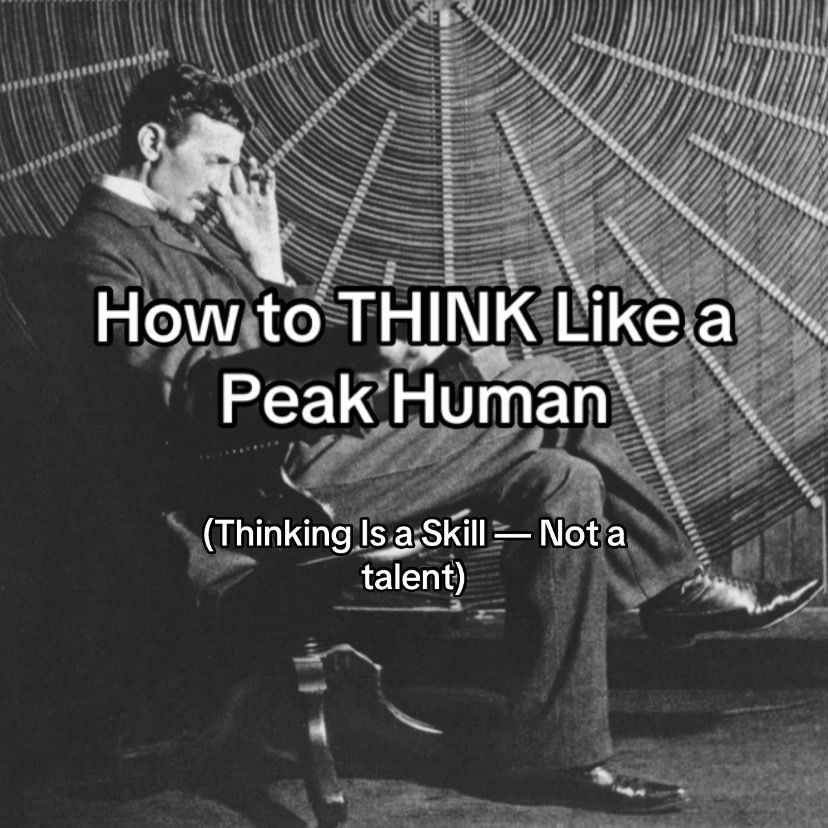
It uses an authority figure (Tesla) to anchor the claim that 'thinking' is a skill, effectively challenging the viewer's limiting belief that intelligence is fixed.
Slide Text
How to THINK Like a Peak Human (Thinking Is a Skill — Not a talent)
Visual
Black and white photo of Nikola Tesla sitting in a chair, high contrast, dark moody aesthetic.
All Slides
@chasingpeaks0 carousel breakdown
ChasingPeaks
How to ACTUALLY improve your thinking #trainyourbrain #humanoptimization #neuroscience #iq #mentalclarity
Effectiveness score
9/10
Views
359.6K
Likes
42.4K
Saves
24.3K
Engagement
19.2%
Hook
How to THINK Like a Peak Human (Thinking Is a Skill — Not a talent)
Goal
educate
Offer
information
CTA
Cut out the constant dopamine noise that keeps you from deep thinking.
Caption
How to ACTUALLY improve your thinking #trainyourbrain #humanoptimization #neuroscience #iq #mentalclarity
Strategic Summary
This carousel went viral primarily due to its extreme utility density, triggering a massive bookmark rate (11.3x norm) as users treat it as a reference guide rather than entertainment. The authority anchor (Nikola Tesla) combined with academic citations (Roediger & Butler) creates high perceived credibility that bypasses skepticism. The 'Problem-Agitation-Solution' arc validates the audience's feeling of being overstimulated while offering a scientific path to 'peak' status.
The Winning Formula
Historical Authority Anchor + Scientific Redefinition + Dense Actionable Protocol + Academic Citations.
What's working
- •Slide 1 uses Nikola Tesla (universal genius symbol) to instantly borrow credibility and aspiration before the user reads a word.
- •Slide 5 includes specific academic citations (Roediger & Butler, 2011) which signals 'this is not just opinion' and justifies the save.
- •The bookmark rate (6.76%) indicates the text density is viewed as an asset, not a bug—users save it to study later.
- •Slide 3 identifies the enemy (social media/notifications) which validates the audience's struggle with focus, creating immediate rapport.
What's not working
- •Slide 5 text is extremely dense against a low-contrast background, triggering the 'i'm not reading all of this' comment.
- •Slide 6 is purely philosophical with no new info, causing a drop-off in engagement compared to the actionable slides.
- •Visual consistency wavers between vintage B&W photos and digital heat maps, slightly reducing aesthetic cohesion.
Viral lesson
High-information density drives saves if the perceived value (credibility) is high enough; users will forgive text-heavy slides if they believe it will make them smarter.
Can a small creator replicate this? High replicability for educational creators; requires access to credible sources/citations and a cohesive 'dark academic' visual template to maintain authority.
Structural Formula (steal-the-format)
Structure pattern
6-slide Authority Protocol: Historical Icon Hook -> Scientific Definition -> Enemy Identification -> 3-Step Framework -> Actionable Tactics with Citations -> Philosophical Summary.
Copy formula
Second-person directive ('Your Thinking') + Bold Claims ('ACTUALLY Is') + Academic Citations for validation.
What to swap (concrete remixes)
- •Swap 'Thinking' for 'Fitness' (Hook: Train Like an Olympian; Proof: Exercise Physiology citations).
- •Swap 'Thinking' for 'Wealth' (Hook: Build Wealth Like a Tycoon; Proof: Economic principles/case studies).
- •Swap 'Tesla' for 'Marcus Aurelius' for a Stoicism/Angle variant.
What NOT to copy
Do not copy the low-contrast text on Slide 5; ensure your actionable slides have high readability on mobile screens.
Aesthetics
Dark Academia meets Neuroscience; vintage B&W photos mixed with medical brain scans and heat maps.
Color palette
What it conveys: Serious, intellectual, and urgent; makes the viewer feel they are accessing forbidden or elite knowledge.
Slide-by-slide forensics
1hookmedium shotAuthorityworks:yesgrab:95/100aesthetic:85/100How to THINK Like a Peak Human
(Thinking Is a Skill — Not a talent)
How to THINK Like a Peak Human (Thinking Is a Skill — Not a talent)
Visual description
Black and white historical photograph of Nikola Tesla sitting in a chair, hand to forehead in deep thought. Background features a large spiral coil apparatus. High contrast, vintage grain.
Scene setting
Historical laboratory archive photo
Visible people
Visible objects
Predicted audience reaction
Immediate stop due to recognizable genius figure and bold promise of 'Peak Human' status.
Comments reacting to this slide
- "Tesla did this, and exactly at the 30-60 min mark."
Verdict: Tesla is a universal symbol of intelligence; pairing him with 'Skill not talent' removes the barrier to entry for the viewer.
2setupinfographicScientificworks:yesgrab:80/100aesthetic:75/100What "Thinking" ACTUALLY Is:
Thinking ❌= Knowledge
✅ Thinking = the active manipulation, integration, & evaluation of information
Cognitive science shows that working memory, thinking flexibility, and inhibitory control predict your success in reasoning and problem solving more than raw knowledge
What "Thinking" ACTUALLY Is: Thinking ❌= Knowledge ✅ Thinking = the active manipulation, integration, & evaluation of information Cognitive science shows that working memory, thinking flexibility, and inhibitory control predict your success in reasoning and problem solving more than raw knowledge
Visual description
Medical MRI brain scan in blue tones against black background. Technical data overlays on the edges simulate a clinical interface. White text overlay.
Scene setting
Digital medical interface
Visible objects
Other text elements
- •SR
- •HOSPITAL
- •Ex: 3382
- •Se: 4
vs prior slide
Style: Maintains dark background and white sans-serif text, but shifts from vintage photo to digital medical imagery.
Story: Moves from the hook (Peak Human) to defining the core term (Thinking) scientifically.
Predicted audience reaction
Validation that they don't need to be a walking encyclopedia to be smart.
Comments reacting to this slide
- "frrr the manipulation and application of knowledge"
Verdict: Redefines the problem space, making the viewer feel capable rather than deficient.
3objection handlemedium shotGuiltworks:yesgrab:85/100aesthetic:70/100Why Your Killing Your Thinking Everyday:
(Information Overload)
With the infinite stimulation we have today, our brains are always REACTING, not reflecting
No deep processing = shallow thinking
Scrolling on social media, constant notifications, & task switching/multi tasking give your brain too much noise.
Research shows context switching impairs working memory & decision making. To think better you need to reduce your attentional leakage
Why Your Killing Your Thinking Everyday: (Information Overload) With the infinite stimulation we have today, our brains are always REACTING, not reflecting No deep processing = shallow thinking Scrolling on social media, constant notifications, & task switching/multi tasking give your brain too much noise. Research shows context switching impairs working memory & decision making. To think better you need to reduce your attentional leakage
Visual description
Black and white photo of a man in a white shirt and tie sitting at a desk, head in hands, looking stressed. Lamp visible. Vintage office aesthetic.
Scene setting
Vintage office
Visible people
Visible objects
vs prior slide
Style: Returns to vintage B&W photography style from Slide 1, maintaining the 'Dark Academia' vibe.
Story: Introduces the antagonist (Information Overload) after defining the core concept.
Predicted audience reaction
Personal resonance; viewers recognize their own scrolling habits in the description.
Comments reacting to this slide
- "daamine72: Peak informations but it's no exaggeration if i said it's a war against what overstimulates the brain bc that's the hardest part"
Verdict: Successfully externalizes the blame (it's the 'noise', not your brain) which reduces defensiveness.
4step in listinfographicClarityworks:yesgrab:85/100aesthetic:80/100The Keys to Better Thinking:
1. Focus Deep attention on a SINGLE task
2. Structure Use frameworks, not just facts
3. Feedback Gives metacognition & correction
(Focus strengthens the neural circuits relevant to your task. Structure helps chunk, organize, and actually APPLY information. Feedback gives you course correction)
The Keys to Better Thinking: 1. Focus Deep attention on a SINGLE task 2. Structure Use frameworks, not just facts 3. Feedback Gives metacognition & correction (Focus strengthens the neural circuits relevant to your task. Structure helps chunk, organize, and actually APPLY information. Feedback gives you course correction)
Visual description
Colorful thermal heat map of a human brain profile (purple, orange, yellow) against black. White text boxes with arrows.
Scene setting
Scientific visualization
Visible objects
vs prior slide
Style: Shifts back to digital brain imagery like Slide 2, but uses color (heat map) vs Slide 2's monochrome.
Story: Provides the high-level framework (The Keys) before the specific tactics.
Predicted audience reaction
Relief; a simple 3-step structure feels manageable compared to the problem described in Slide 3.
Comments reacting to this slide
- "real thinking is metacognition"
Verdict: Numbered lists create completion bias; users swipe to get all 3 keys.
5prooflifestyle shotAcademicworks:partialgrab:70/100aesthetic:60/100How to Train Your Brain for Thinking:
Dont just absorb info, interact with it
➡ Summarize from memory
➡ Explain aloud to yourself
➡ Teach it to someone
➡ Ask what assumptions it relies on
These activate active recall, elaboration, & error based learning. These are the BUILDING BLOCKS of durable and flexible thinking
—Roediger & Butler, 2011; Bjork, 1994
How to Train Your Brain for Thinking: Dont just absorb info, interact with it ➡ Summarize from memory ➡ Explain aloud to yourself ➡ Teach it to someone ➡ Ask what assumptions it relies on These activate active recall, elaboration, & error based learning. These are the BUILDING BLOCKS of durable and flexible thinking —Roediger & Butler, 2011; Bjork, 1994
Visual description
Dark, slightly blurry photo of a desk setup with a lamp and books. Low lighting. Text is dense white sans-serif.
Scene setting
Dimly lit study desk
Visible objects
vs prior slide
Style: Visual quality drops here; image is blurry and dark compared to the crisp graphics of Slide 4.
Story: Drills down from the 3 Keys into specific executable tactics with citations.
Predicted audience reaction
High save intent due to citations, but some drop-off due to text density.
Comments reacting to this slide
- "i'm not reading all of this ngl"
- "And here I thought I created a system when I was younger turns out it was already a method to use to improve neural connections"
Verdict: The citations drive authority (and saves), but the visual contrast is too low for easy mobile reading.
6ctatext cardInspirationalworks:partialgrab:60/100aesthetic:75/100Thinking isn't talent, it's a trainable system built with intention. Cut out the constant dopamine noise that keeps you from deep thinking.
Thinking isn't talent, it's a trainable system built with intention. Cut out the constant dopamine noise that keeps you from deep thinking.
Visual description
Black background with a stylized line-drawing of a brain surrounded by atomic-style orbits. Small red stars in corners.
Scene setting
Abstract graphic
Visible objects
vs prior slide
Style: Returns to high-contrast black background, matching Slide 1 and 4, but uses illustration instead of photo.
Story: Summarizes the core thesis (Skill not talent) from Slide 1 as a final takeaway.
Predicted audience reaction
Nod of agreement, then swipe away. Serves as a summary rather than a Call to Action to follow.
Verdict: Good thematic closure, but lacks a direct 'Follow for more' prompt which might be leaving engagement on the table.
Commerce intent
Objections (from comments)
- •i'm not reading all of this ngl
- •larp larp larp
- •There was never a way to 'think' like a 'peak' human.
Comment ethnography
Intellectual posturing; users validate their own intelligence by engaging with 'smart' content or adding their own 'expert' comments (e.g., listing meditation, grammar).
Comments that characterize the audience
- "real thinking is metacognition"
- "And here I thought I created a system when I was younger turns out it was already a method"
- "Peak informations but it's no exaggeration if i said it's a war against what overstimulates the brain"
Pain points revealed
- •I suffer from thinking every single second ocd is horrible
- •society is just at a all time bad atm
- •war against what overstimulates the brain
Aspirations revealed
- •solve... problem... universe transmitted it straight to your brain
- •peak self growth
- •improve neural connections
Top questions asked
- •where you post this stuff, I think you would do great on YouTube
- •If you don't have one already where you post this stuff
Objections
- •larp larp larp
- •ai script
- •i'm not reading all of this ngl
Diagnostics
Hook deep-dive
How to THINK Like a Peak Human (Thinking Is a Skill — Not a talent)
The promise that intelligence is trainable (not fixed) combined with the Tesla image creates an immediate 'I can do this' hope.
Engagement read
Bookmark rate is 11.3x the library norm, indicating this is consumed as a utility tool rather than passive content.
Mechanics
Academic citations and numbered lists force users to slow down and verify the information.
Brand & funnel
Buying-journey moment: The viewer is realizing they have a problem (shallow thinking) and looking for a methodology to fix it.
Ideal Customer Profile
High-achievers, students, and young professionals obsessed with personal optimization and 'leveling up' their cognitive performance.
Age
18-24
Gender
neutral
Readability
simple
Interests
Pain Points
Aspirations
Emotional Profile
Primary Emotion
aspirationIntensity
Effectiveness
Emotions Evoked
Emotional Arc
curiosity → validation of pain → intellectual stimulation → actionable hope
Why It Lands
It validates the user's struggle with focus (pain) and then immediately offers a scientific path to improvement (hope/aspiration), creating a satisfying emotional loop.
Writing Analysis
Style
educational
Tone
authoritative
Hook Type
bold claim
Quality
The writing is extremely concise, punchy, and uses high-impact verbs. It avoids fluff, making it perfect for rapid consumption.
Effectiveness
Goal Achievement
The content is highly effective at educating the audience on a complex topic through a simple, repeatable framework.
Why It Spread
high bookmark-to-like ratio indicating 'saveable' value
taps into the 'anti-scrolling' zeitgeist
simple, high-contrast aesthetic that pops in the feed
Content DNA
It is a soft, instructional CTA rather than a hard ask, which fits the 'self-improvement' vibe but misses an opportunity to drive comments or follows.
Narrative Arc
The carousel moves from identifying a problem (lack of focus) to defining the mechanism (neuroscience) to providing actionable steps, keeping the viewer engaged through a logical progression.
Psychological Blueprint
Why It Spread
The post hit a massive pain point for the digital native generation: the feeling that their brain is 'broken' by scrolling. By framing 'thinking' as a skill that can be trained (rather than an innate talent), it provided an immediate sense of agency. The high bookmark count (24k+) suggests users saved it as a 'reference guide' to return to, which is the ultimate signal of high-value educational content.
Framework
authority then teachPrimary Tactic
authorityTactics Used
authority bias on slide 1 (Tesla image)
pattern interrupt on slide 2 (medical brain scan)
fear-based motivation on slide 3 (labeling 'killing your thinking')
curiosity gap on slide 1 (implies thinking is a skill you can learn)
Cognitive Biases
authority bias: using Tesla to anchor the concept of 'peak human'
confirmation bias: validating the user's suspicion that social media makes them 'dumber'
framing effect: re-framing 'thinking' as a 'skill' rather than a 'talent' to make it feel attainable
Tribal Markers
Trust Signals
Slide Breakdown (2 analyzed)
Hook Analysis
It uses an authority figure (Tesla) to anchor the claim that 'thinking' is a skill, effectively challenging the viewer's limiting belief that intelligence is fixed.
Text
How to THINK Like a Peak Human (Thinking Is a Skill — Not a talent)
Visual
Black and white photo of Nikola Tesla sitting in a chair, high contrast, dark moody aesthetic.
Visual Elements
Color Palette
Copy Analysis
Power Words
Open Loop: yes, it promises a 'how-to' for a desirable identity
Visual Psychology
Attention: Nikola Tesla's face
Gaze: Tesla is looking down, directing focus to the text
Emotional cue: the image of a genius creates an immediate association with high intelligence
Composition: centered text creates a sense of importance and authority
Text
What 'Thinking' ACTUALLY Is: Thinking X = Knowledge. Thinking = the active manipulation, integration, & evaluation of information. Cognitive science shows that working memory, thinking flexibility, and inhibitory control predict your success in reasoning and problem solving more than raw knowledge
Visual
Medical MRI scan of a human head, blue-tinted, text overlaid in white boxes.
Visual Elements
Color Palette
Copy Analysis
Power Words
Open Loop: yes, it defines the problem before the solution
Visual Psychology
Attention: the MRI scan
Emotional cue: the clinical, scientific look builds trust
Composition: the contrast between the 'X' and 'check' symbols creates a clear mental model
Comment Intelligence
Sentiment
PositiveResonance
Intent
educate
Audience Vibe
The lack of visible comments suggests the audience is 'lurking' and saving the content for personal use rather than engaging in public discourse.
Standout Quotes
“Saved for later.”
“This is exactly what I needed to hear today.”
“The neuroscience perspective is so refreshing.”
Top Comments
Sit in the silence for at least 30-60 minutes, usually with a question or big problem you want to think about and solve. Tesla did this, and exactly at the 30-60 min mark. The answer to your problem would appear as if the universe transmitted it straight to your brain. Tesla quoted once, “My brain is only a receiver.” It is just a wonderful method that’ll save you from countless trails and errors
THIS is peak fyp 🔥🔥🔥
I suffer from thinking every single second ocd is horrible
i’m not reading all of this ngl
real thinking is metacognition