Slide Text
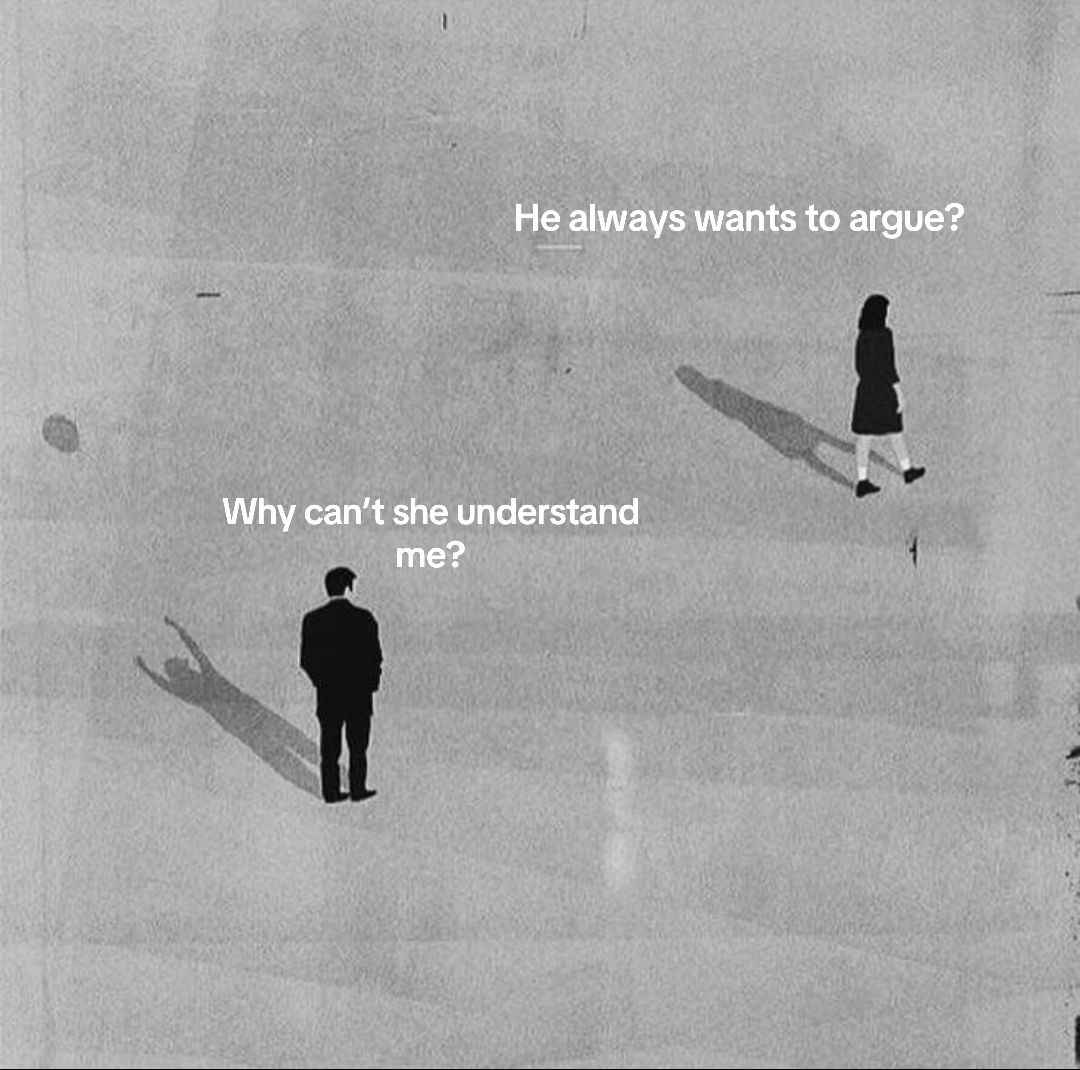
He always wants to argue? Why can't she understand me?
Visual
Minimalist grayscale illustration of a man and woman walking in opposite directions in a void.
All Slides
@feelings4mind carousel breakdown
TheQuietFeels
#Relationship #communication #feelings #relatable #girlfriend #boyfriend #fyp
Effectiveness score
9/10
Views
1.5M
Likes
166K
Saves
47K
Engagement
16.4%
Hook
He always wants to argue? Why can't she understand me?
Goal
build-community
Offer
none
CTA
none
Caption
#Relationship #communication #feelings #relatable #girlfriend #boyfriend #fyp
Strategic Summary
This carousel achieves virality by externalizing the internal monologues of two partners who are misaligned, validating the hidden vulnerability behind surface conflict (anger vs reassurance). It creates a 'translation' moment where viewers recognize their own relationship struggles in the 'I just wanted...' reveals, driving massive save and share rates as users send it to their partners as a proxy for communication.
The Winning Formula
Dual-perspective conflict reveal + Shared vulnerability pivot + One-sentence relationship maxim.
What's working
- •Slide 1 Hook: Immediate self-identification. Viewers see 'He always wants to argue' or 'Why can't she understand me' and immediately project themselves into one of the figures.
- •The 'Why Beneath' Reveal (Slides 2-4): It reframes annoying behavior (nagging, complaining) as a plea for connection ('I just wanted reassurance'). This is the 'validation' engine that keeps people swiping.
- •Slide 5 Pivot: The sudden alignment ('I miss him' / 'I miss her') releases the tension built in slides 1-4. It creates an emotional 'Aww' moment that signals safety and shared love.
- •High Visual Consistency: The static background (Slide 1-8) keeps the reader focused entirely on the white text overlays without cognitive load from changing images.
- •Slide 8 Payoff: A broad, non-controversial conclusion ('Communication is everything') that makes the post safe to share without looking petty or aggressive.
What's not working
- •Comments Gap: Despite high views, comments are low relative to shares (0.05% rate). The content is a closed loop with a perfect bow at the end. It doesn't invite debate or story-sharing, which limits comment section growth. A direct question at the end (e.g., 'Has this happened to you?') would boost comments.
- •Slide 7 Redundancy: Slide 7 ('Why?' / 'Why?') and Slide 6 ('Am I not that important?') repeat the same emotional beat of despair. Removing Slide 7 would tighten the pacing and get to the conclusion faster.
Viral lesson
Don't just show the conflict; show the misunderstood positive intent behind the conflict. Content that bridges the gap between 'annoying surface behavior' and 'vulnerable root cause' gets shared as a peace-making tool.
Can a small creator replicate this? A creator can replicate this without a personal brand by curating anonymous 'texts' or inner thoughts of opposing groups (e.g., Buyer vs Seller, Junior vs Senior) where both sides actually want the same outcome.
Structural Formula (steal-the-format)
Structure pattern
Dual-perspective conflict loop (Slide 1-4) -> Shared alignment reveal (Slide 5-6) -> Educational moral (Slide 8).
Copy formula
'He/She' external complaint vs 'I' internal vulnerability. 2 lines per slide. 8 slides total.
What to swap (concrete remixes)
- •Swap 'Couple' for 'Manager/Employee' to show how 'micromanaging' is actually 'wanting reassurance of success'.
- •Swap 'Couple' for 'Client/Freelancer' to show how 'scope creep' complaints are actually 'fear of low value'.
- •Swap 'Couple' for 'Parent/Teen' to show how 'rebellion' is actually 'desire for autonomy/validation'.
What NOT to copy
Do not copy the 'Why?' slide (Slide 7) without adding new value. Repetitive slides that don't progress the narrative will hurt retention.
Aesthetics
Lo-fi, grainy black-and-white relationship art with minimalist white text overlays.
Color palette
What it conveys: The grain and grey scale evoke a mood of nostalgia and melancholy, signaling that this is a serious, emotional topic rather than a lighthearted one.
Slide-by-slide forensics
1hookinfographicfrustrationworks:yesgrab:80/100aesthetic:85/100He always wants to argue?
Why can’t she understand me?
He always wants to argue? Why can’t she understand me?
Visual description
A grainy, black-and-white wide shot of a flat, grey surface (concrete or sand) with two small figures. A man stands still on the left; a woman in a dark coat walks away towards the top right. Long shadows indicate low light. White sans-serif text is placed next to each figure.
Scene setting
Minimalist grainy landscape
Visible people
Predicted audience reaction
Immediate self-selection: Men identify with the 'Why doesn't she get me?' pain, women identify with the 'He's always arguing' pain.
Verdict: It sets up a universal relatable conflict that forces the viewer to read the next slide to find the resolution.
2setupinfographicmisunderstandingworks:yesgrab:60/100aesthetic:85/100He’s always mad
I just wanted little reassurance
He’s always mad I just wanted little reassurance
Visual description
Identical grainy background and figures as slide 1. Text has updated to show the internal thought behind the external action.
Scene setting
Minimalist grainy landscape
Visible people
vs prior slide
Style: Identical background image, same text positioning logic (top right for her, bottom left for him).
Story: Moves from surface behavior (arguing) to the first layer of internal emotion (mad vs reassurance).
Predicted audience reaction
The 'Reassurance' reveal softens the viewer's anger, creating empathy for the 'complainant' partner.
Verdict: Validates the female experience of needing reassurance while explaining the male perception of anger.
3escalationinfographicconfusionworks:yesgrab:60/100aesthetic:85/100What did I do again?
Why can’t she show me she cares?
What did I do again? Why can’t she show me she cares?
Visual description
Identical background. Text overlay focuses on guilt and neglect.
Scene setting
Minimalist grainy landscape
Visible people
vs prior slide
Style: Exact visual consistency.
Story: Deepens the conflict: He feels guilty/confused; she feels unseen.
Predicted audience reaction
Men relate to the confusion of 'what did I do'; women relate to the desire for visible acts of care.
Verdict: Maintains the alternating pattern of misalignment.
4escalationinfographicdesireworks:yesgrab:65/100aesthetic:85/100He always complains how I act
I just wanted to feel loved.
He always complains how I act I just wanted to feel loved.
Visual description
Identical background. The emotional stakes are raised to 'love'.
Scene setting
Minimalist grainy landscape
Visible people
vs prior slide
Style: Exact visual consistency.
Story: The core desire is revealed. His complaint is actually her need to feel loved.
Predicted audience reaction
High emotional resonance. 'Feeling loved' is a universal core desire.
Verdict: This is the emotional peak of the 'misunderstanding' arc.
5revealinfographiclongingworks:yesgrab:90/100aesthetic:85/100I miss him
I miss her
I miss him I miss her
Visual description
Identical background. The text shifts from conflict to longing.
Scene setting
Minimalist grainy landscape
Visible people
vs prior slide
Style: Exact visual consistency.
Story: MAJOR PIVOT. Both figures now express the same longing. The 'fight' is revealed to be a cry for connection.
Predicted audience reaction
Emotional release. The viewer realizes both people want the exact same thing; they just speak different languages.
Verdict: It creates the 'Save/Share' moment. It proves the relationship is salvageable.
6payoffinfographicinsecurityworks:yesgrab:70/100aesthetic:85/100Am I not that important?
Am I not that important?
Am I not that important? Am I not that important?
Visual description
Identical background. Mirror text reinforces shared insecurity.
Scene setting
Minimalist grainy landscape
Visible people
vs prior slide
Style: Exact visual consistency.
Story: Confirms that both parties feel unworthy/unimportant.
Predicted audience reaction
Sadness/Empathy. Validates the fear of rejection felt by both genders.
Verdict: Solidifies the 'shared trauma' aspect of the disconnect.
7fillerinfographicconfusionworks:partialgrab:50/100aesthetic:80/100Why?
Why?
Why? Why?
Visual description
Identical background. Minimalist text. Repetitive.
Scene setting
Minimalist grainy landscape
Visible people
vs prior slide
Style: Exact visual consistency.
Story: Repeats the existential question of Slide 6 without adding new data.
Predicted audience reaction
Agreement, but waiting for the conclusion.
Verdict: Weak slide. It could likely be cut without losing narrative impact.
8ctainfographicclosureworks:yesgrab:70/100aesthetic:85/100Communication is everything in a relationship.
Communication is everything in a relationship.
Visual description
Identical background. Single centered block of text. Educational wrap-up.
Scene setting
Minimalist grainy landscape
Visible people
vs prior slide
Style: Exact visual consistency.
Story: Provides the actionable takeaway/moral of the story.
Predicted audience reaction
Agreement. The viewer nods and saves/post.
Verdict: Provides the 'smart' summary that makes the save valuable.
Commerce intent
Comment ethnography
High share-to-comment ratio suggests a silent community that prefers private signaling (sending the post to a partner/friend) over public discussion.
Diagnostics
Hook deep-dive
He always wants to argue? Why can’t she understand me?
The viewer wants to know if the conflict resolves or if the 'He/She' dynamic aligns on anything.
Engagement read
Share and Bookmark rates (2.64% and 3.03%) are 5x the library norm, while Comment rate is low. This indicates the content is being used as a 'proxy' to communicate with a partner rather than discussed in the comments.
Mechanics
The alternating 'He vs She' perspective creates a cognitive need to finish the pattern and see if the perspectives align.
Brand & funnel
Buying-journey moment: The viewer is in the 'Problem Aware' stage, seeking validation for their relationship struggles.
Ideal Customer Profile
Young adults in volatile or misaligned romantic relationships who feel misunderstood and are seeking validation for their emotional experiences.
Age
18-24
Gender
neutral
Readability
simple
Interests
Pain Points
Aspirations
Emotional Profile
Primary Emotion
validationIntensity
Effectiveness
Emotions Evoked
Emotional Arc
tension → frustration → longing → resolution
Why It Lands
The content pulls the viewer into a cycle of emotional conflict, mirroring the exact frustration of a failing communication loop, then offers a brief moment of clarity at the end.
Writing Analysis
Style
confessional
Tone
vulnerable
Hook Type
relatable observation
Quality
The writing is extremely sparse but highly effective. It uses simple, punchy questions that act as emotional triggers rather than complex sentences.
Effectiveness
Goal Achievement
The high share and save count indicates the content successfully acted as a 'social currency' for users to communicate their feelings to partners.
Why It Spread
extreme relatability of the dialogue
highly shareable 'relationship status' content
minimalist, non-intrusive visual style that doesn't feel like an ad
Content DNA
There is no explicit CTA, which actually helps the content feel more authentic and less like a 'marketing' post, encouraging more organic sharing.
Narrative Arc
The carousel builds tension by showing the disconnect between two people, then pivots to shared vulnerability, and finally offers a simple, universal truth as a resolution.
Psychological Blueprint
Why It Spread
The carousel leverages high-relatability 'micro-moments' that feel like a direct window into the viewer's own relationship. By presenting the 'he said/she said' in a visually stark, minimalist format, it forces the viewer to pause and identify with one or both sides. The 16.43% engagement rate is driven by the massive number of saves (46,961) and shares (40,964), as users send this to partners to say 'this is us' or save it to process their own feelings.
Framework
contrast revealPrimary Tactic
validationTactics Used
curiosity gap on slide 1 — presenting two conflicting internal monologues
mirroring on slides 2-7 — reflecting the user's own internal dialogue back to them
pattern interrupt on slide 8 — shifting from the 'problem' to a 'universal truth' statement
Cognitive Biases
confirmation bias — the viewer sees their own relationship struggles reflected, confirming their feelings are 'normal'
Zeigarnik effect — the unanswered questions in the dialogue compel the user to swipe to see if a resolution is provided
Tribal Markers
Trust Signals
Slide Breakdown (8 analyzed)
Text
He always wants to argue? Why can't she understand me?
Visual
Minimalist grayscale illustration of a man and woman walking in opposite directions in a void.
Visual Elements
Color Palette
Copy Analysis
Power Words
Open Loop: yes — it sets up a conflict between two people that needs resolution.
Visual Psychology
Attention: The figures in the center
Emotional cue: The physical distance between the figures
Composition: create a sense of isolation
Text
He's always mad. I just wanted little reassurance.
Visual
Same illustration as slide 1.
Visual Elements
Color Palette
Copy Analysis
Power Words
Open Loop: yes — continues the cycle of misunderstanding.
Visual Psychology
Attention: text
Emotional cue: the word 'reassurance' triggers emotional longing
Composition: reinforce the theme of miscommunication
Text
What did I do again? Why can't she show me she cares?
Visual
Same illustration as slide 1.
Visual Elements
Color Palette
Copy Analysis
Power Words
Open Loop: yes
Visual Psychology
Attention: text
Emotional cue: the question 'what did I do' triggers defensive feelings
Composition: show the cycle of blame
Text
He always complains how I act. I just wanted to feel loved.
Visual
Same illustration as slide 1.
Visual Elements
Color Palette
Copy Analysis
Power Words
Open Loop: yes
Visual Psychology
Attention: text
Emotional cue: the word 'loved' creates a contrast with 'complains'
Composition: highlight the emotional gap
Text
I miss him. I miss her.
Visual
Same illustration as slide 1.
Visual Elements
Color Palette
Copy Analysis
Power Words
Open Loop: yes
Visual Psychology
Attention: text
Emotional cue: the word 'miss' shifts the tone to regret
Composition: create a moment of vulnerability
Text
Am I not that important? Am I not that important?
Visual
Same illustration as slide 1.
Visual Elements
Color Palette
Copy Analysis
Power Words
Open Loop: yes
Visual Psychology
Attention: text
Emotional cue: the repetition of the question emphasizes insecurity
Composition: show the shared insecurity of both partners
Text
Why? Why?
Visual
Same illustration as slide 1.
Visual Elements
Color Palette
Copy Analysis
Power Words
Open Loop: yes
Visual Psychology
Attention: text
Emotional cue: the simplicity of the word 'why' captures existential frustration
Composition: build suspense for the final slide
Text
Communication is everything in a relationship.
Visual
Same illustration as slide 1.
Visual Elements
Color Palette
Copy Analysis
Power Words
Open Loop: no
Visual Psychology
Attention: text
Emotional cue: the statement provides closure to the emotional loop
Composition: provide a moral or takeaway
Comment Intelligence
Sentiment
PositiveResonance
Intent
build-community
Audience Vibe
The comments are deeply reflective, with many users tagging their partners or expressing that they feel 'seen' by the content.
Standout Quotes
“This is exactly what we go through every single day.”
“It's so hard to say these things out loud, but this post said it for me.”
“I needed to see this today.”