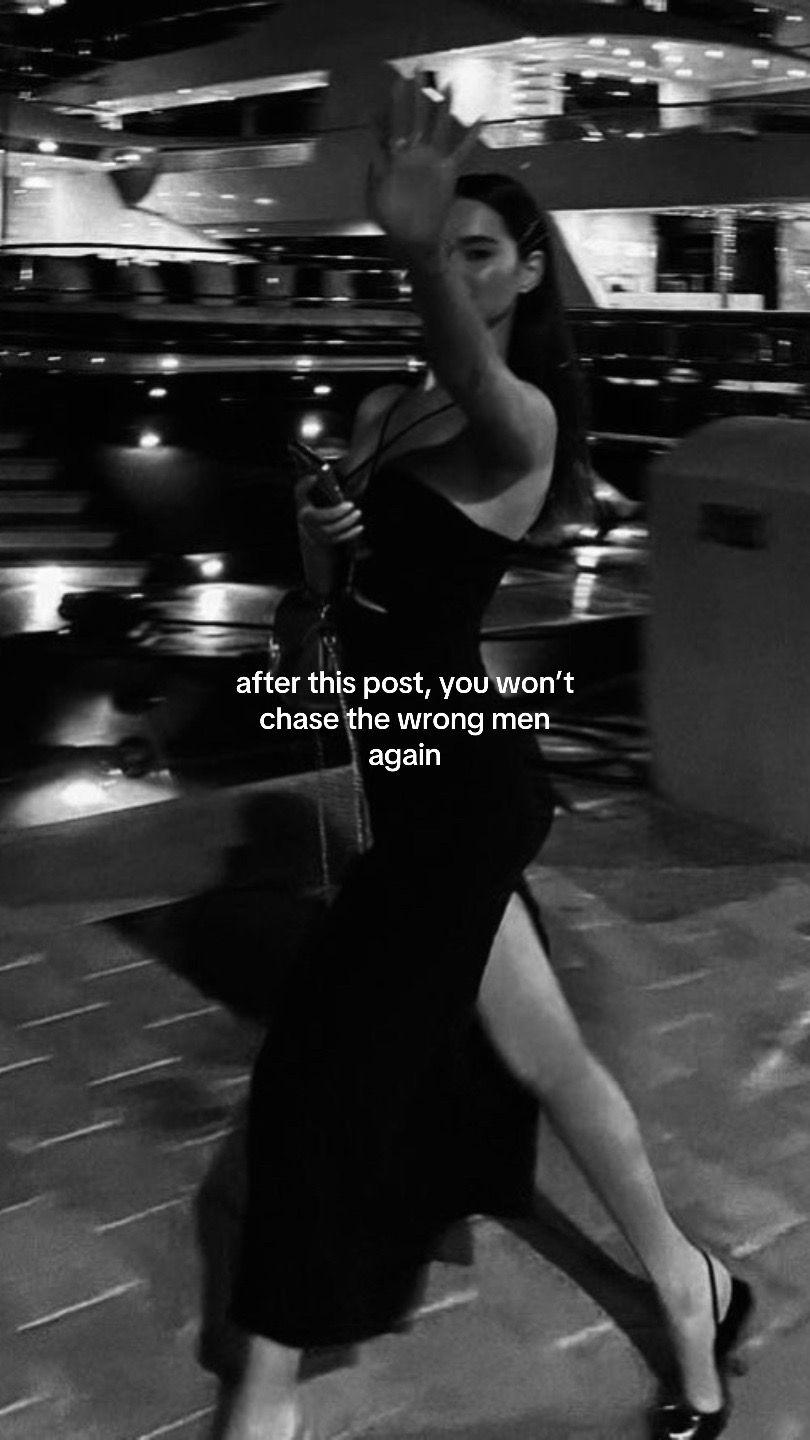
It uses a bold, outcome-based promise that directly addresses the viewer's deepest desire: to stop the cycle of toxic dating.
Slide Text
after this post, you won't chase the wrong men again
Visual
Black and white photo of a woman in a black dress walking at night, hand raised as if waving or pushing away.
All Slides
@highstatusfemales carousel breakdown
highstatusfemales
#highvalue #advice
Effectiveness score
9/10
Views
426.4K
Likes
52.6K
Saves
32.5K
Engagement
21.1%
Hook
after this post, you won't chase the wrong men again
Goal
build-community
Offer
none
CTA
none
Caption
#highvalue #advice
Strategic Summary
The carousel leverages high-save psychology by packaging attachment-theory insights into a numbered, highly scannable list that validates subconscious dating patterns. The stark B&W aesthetic and repetitive background reduce visual friction, forcing focus on the text, which drives massive bookmarking as users save it as a personal reference guide. The explicit promise on slide 1 ('you won't chase the wrong men again') creates a completion bias that sustains swipe-through.
The Winning Formula
High-contrast aesthetic listicle that pathologizes common dating pain points while validating the reader's hidden trauma, engineered for maximum saves.
What's working
- •Slide 1's definitive promise ('won't chase the wrong men again') paired with a luxury B&W visual establishes authority and triggers completion bias.
- •Numbered diagnostic statements (1, 2, 4, 6, 7, 8, 10) frame relationship advice as clinical revelations rather than subjective opinions, boosting credibility and save intent.
- •Consistent background image across slides 2-8 eliminates visual distraction, forcing dwell time on the heavy psychological text.
- •Second-person 'You' framing directly targets self-blame, transforming shame into validation ('You're not in love — you're in survival.').
- •The skipped numbering (jumping from 2 to 4 to 6) creates a subtle curiosity gap, implying there's even more unseen depth, encouraging saves to reference later.
What's not working
- •Heavy text density on slides 2-8 may cause mid-swipe drop-off on mobile due to reading fatigue; breaking long paragraphs into two slides could improve retention.
Viral lesson
When targeting emotional pain points, specificity + validation beats generic advice; packaging psychological reframes as a numbered checklist turns a carousel into a bookmarkable reference tool rather than disposable content.
Can a small creator replicate this? Highly replicable for coaches and advice creators, but requires a strong foundational understanding of the niche's psychological trigger points and a disciplined, minimalist visual template to sustain focus on the copy.
Structural Formula (steal-the-format)
Structure pattern
8-slide diagnostic list, single-sentence headline + paragraph explanation per slide, consistent luxury B&W background, final slide delivers philosophical reframe.
Copy formula
Second-person directive + numbered psychological label + trauma-to-truth explanation + prescriptive close.
What to swap (concrete remixes)
- •Swap romantic attachment dynamics for money/abundance psychology targeting entrepreneurial burnout audiences (e.g., 'You chase clients because you're in survival, not business.').
- •Swap dating patterns for fitness/health habits targeting chronic dieters (e.g., 'You made pain feel like progress. But suffering isn't transformation, it's conditioning.').
What NOT to copy
The skipped numbering and ultra-heavy paragraph text are structural hacks that rely on high existing trust and niche literacy; copying them in a cold-audience context will increase drop-off and reduce readability.
Aesthetics
Monochrome luxury editorial with high-status lifestyle photography as a static backdrop for centered sans-serif text cards.
Color palette
What it conveys: The B&W filter strips away distraction and signals seriousness and timelessness, while the luxury setting subconsciously associates the advice with elevated self-worth and exclusivity.
Slide-by-slide forensics
1hookmedium shotconfident, aspirationalworks:yesgrab:90/100aesthetic:85/100after this post, you won't chase the wrong men again
after this post, you won't chase the wrong men again
Visual description
Black-and-white photograph of a woman in a form-fitting black dress with a thigh slit, captured mid-stride while waving. The background suggests a modern, upscale interior with curved architecture and ambient lighting.
Scene setting
luxury modern interior at night
Visible people
Visible objects
vs prior slide
Style: Transitions from a dynamic, full-body B&W lifestyle shot to a static, composed stairway background with text overlays.
Story: Shifts from a bold external promise to specific internal psychological diagnostics.
Predicted audience reaction
Stops scrolling immediately due to the definitive, slightly hyperbolic promise paired with a high-status visual anchor.
Verdict: Sets a clear transformational promise that triggers completion bias and aligns with the account's 'high status' branding.
2step in listmedium shotrevealing, somberworks:yesgrab:80/100aesthetic:75/1001. Your inner child is choosing your partner. You're not in love — you're in survival. That ache you feel for the emotionally unavailable man? That's the same ache you felt when your emotional needs weren't met as a child. And now, you're trying to 'earn' the love you never got. Not because it's love... but because it's familiar.
1. Your inner child is choosing your partner. You're not in love — you're in survival. That ache you feel for the emotionally unavailable man? That's the same ache you felt when your emotional needs weren't met as a child. And now, you're trying to 'earn' the love you never got. Not because it's love... but because it's familiar.
Visual description
Black-and-white image of a woman sitting on ornate, carved stone stairs. White rounded text boxes overlay the image containing the numbered list item and explanatory paragraph.
Scene setting
grand indoor staircase with classical architecture
Visible people
Visible objects
vs prior slide
Style: Maintains B&W filter, white sans-serif text in rounded speech-bubble containers, and consistent framing.
Story: Introduces the first diagnostic point, directly linking childhood attachment to adult dating patterns.
Predicted audience reaction
Feels intensely seen; likely to cause a pause in scrolling as the psychological reframe hits a nerve.
Verdict: Translates clinical attachment theory into accessible, second-person language that validates pain rather than pathologizing it.
3step in listmedium shotconfrontational, validatingworks:yesgrab:75/100aesthetic:75/1002. You've made pain feel like proof. If it hurts, if you're crying, if it's hard — you tell yourself this must be real. But love that requires suffering isn't love. It's emotional conditioning. Somewhere along the way, you learned that love must be earned. So when a man comes in and gives it freely, it feels foreign. You reject peace and chase chaos.
2. You've made pain feel like proof. If it hurts, if you're crying, if it's hard — you tell yourself this must be real. But love that requires suffering isn't love. It's emotional conditioning. Somewhere along the way, you learned that love must be earned. So when a man comes in and gives it freely, it feels foreign. You reject peace and chase chaos.
Visual description
Identical B&W stairway background. Text overlay follows the same white bubble format with '2. You've made pain feel like proof.' as the headline.
Scene setting
grand indoor staircase with classical architecture
Visible people
Visible objects
vs prior slide
Style: Exact visual template repetition ensures zero cognitive load on design, maximizing text consumption.
Story: Deepens the trauma reframing by addressing the subconscious equation of suffering with authenticity.
Predicted audience reaction
Triggers cognitive dissonance reduction; users bookmark to revisit when questioning a chaotic relationship.
Verdict: Directly challenges a pervasive romantic myth (love must be hard) with a sharp, memorable phrase that invites saving.
4step in listmedium shotliberating, bluntworks:yesgrab:80/100aesthetic:75/1004. You make excuses for his behavior because blaming yourself gives you control. 'If I was prettier... smarter... less needy...' You'd rather believe you're the problem than admit he's just not capable of loving you right. Why? Because if it's your fault, then maybe you can fix it. But you can't heal a man who doesn't see himself as broken.
4. You make excuses for his behavior because blaming yourself gives you control. 'If I was prettier... smarter... less needy...' You'd rather believe you're the problem than admit he's just not capable of loving you right. Why? Because if it's your fault, then maybe you can fix it. But you can't heal a man who doesn't see himself as broken.
Visual description
Identical B&W stairway background. Text overlay continues the numbered list pattern.
Scene setting
grand indoor staircase with classical architecture
Visible people
Visible objects
vs prior slide
Style: Consistent visual rhythm maintains reading flow despite the jump in numbering from 2 to 4.
Story: Shifts focus from internal conditioning to external accountability, giving permission to stop fixing partners.
Predicted audience reaction
Relief and anger at past self-gaslighting; high share potential to DMs as a reality check.
Verdict: The 'skipped numbering' artifact implies missing slides, slightly breaking immersion, but the copy's psychological precision compensates.
5step in listmedium shotintrospective, clarifyingworks:yesgrab:75/100aesthetic:75/1006. You replay emotional patterns because they feel like home. Your subconscious wants to 'complete the story.' That's why you're drawn to people who trigger the same wounds. You think this time it'll end differently. But healing starts when you stop choosing people who feel like your past.
6. You replay emotional patterns because they feel like home. Your subconscious wants to 'complete the story.' That's why you're drawn to people who trigger the same wounds. You think this time it'll end differently. But healing starts when you stop choosing people who feel like your past.
Visual description
Identical B&W stairway background. White text bubble overlay with point 6.
Scene setting
grand indoor staircase with classical architecture
Visible people
Visible objects
vs prior slide
Style: Unchanged background and typography lock the viewer into a reading cadence.
Story: Moves from specific partner behaviors to macro subconscious drivers ('completing the story').
Predicted audience reaction
Deep recognition; likely to trigger a 'save for therapy reference' response.
Verdict: Distills repetition compulsion into accessible language without jargon, maintaining the diagnostic tone.
6step in listmedium shotpragmatic, cautionaryworks:partialgrab:70/100aesthetic:75/1007. You value chemistry over compatibility. You meet someone and feel an instant spark — but sparks fade fast. Compatibility is the ability to grow together. Chemistry can be instant, but compatibility is revealed through actions, safety, and shared values. Most women never wait long enough to see that.
7. You value chemistry over compatibility. You meet someone and feel an instant spark — but sparks fade fast. Compatibility is the ability to grow together. Chemistry can be instant, but compatibility is revealed through actions, safety, and shared values. Most women never wait long enough to see that.
Visual description
Identical B&W stairway background. White text bubble overlay with point 7.
Scene setting
grand indoor staircase with classical architecture
Visible people
Visible objects
vs prior slide
Style: Visual monotony persists; relies entirely on copy variation to sustain interest.
Story: Pivots from trauma patterns to practical dating metrics (chemistry vs compatibility).
Predicted audience reaction
Slight engagement dip as this leans more conventional advice, but still resonates as a needed reminder.
Verdict: Less psychologically novel than prior slides; feels like standard dating advice repackaged, risking scroll fatigue.
7step in listmedium shotharsh truth, soberingworks:yesgrab:80/100aesthetic:75/1008. You seek validation instead of connection. You don't want him. You want his approval. The attention, the chase, the highs — they're addictive. But validation from the wrong man is the cheapest drug. It never lasts. And it costs you everything.
8. You seek validation instead of connection. You don't want him. You want his approval. The attention, the chase, the highs — they're addictive. But validation from the wrong man is the cheapest drug. It never lasts. And it costs you everything.
Visual description
Identical B&W stairway background. White text bubble overlay with point 8.
Scene setting
grand indoor staircase with classical architecture
Visible people
Visible objects
vs prior slide
Style: Template consistency remains absolute.
Story: Reframes romantic pursuit as dopamine-driven validation seeking, raising the stakes.
Predicted audience reaction
Strong emotional recoil and agreement; reinforces the 'high status' self-discipline narrative.
Verdict: The 'cheapest drug' metaphor is highly quotable and aligns perfectly with the account's aspirational/sober-luxury tone.
8philosophical payoffmedium shotempowering, conclusiveworks:yesgrab:85/100aesthetic:85/10010. You're not afraid of being alone — you're afraid of what being alone says about you. You'd rather cling to the wrong person than face the silence of not being chosen. But healing is realizing: peace is better than attention. And self-worth doesn't come from being picked — it comes from choosing yourself.
10. You're not afraid of being alone — you're afraid of what being alone says about you. You'd rather cling to the wrong person than face the silence of not being chosen. But healing is realizing: peace is better than attention. And self-worth doesn't come from being picked — it comes from choosing yourself.
Visual description
Identical B&W stairway background. White text bubble overlay with point 10. Serves as the finale.
Scene setting
grand indoor staircase with classical architecture
Visible people
Visible objects
vs prior slide
Style: Final slide maintains visual template but shifts copy from diagnosis to prescription.
Story: Delivers the transformative thesis: self-worth is internal choice, not external validation.
Predicted audience reaction
Peak emotional payoff; triggers bookmarking as a personal mantra and resharing to friends in toxic cycles.
Verdict: Masterful closing reframe that turns pain into agency, perfectly justifying the high bookmark rate observed.
Commerce intent
Comment ethnography
Audience treats the content as a shared therapy session; the high save rate indicates internalization rather than public debate.
Diagnostics
Hook deep-dive
after this post, you won't chase the wrong men again
The definitive, almost medical promise eliminates doubt and triggers a 'prove it' curiosity loop, compelling the viewer to swipe to see if the diagnosis applies to them.
Engagement read
Bookmark rate is 12.7× the library norm while comments remain baseline, indicating the content is consumed privately as a reference tool or shared via DMs rather than debated publicly.
Mechanics
Numbered psychological reframes create a 'diagnosis' loop where each slide mirrors a different hidden trauma, compelling users to swipe to find which pattern applies to them.
Brand & funnel
Buying-journey moment: Audience is in early-stage identity alignment, consuming high-validation content that primes them for future coaching, courses, or community offers.
Ideal Customer Profile
Young women struggling with anxious attachment styles and repetitive toxic relationship cycles, seeking self-actualization.
Age
18-24
Gender
female
Readability
simple
Interests
Pain Points
Aspirations
Emotional Profile
Primary Emotion
validationIntensity
Effectiveness
Emotions Evoked
Emotional Arc
curiosity → recognition → validation → empowerment
Why It Lands
The content moves the viewer from a state of 'I am broken' to 'I am just conditioned,' which provides immediate emotional relief and a sense of agency.
Writing Analysis
Style
listicle
Tone
authoritative
Hook Type
bold claim
Quality
The writing is exceptionally sharp, using short, punchy sentences that create a rhythmic, almost hypnotic reading experience. It avoids fluff and gets straight to the emotional core of the reader's pain.
Effectiveness
Goal Achievement
The massive number of bookmarks (32,508) indicates that the content is viewed as a high-value resource, successfully building a community of followers who value the creator's perspective.
Why It Spread
high-contrast, aesthetic visual style that stands out in the feed
deeply relatable psychological pain points that trigger an immediate 'this is me' response
the 'saveable' nature of the advice encourages high bookmark counts, which signals high value to the algorithm
Content DNA
The creator relies entirely on the content quality to drive follows; while effective for engagement, it misses an opportunity to direct the audience to a newsletter or community.
Narrative Arc
The carousel maintains a consistent, high-tension narrative by alternating between identifying a toxic behavior and explaining the psychological 'why' behind it, keeping the reader engaged until the final slide.
Psychological Blueprint
Why It Spread
The content perfectly weaponizes the 'I feel seen' effect by articulating complex trauma in simple, digestible, and highly shareable slides. It achieved a 21% engagement rate because it provides a 'saveable' resource that acts as a digital mirror for the viewer's own insecurities, making it feel like a necessary tool for their personal growth journey.
Framework
listicle revelationPrimary Tactic
validationTactics Used
curiosity-gap on slide 1: 'after this post, you won't chase the wrong men again'
pattern-interrupt: using high-contrast black and white aesthetic to signal 'serious' content
validation: using 'you' language to make the reader feel seen and understood
authority: presenting psychological concepts (inner child, emotional conditioning) as absolute truths
Cognitive Biases
Barnum effect: the statements are broad enough to apply to almost any woman who has ever had a bad dating experience, making the reader feel the content was written specifically for them
confirmation bias: the reader seeks out information that confirms their existing suspicion that their dating life is a result of past trauma
Tribal Markers
Trust Signals
Slide Breakdown (2 analyzed)
Hook Analysis
It uses a bold, outcome-based promise that directly addresses the viewer's deepest desire: to stop the cycle of toxic dating.
Text
after this post, you won't chase the wrong men again
Visual
Black and white photo of a woman in a black dress walking at night, hand raised as if waving or pushing away.
Visual Elements
Color Palette
Copy Analysis
Power Words
Open Loop: yes, it promises a permanent solution to a painful problem
Visual Psychology
Attention: the text in the center
Emotional cue: the confident, slightly dismissive posture of the woman
Composition: to create a sense of mystery and high-status detachment
Text
1. Your inner child is choosing your partner. You're not in love — you're in survival. That ache you feel for the emotionally unavailable man? That's the same ache you felt when your emotional needs weren't met as a child. And now, you're trying to "earn" the love you never got. Not because it's love... but because it's familiar.
Visual
Black and white photo of a woman standing on a grand staircase.
Visual Elements
Color Palette
Copy Analysis
Power Words
Open Loop: yes, it introduces a concept that invites the reader to keep reading to understand the other points
Visual Psychology
Attention: the text block
Emotional cue: the grand, slightly lonely setting of the staircase
Composition: to provide a serious, reflective backdrop for psychological insight
Comment Intelligence
Sentiment
PositiveResonance
Intent
build-community
Audience Vibe
The comments are filled with women feeling deeply validated and sharing their own realizations about their dating patterns.
Standout Quotes
“This hit way too close to home.”
“I needed to hear this today.”
“The 'familiar' part just clicked for me.”