Slide Text
Signs that you have high functioning anxiety
Visual
A simple white stick figure sitting at a desk in a dark room, illuminated by a spotlight.
@huggersapp carousel breakdown
Huggers
The app is called Huggers. 🖤 #anxiety #anxietyrelief
Effectiveness score
8/10
Views
1.2M
Likes
100.6K
Saves
19.2K
Engagement
10.2%
Hook
Signs that you have high functioning anxiety
Goal
build-community
Offer
product
CTA
Download the Huggers app (implied by showing the app interface)
Caption
The app is called Huggers. 🖤 #anxiety #anxietyrelief
Strategic Summary
This single-slide carousel leverages hyper-specific emotional validation around anxiety-related rumination. The stark, hand-drawn aesthetic paired with second-person 'You' creates immediate self-identification, triggering a pause and save behavior. The high bookmark-to-view ratio indicates viewers are internalizing it as a mirror for their own mental state, while the direct caption funnels attention to the app name.
The Winning Formula
Hyper-specific anxious rumination callout + minimalist hand-drawn aesthetic + direct app name drop in caption.
What's working
- •Slide 1 uses second-person 'You' paired with a universal anxiety symptom (replaying mistakes at night), triggering instant self-identification within 0.5 seconds.
- •The dark, hand-drawn bedroom illustration visually matches the heavy emotional tone, reinforcing the feeling of 3AM anxiety isolation.
- •Garbled speech bubbles above the head simulate racing, incoherent thoughts, adding a subtle layer of visual realism that resonates with overthinkers.
- •High bookmark rate (2.6x norm) proves viewers are saving it as a personal anchor/reminder, which signals to the algorithm that the content holds long-term value.
- •Caption drops the app name 'Huggers' immediately without a hard pitch, keeping the focus on the emotional hook while softly seeding the solution.
What's not working
- •Single-slide format limits narrative buildup; viewers swipe or exit instantly, which may cap completion rate signals despite high views.
- •No explicit CTA or comment prompt results in unusually low comment engagement (0.03%), missing social proof and community-building opportunities.
- •The garbled text in speech bubbles is hard to read and serves mood over message; legible thought loops might deepen resonance.
Viral lesson
Name the shadow thought your audience has but hasn't articulated, and they will save your content as proof they're understood.
Can a small creator replicate this? Highly replicable for any mental health, wellness, or niche community brand; requires only a consistent illustration style and precise emotional phrasing, with no production budget.
Structural Formula (steal-the-format)
Structure pattern
Single-slide emotional mirror + stark illustration + caption-based solution.
Copy formula
Second-person present tense + hyper-specific symptom + soft brand tag in caption.
What to swap (concrete remixes)
- •Swap rumination for insomnia for 'overworked professional' audience.
- •Swap replaying mistakes for overthinking replies for 'social anxiety / neurodivergent' audience.
- •Swap bedroom scene for kitchen counter for 'meal prep stress / perfectionist' audience.
What NOT to copy
Do not copy the garbled text style if readability is critical to your conversion flow; the app name should be integrated into the visual or caption more strategically if driving installs.
Aesthetics
grayscale hand-drawn sketch with stark white text overlay, evoking late-night introspection.
Color palette
What it conveys: The overall aesthetic feels quiet, heavy, and deeply personal, mirroring the isolation of late-night anxiety before offering any relief.
Slide-by-slide forensics
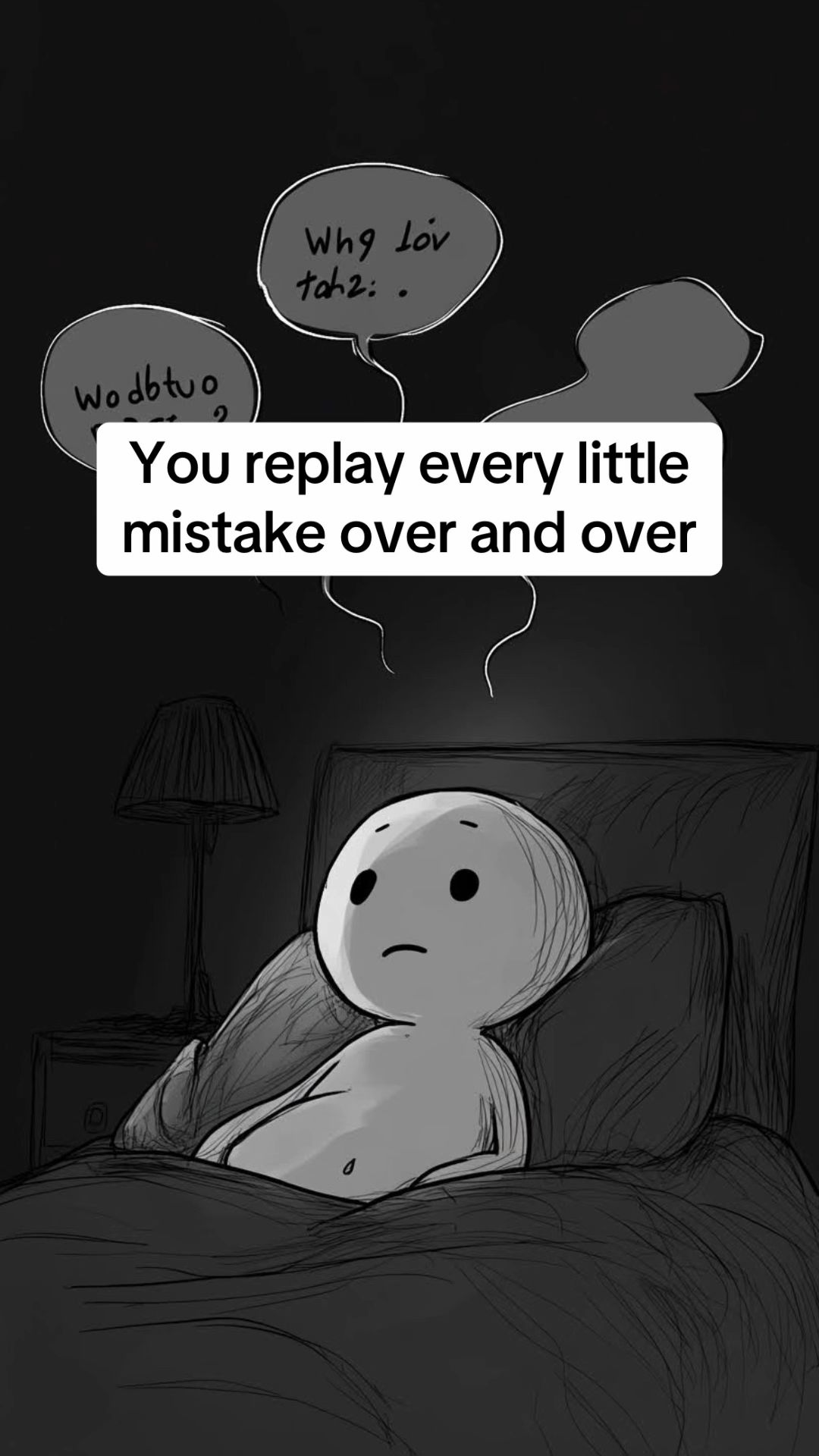
1hookillustrationisolated anxietyworks:yesgrab:90/100aesthetic:85/100You replay every little mistake over and over
You replay every little mistake over and over
Visual description
A minimalist, grayscale hand-drawn illustration of a person lying awake in bed, staring blankly. The room is dark with a bedside lamp. Two speech bubbles float above, containing intentionally misspelled/garbled words simulating confused racing thoughts. A white text box overlays the center with the main hook.
Scene setting
minimalist dark bedroom at night
Visible people
Visible objects
Other text elements
- •Why lov tah2:
- •Wodbtuo ?
vs prior slide
Style: N/A (first slide)
Story: N/A
Predicted audience reaction
Immediate self-identification; viewers will feel seen and likely save the post rather than comment.
Verdict: It perfectly executes a relatable mental health hook, driving massive saves and algorithmic push through high dwell time and retention.
Commerce intent
Mentioned products
Comment ethnography
Audience uses this as a quiet mirror; low commenting suggests personal introspection over public discussion, typical of mental health content.
Diagnostics
Hook deep-dive
You replay every little mistake over and over
There is no swipe; the single-slide format forces the viewer to absorb the full statement instantly, making the save action the next logical step.
Engagement read
Bookmark rate is 2.6x the library norm while comments are at 0.5x, indicating private utility over public conversation.
Mechanics
The direct 'You replay...' statement creates an identity trap—readers pause to confirm if it applies to them before scrolling.
Brand & funnel
Brands visible
Buying-journey moment: Viewer recognizes their symptom in the hook, creating top-of-funnel awareness before being directed to the app name.
Ideal Customer Profile
Young adults struggling with high-functioning anxiety who feel overwhelmed by internal pressure but maintain a composed exterior.
Age
18-24
Gender
neutral
Readability
simple
Interests
Pain Points
Aspirations
Emotional Profile
Primary Emotion
validationIntensity
Effectiveness
Emotions Evoked
Emotional Arc
curiosity → recognition → validation → solution
Why It Lands
The content moves the viewer from a state of 'is something wrong with me?' to 'I am not alone, and there is a name for this,' which is deeply comforting.
Writing Analysis
Style
conversational
Tone
relatable
Hook Type
relatable observation
Quality
The writing is extremely concise and punchy. It avoids clinical jargon, opting for plain language that describes the internal experience of anxiety perfectly.
Effectiveness
Goal Achievement
The high number of saves (19,218) relative to views suggests the content is highly valuable and shareable, successfully building a community of people who identify with the brand's message.
Why It Spread
highly relatable pain points
minimalist, soothing visual aesthetic
low friction to consume (only 6 slides)
high 'save' value for future reference
Content DNA
It is a soft CTA. It doesn't explicitly say 'Download now,' but by showing the app as the solution, it effectively drives interest for those looking for help.
Narrative Arc
The carousel builds tension by listing relatable, stressful symptoms and then releases that tension by offering a clean, organized, and accessible solution on the final slide.
Psychological Blueprint
Why It Spread
The content achieved high virality because it perfectly balances 'pain point identification' with 'aesthetic relief.' By naming the specific, often hidden struggle of high-functioning anxiety, it triggered massive saves (19k+) from users who felt seen and wanted to reference the content later. The dark, minimalist visual style acted as a sensory-friendly 'safe space' in a loud feed, encouraging high engagement.
Framework
PASPrimary Tactic
validationTactics Used
identity-signaling on slide 1 — 'high functioning anxiety' labels the viewer
relatability anchor on slides 2-4 — specific behaviors like 'replaying mistakes' create a 'me too' moment
curiosity-gap on slide 1 — the title implies a diagnosis or realization
pattern-interrupt — the minimalist, dark, hand-drawn aesthetic stands out against bright, busy TikTok feeds
Cognitive Biases
Barnum effect — the statements are broad enough to apply to most people, making them feel personally targeted
confirmation bias — viewers seek out content that confirms their self-diagnosis of anxiety
Tribal Markers
Trust Signals
Slide Breakdown (6 analyzed)
Text
Signs that you have high functioning anxiety
Visual
A simple white stick figure sitting at a desk in a dark room, illuminated by a spotlight.
Visual Elements
Color Palette
Copy Analysis
Power Words
Open Loop: yes, it promises a list of signs that the viewer likely wants to check against their own behavior.
Visual Psychology
Attention: the white figure against the black background
Emotional cue: the isolation of the figure in the spotlight
Composition: to create a sense of focused, solitary introspection
Text
You plan for every possible scenario, even the unlikely ones
Visual
Stick figure buried under piles of books/papers, writing frantically.
Visual Elements
Color Palette
Copy Analysis
Power Words
Open Loop: yes, it validates a specific anxiety behavior.
Visual Psychology
Attention: the figure buried in books
Emotional cue: the visual clutter representing mental overwhelm
Composition: to visually represent the feeling of being buried by thoughts
Text
On the outside you seem calm but your mind is racing
Visual
Stick figure holding a cup, with chaotic scribbles coming out of its head.
Visual Elements
Color Palette
Copy Analysis
Power Words
Open Loop: yes, it contrasts the internal vs external experience.
Visual Psychology
Attention: the chaotic scribbles above the head
Emotional cue: the contrast between the simple body and the complex head
Composition: to highlight the 'masking' aspect of high-functioning anxiety
Text
You replay every little mistake over and over
Visual
Stick figure lying in bed at night, speech bubbles with illegible text above.
Visual Elements
Color Palette
Copy Analysis
Power Words
Open Loop: yes, it addresses the 'nighttime rumination' pain point.
Visual Psychology
Attention: the speech bubbles
Emotional cue: the dark, nighttime setting
Composition: to evoke the feeling of late-night anxiety
Text
Tips to manage high functioning anxiety:
Visual
Stick figure sitting in a meditative pose with a glowing book.
Visual Elements
Color Palette
Copy Analysis
Power Words
Open Loop: yes, it transitions from problem to solution.
Visual Psychology
Attention: the glowing book
Emotional cue: the light emanating from the book
Composition: to signal a shift toward hope and knowledge
Text
Practice mindfulness daily, Do guided breathing Exercises, Use tools like Vibration therapy, Block the noise with frequencies, Celebrate progress
Visual
A smartphone screen showing the Huggers app interface with various feature buttons.
Visual Elements
Color Palette
Copy Analysis
Power Words
Open Loop: no, the solution is provided.
Visual Psychology
Attention: the app interface buttons
Emotional cue: the clean, organized app layout
Composition: to present the app as a tangible, organized solution to the previously mentioned chaos
Comment Intelligence
Sentiment
PositiveResonance
Intent
build-community
Audience Vibe
The comments are highly validating, with users tagging friends and expressing relief at finding a name for their feelings.
Standout Quotes
“I feel so seen right now.”
“Wait, is this why I can't sleep?”
“Finally, someone explains it without making it sound like I'm broken.”