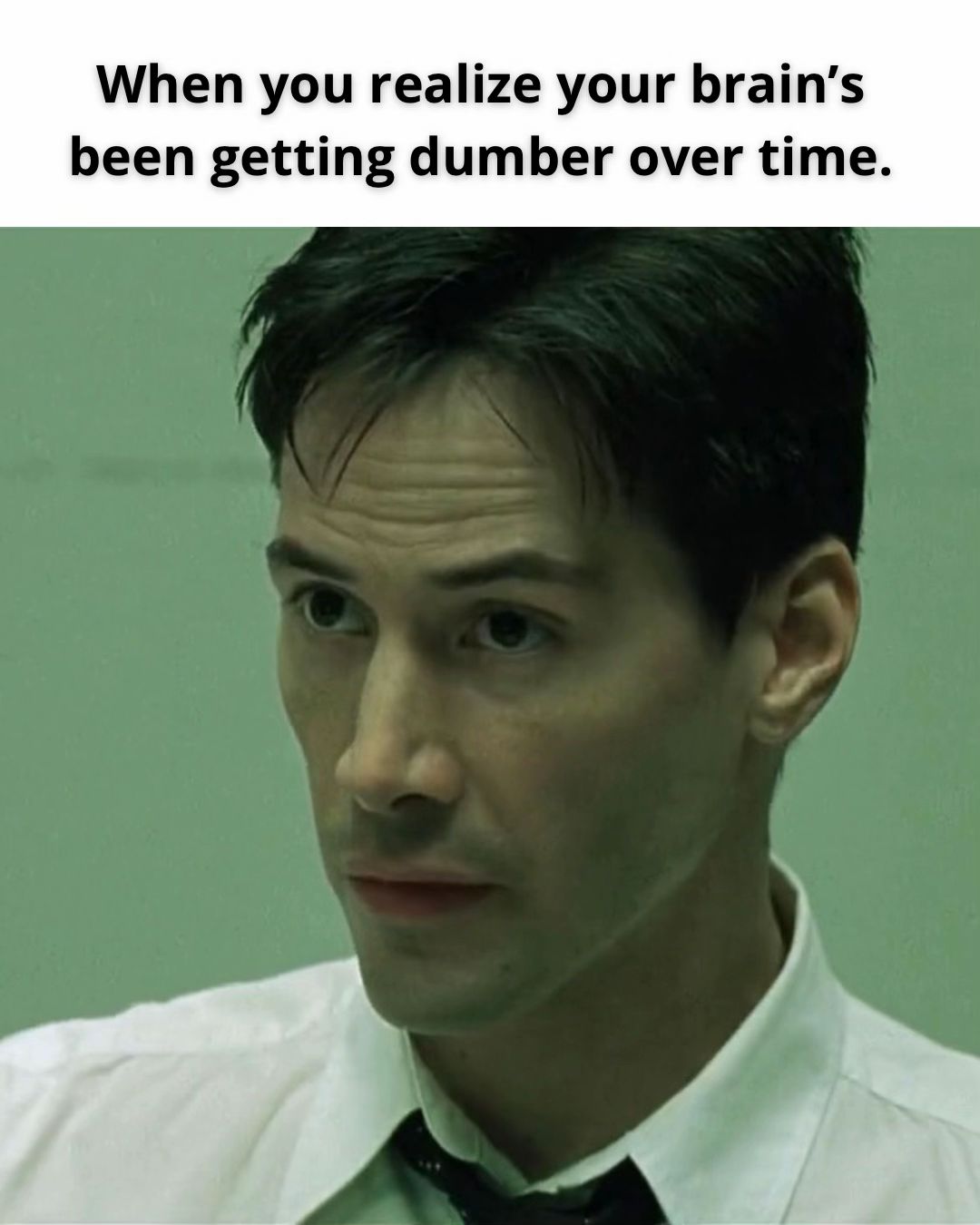
It uses a popular meme format to state a harsh, relatable truth, instantly stopping the scroll for anyone who feels mentally sluggish.
Slide Text
When you realize your brain's been getting dumber over time.
Visual
A still image of Keanu Reeves (Neo) from The Matrix looking intense and slightly concerned.
All Slides
@dimendr4 carousel breakdown
Anabion |
#selfgrowth #LearnOnTikTok #SelfImprovement #selfreminder #relatable
Effectiveness score
9/10
Views
251.4K
Likes
38.6K
Saves
14K
Engagement
22.1%
Hook
When you realize your brain's been getting dumber over time.
Goal
educate
Offer
information
CTA
So basically: feed your brain better, or it gets weaker.
Caption
#selfgrowth #LearnOnTikTok #SelfImprovement #selfreminder #relatable
Strategic Summary
This carousel went viral because it validates a widespread, unspoken insecurity (cognitive decline/'brainrot') using a credible authority figure (neuroscience expert) and a simple, digestible analogy (brain = body, info = food). The high bookmark rate (9.3x norm) indicates users are saving this as a reminder or blueprint for self-correction, while the high like rate signals strong emotional resonance with the 'brainrot' diagnosis.
The Winning Formula
Relatable insecurity hook + Authority validation + Simple bodily analogy + Binary action plan.
What's working
- •Slide 1 uses a popular meme format (Keanu Reeves) to instantly signal 'realization' and 'shock', lowering the barrier to entry for a heavy topic.
- •Slides 2-3 establish authority ('neuroscience expert') without naming them, creating a curiosity gap that drives comments asking for the source.
- •Slides 4-5 use a 'body/food' analogy that makes abstract neuroscience concrete and immediately understandable.
- •Slide 6 offers a clear binary solution (reduce social media, increase books/podcasts) that feels actionable.
- •Visual shift in Slides 7-8 to circuit boards reinforces the 'mechanical/biological' function of the brain, adding a layer of 'science' aesthetic.
What's not working
- •Slide 7 text ('That's the part of your brain responsible for focus...') lacks an antecedent noun in the immediate text bubble, requiring users to infer it refers to the prefrontal cortex or similar, which might cause slight cognitive friction.
- •No specific call-to-action (CTA) on the final slide beyond the philosophical summary; a 'Follow for more' or 'Save this' prompt is missing, relying purely on content value.
Viral lesson
Validation beats instruction. People don't save content because it teaches them something new; they save it because it names a feeling they already have and gives them permission to fix it.
Can a small creator replicate this? Highly replicable for any educational creator. Requires no budget, only the ability to synthesize complex ideas into simple analogies and pair them with moody, consistent aesthetics.
Structural Formula (steal-the-format)
Structure pattern
8-slide narrative: Meme Hook -> Authority Setup -> Problem Definition -> Analogy -> Application -> Solution -> Mechanism -> Summary.
Copy formula
Second-person ('Your brain') + Expert attribution ('He said') + Binary choice ('Reduce X, Replace with Y').
What to swap (concrete remixes)
- •Swap 'brainrot' for 'burnout' for corporate LinkedIn audience.
- •Swap 'information diet' for 'sugar diet' for fitness/health niche.
- •Swap 'neuroscience expert' for 'financial advisor' for wealth-building niche.
What NOT to copy
Do not copy the vague reference to a 'neuroscience expert' without actually having the insight; audiences in comments are asking for the source, and fake authority will damage trust long-term.
Aesthetics
Dark academia meets digital dystopia: B&W cityscapes and circuit schematics with clean text overlays.
Color palette
What it conveys: Serious, intellectual, slightly ominous but ultimately hopeful.
Slide-by-slide forensics
1hookface closeupshockworks:yesgrab:95/100aesthetic:80/100When you realize your brain's been getting dumber over time.
When you realize your brain's been getting dumber over time.
Visual description
Close-up of Keanu Reeves looking concerned/shocked, cropped from a movie scene. Greenish tint. Text is black sans-serif on white background at top.
Scene setting
Meme template
Visible people
vs prior slide
Style: Only slide with color and a face; distinct from the rest of the carousel.
Story: Sets the problem statement immediately.
Predicted audience reaction
Immediate self-identification ('That's me').
Comments reacting to this slide
- "so the term brainrot is actually real"
- "i was an A student on math and now i cant even do basic calculations 😭"
Verdict: Uses a recognized meme format to lower resistance to a heavy psychological topic.
2setupwide shotauthorityworks:yesgrab:60/100aesthetic:75/100I just watched a podcast with a neuroscience expert. He shared a lot of valuable insights about the brain, but there was one thing he said that really stood out to me.
I just watched a podcast with a neuroscience expert. He shared a lot of valuable insights about the brain, but there was one thing he said that really stood out to me.
Visual description
Black and white photo of New York City skyline at night with bridge in foreground. Three white text bubbles with black serif text.
Scene setting
Urban night skyline
Visible objects
vs prior slide
Style: Shifts from color meme to B&W aesthetic editorial style.
Story: Introduces the authority figure to validate the hook.
Predicted audience reaction
Curiosity about which expert/podcast.
Comments reacting to this slide
- "btw what was the podcast name?"
- "do u mind telling me the podcast name?"
Verdict: Creates an open loop (what was the one thing?) that forces a swipe.
3setupwide shoturgencyworks:yesgrab:65/100aesthetic:75/100He said that in today's world, where information is everywhere, even when you don't want it one of the most important things you can do to keep your brain healthy is to go on an information diet.
He said that in today's world, where information is everywhere, even when you don't want it one of the most important things you can do to keep your brain healthy is to go on an information diet.
Visual description
Black and white aerial view of city buildings at night. Three white text bubbles.
Scene setting
Urban aerial night
Visible objects
vs prior slide
Style: Maintains B&W city aesthetic and text bubble format.
Story: Delivers the core concept ('information diet').
Predicted audience reaction
Recognition of the problem (information overload).
Verdict: Defines the problem clearly using a term ('information diet') that feels actionable.
4step in listwide shotclarityworks:yesgrab:70/100aesthetic:75/100He explained it like this: Your brain works just like your body. If you keep feeding your body instant, unhealthy food, your health obviously suffers, right?
He explained it like this: Your brain works just like your body. If you keep feeding your body instant, unhealthy food, your health obviously suffers, right?
Visual description
Black and white city skyline at night, Empire State Building visible. Three white text bubbles.
Scene setting
Urban night skyline
Visible objects
vs prior slide
Style: Consistent B&W city theme.
Story: Introduces the core analogy (Brain = Body).
Predicted audience reaction
Agreement with the logic.
Verdict: The analogy simplifies complex neuroscience into something everyone understands (diet).
5escalationwide shotchallengeworks:yesgrab:70/100aesthetic:80/100It's the same with your brain. If you constantly consume instant, shallow, or useless information, do you really think your brain will stay in good shape?
It's the same with your brain. If you constantly consume instant, shallow, or useless information, do you really think your brain will stay in good shape?
Visual description
Black and white manga-style or grainy photo of city rooftops with moon/stars in sky. Three white text bubbles.
Scene setting
Urban rooftops night
Visible objects
vs prior slide
Style: Shifts to a slightly more artistic/manga aesthetic background but keeps B&W.
Story: Applies the analogy directly to the user's behavior.
Predicted audience reaction
Guilt or realization.
Comments reacting to this slide
- "i was an A student on math and now i cant even do basic calculations 😭"
Verdict: Directly challenges the reader, prompting self-reflection.
6revealwide shotsolutionworks:yesgrab:75/100aesthetic:75/100The only way, according to him, is to reduce your intake of meaningless content from social media and replace it with higher-quality information, like books, educational videos, or podcasts.
The only way, according to him, is to reduce your intake of meaningless content from social media and replace it with higher-quality information, like books, educational videos, or podcasts.
Visual description
Black and white city skyline with illuminated skyscrapers. Three white text bubbles.
Scene setting
Urban night skyline
Visible objects
vs prior slide
Style: Returns to standard B&W city photo.
Story: Provides the actionable solution.
Predicted audience reaction
Relief (there is a fix).
Comments reacting to this slide
- "Started reading books, and watching education videos literally helped reset my brainrotted brain"
Verdict: Gives the specific 'how-to' that justifies the bookmark.
7proofinfographicscientificworks:partialgrab:80/100aesthetic:85/100That's the part of your brain responsible for focus, planning, and higher-level thinking.
That's the part of your brain responsible for focus, planning, and higher-level thinking.
Visual description
Black background with white circuit board schematic lines. Two white text bubbles.
Scene setting
Abstract technical
Visible objects
vs prior slide
Style: Shifts from photography to vector/technical line art, but keeps B&W palette.
Story: Explains the biological mechanism behind the advice.
Predicted audience reaction
Intellectual validation.
Verdict: Visual is strong, but text refers to a 'part' not explicitly named in previous slide, causing slight confusion.
8ctainfographicfinalityworks:yesgrab:70/100aesthetic:85/100So basically: feed your brain better, or it gets weaker.
So basically: feed your brain better, or it gets weaker.
Visual description
Black background with white circuit board schematic lines (different pattern than slide 7). One white text bubble centered.
Scene setting
Abstract technical
Visible objects
vs prior slide
Style: Maintains circuit board aesthetic.
Story: Summarizes the entire carousel into one memorable rule.
Predicted audience reaction
Motivation to save/act.
Comments reacting to this slide
- "Man I needed this"
Verdict: Perfect summary statement that serves as a mantra for the user.
Commerce intent
Objections (from comments)
- •is there a way to listen to podcast free? what apps for you use
Comment ethnography
The audience self-identifies as 'brainrotted' Gen Z/Millennials seeking intellectual rehabilitation. There is a shared language around 'brain fog' and 'scrolling'.
Comments that characterize the audience
- "so the term brainrot is actually real"
- "i was an A student on math and now i cant even do basic calculations 😭"
- "Man I needed this"
Pain points revealed
- •i was an A student on math and now i cant even do basic calculations
- •I thought I'm the only one who's very aware. This is also a coincidence, I've already hit rock bottom of that
- •ADHD
Aspirations revealed
- •Started reading books, and watching education videos literally helped reset my brainrotted brain
- •I know that it really pisses me off but I'm gonna get better
Top questions asked
- •btw what was the podcast name?
- •do u mind telling me the podcast name?
- •Question, how would your brain differentiate between useful and useless information?
- •is there a way to listen to podcast free?
Objections
- •is there a way to listen to podcast free?
Diagnostics
Hook deep-dive
When you realize your brain's been getting dumber over time.
The combination of a relatable fear (getting dumber) with a celebrity reaction face creates an immediate need to know 'Why?'
Engagement read
Bookmark rate is exceptionally high (9.3x norm) compared to like rate, indicating high utility value over pure entertainment.
Mechanics
Curiosity gap regarding the specific 'one thing' the expert said, resolved only in Slide 6.
Brand & funnel
Buying-journey moment: Problem awareness: The viewer realizes they have a problem they didn't have a name for.
Ideal Customer Profile
Young adults and professionals feeling overwhelmed by digital consumption and struggling with focus or 'brain fog'.
Age
18-34
Gender
neutral
Readability
simple
Interests
Pain Points
Aspirations
Emotional Profile
Primary Emotion
validationIntensity
Effectiveness
Emotions Evoked
Emotional Arc
anxiety → recognition → validation → motivation
Why It Lands
It starts by validating the user's secret fear (that they are losing intelligence) and then pivots to a hopeful, actionable solution, creating a satisfying emotional arc.
Writing Analysis
Style
educational
Tone
relatable
Hook Type
relatable observation
Quality
The writing is punchy and uses short, digestible sentences. It avoids jargon, making complex neuroscience concepts accessible to a general audience.
Effectiveness
Goal Achievement
The high bookmark-to-view ratio proves the content was highly educational and perceived as valuable enough to revisit.
Why It Spread
taps into the 'digital detox' trend
highly shareable 'truth' that makes the reader feel smart for knowing it
low-friction, high-value format
Content DNA
It is a soft CTA that relies on the 'truth' of the statement to drive engagement rather than a direct request to follow or comment.
Narrative Arc
The carousel builds tension by identifying a problem, explaining the mechanism, and providing a simple, actionable solution.
Psychological Blueprint
Why It Spread
The post hit a massive collective pain point: the universal feeling of 'brain rot' from excessive scrolling. By framing the solution as an 'information diet'—a term that feels actionable and health-conscious—it gave users a sense of control. The high bookmark count (14k) indicates that users saved this as a 'reminder' to change their habits, which is a powerful driver for algorithmic reach.
Framework
PASPrimary Tactic
validationTactics Used
curiosity-gap on slide 1: 'getting dumber' implies a hidden, alarming truth
relatability on slide 1: using Neo from The Matrix to represent the 'realization' moment
analogy on slide 5: comparing brain health to physical diet to make abstract concepts concrete
authority-borrowing on slide 2: citing a 'neuroscience expert' to validate the claim
Cognitive Biases
confirmation bias: viewers already feel their attention span is failing, so they accept the premise immediately
availability heuristic: the 'information diet' concept is easy to visualize and remember
loss aversion: the threat of the brain 'getting weaker' motivates the user to keep reading
Tribal Markers
Trust Signals
Slide Breakdown (2 analyzed)
Hook Analysis
It uses a popular meme format to state a harsh, relatable truth, instantly stopping the scroll for anyone who feels mentally sluggish.
Text
When you realize your brain's been getting dumber over time.
Visual
A still image of Keanu Reeves (Neo) from The Matrix looking intense and slightly concerned.
Visual Elements
Color Palette
Copy Analysis
Power Words
Open Loop: yes, it forces the user to swipe to see if they are actually getting dumber and what to do about it.
Visual Psychology
Attention: Keanu Reeves' eyes
Gaze: looking slightly off-camera, creating a sense of internal realization
Emotional cue: the 'Matrix' reference signals a 'glitch in the system' or 'waking up' moment
Composition: centered, high-contrast text forces immediate reading
Text
I just watched a podcast with a neuroscience expert. He shared a lot of valuable insights about the brain, but there was one thing he said that really stood out to me.
Visual
Black and white cityscape at night.
Visual Elements
Color Palette
Copy Analysis
Power Words
Open Loop: yes, the 'one thing' creates a curiosity gap.
Visual Psychology
Attention: white text boxes
Emotional cue: the night city aesthetic implies a serious, reflective mood
Composition: the dark background makes the text pop, ensuring readability
Comment Intelligence
Sentiment
PositiveResonance
Intent
educate
Audience Vibe
Reflective and appreciative, with users tagging friends or acknowledging their own need for a digital detox.
Standout Quotes
“This is exactly what I needed to hear today.”
“The information diet is real, I felt my brain rotting.”
“Saving this for when I need a reminder to put the phone down.”
Top Comments
so the term brainrot is actually real
Started reading books, and watching education videos literally helped reset my brainrotted brain
i was an A student on math and now i cant even do basic calculations 😭
i learned this reading Sherlock Holmes novels. He said human brain is a compartment. you can stuff a lot of things but ultimately its limited. so all we can do is try to stuff the thing relevant to our need
I know that it really pisses me off but I’m gonna get better